

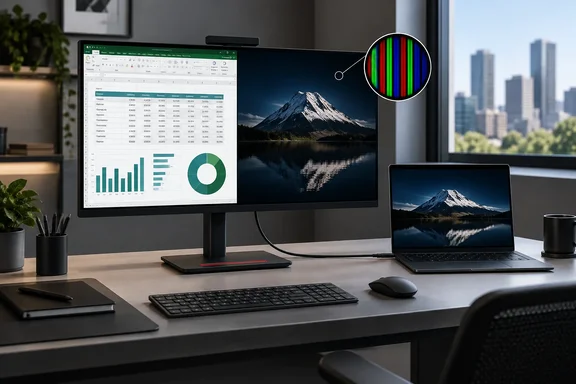
Lenovo ThinkVision P27UL-40 brings inkjet-printed OLED to the Thunderbolt office desk
TCL CSOT's release calls the P27UL-40 the brand's first 27" UHD IJP OLED Thunderbolt™ docking monitor for commercial environments and remote collaboration. Lenovo used almost the same wording in its own September 3 IFA announcement, where the monitor launched next to the ThinkVision P34WD-4v and the new T32UD-4v and T34WD-4v docking monitors.
Lenovo's announcement and a spec listing from Japan's PC Watch agree on the core specifications:
| Specification | ThinkVision P27UL-40 |
|---|---|
| Panel | 27-inch IJP (inkjet-printed) OLED, TCL CSOT |
| Resolution | 3840 × 2160 (UHD/4K) |
| Refresh rate | 60–120 Hz |
| Brightness | 300 nits (full white / SDR) |
| Contrast | 1,500,000:1 dynamic |
| Color gamut | 99% DCI-P3, 100% sRGB, 100% BT.709 |
| HDR | HDR10, VESA DisplayHDR True Black 500 |
| Subpixel layout | Real Stripe RGB |
TFTCentral separately lists the same basics: 3840 x 2160 "4K" resolution, 300 nits brightness (SDR), 178/178 viewing angles, 99% DCI-P3 wide colour gamut, and VESA DisplayHDR True Black 500 certification. The TCL release says "120Hz" and Lenovo lists a 60–120 Hz range. Those don't conflict: one is the maximum and the other is the supported range.
The 300-nit full-white figure matters for office buyers. OLED panels usually get dimmer on large, bright areas such as a white spreadsheet or a document. Whether 300 nits is enough depends on the room, and nobody has published measurements for this monitor yet.
Real Stripe RGB is the P27UL-40's pitch to Windows text users
The main selling point is the subpixel layout. TCL CSOT says the panel's Real Stripe RGB pixel layout reduces color fringing, providing altogether sharper text and improved clarity for content creation, design, and other professional applications. Lenovo's wording is more careful: the RGB layout "helps reduce" color fringing and gives sharper text.
Some general background, not taken from the Lenovo or TCL material: Windows' ClearType text rendering assumes each pixel is three vertical stripes in red, green and blue order. Many current OLED desktop panels arrange subpixels differently, and text on them can show colored edges. That is why a standard RGB stripe on an OLED monitor is interesting to Windows users.
TCL CSOT's release goes further than Lenovo's. It says the technology delivers major improvements in text color fringing and is already being mass produced across a range of consumer and professional applications. Neither company has published measurements, side-by-side comparisons or tests under different Windows scaling and ClearType settings. For now, treat the text-clarity benefit as a design claim that makes sense on paper.
The release also claims benefits it doesn't explain. It says the panel helps users "maintain focus", improves "workflow continuity" and adds "viewing comfort". Lenovo's version is more concrete. It cites TÜV Rheinland Eye Comfort 5-star certification and circadian-friendly display adjustments that it says keep harmful blue light at or below 20%.
TCL CSOT's IJP panel takes aim at LG and Samsung's OLED duopoly
The panel supplier matters beyond this one model. According to TFTCentral, the P27UL-40 is the second monitor we've seen announced (the other being the MSI PRO MAX OLED 271UPJW12) featuring a new panel from panel manufacturer TCL CSOT, who are looking to disrupt the long-standing dominance of LG Display and Samsung Display in the OLED panel market. So the P27UL-40 is the second announced monitor using this panel type, after MSI's.
The difference is in how the panel is made. The company says the P27UL-40 leverages TCL CSOT's IJP OLED technology to produce vivid contrast and vibrant color accuracy with improved energy efficiency while bringing OLED technology into reach for more professionals. "Into reach" suggests lower cost, but neither Lenovo nor TCL CSOT has published power figures, yield data or cost comparisons with other OLED production methods. The efficiency and affordability claims are unquantified.
The €1,099 starting price does show where Lenovo is positioning the monitor. It is the same expected price Lenovo gave the 34-inch ThinkVision P34WD-4v conferencing monitor, and €300 more than the 31.5-inch 4K ThinkVision T32UD-4v, an LCD-class mainstream docking monitor.
Thunderbolt 4 docking and Display Fleet Manager make the P27UL-40 an IT purchase
Picture quality alone doesn't make this a business monitor. Lenovo sells it as a Thunderbolt docking display, so one cable from a laptop can carry video and connect peripherals. PC Watch reports these video inputs:
- Thunderbolt 4
- HDMI 2.1
- DisplayPort 1.4 HBR3
It also reports Thunderbolt 4 and DisplayPort outputs, which suggest the monitor can drive a second display.
Two things aren't in the published material: the USB hub layout and the maximum laptop charging wattage. For a docking monitor, charging wattage decides whether it can power a workstation laptop on its own. Lenovo gave 100W Power Delivery for the T32UD-4v and T34WD-4v in the same announcement, but no figure for the P27UL-40. Don't assume the T-series number carries over.
PC Watch lists the stand adjustments as:
- tilt from −5 to 23.5 degrees
- swivel of 45 degrees each way
- pivot of 90 degrees each way
- 155 mm of height adjustment
Portrait pivot matters for anyone reading long documents or code.
Lenovo's announcement also lists features for its own laptops and for IT management:
- Lenovo laptop integration: synchronized brightness controls and a mirrored power button. Lenovo hasn't said which laptop models support this.
- Automatic OLED panel maintenance: Lenovo says it preserves long-term image quality "without requiring manual screen refreshes". It hasn't described the cycle, the user controls or any link to the warranty.
- Lenovo Display Fleet Manager: software for remote management of connected monitors, including firmware updates, central asset tracking and remote control of monitor settings.
The announcement says ThinkVision monitors in general support Display Fleet Manager. It doesn't say what deployment requires on this model: licensing, the host connection, or regional availability.
The €1,099, February 2027 timeline and three IFA awards
Lenovo's September 3 announcement says the P27UL-40 is expected from February 2027 at €1,099, and PC Watch reported the same. These are European figures. Lenovo hasn't announced a U.S. price or U.S. date, and as of late September 2026 the monitor had not shipped.
The TCL CSOT release says the monitor won three honors, The Gadgeteer's Best of IFA 2026 Award, The Techfinitive's Best of IFA 2026 Award, and the OLED Display Solutions Gold Award at the 2026 Global Product Technology Innovation Awards. The awards are reported by the panel supplier, which has a clear interest in promoting them. The release gives no judging criteria, and trade-show awards are usually based on hands-on demos, not lab measurements. The awards show the monitor got attention at IFA. They say nothing about text clarity, burn-in resistance or color accuracy on production units.
The September 23 date is the release date, not a new product event. The same TCL CSOT copy has since been syndicated by many PR Newswire partners. That is one source repeated many times, not independent confirmation.
What this means for fleet buyers weighing the P27UL-40
Nothing needs to be decided yet. The monitor is about five months from its announced European launch and has no U.S. terms. Put it on the evaluation list if your users have avoided OLED because of text fringing, or if you want one-cable Thunderbolt setups with a high-end panel. If you buy large numbers of LCD docking monitors on a normal refresh cycle, keep doing that. The P27UL-40 isn't a replacement for those yet.
Things to confirm before it goes into a purchase plan:
- Get Lenovo's laptop charging wattage and USB hub specs for the P27UL-40. The T-series 100W figure may not apply.
- Test text clarity yourself on a demo or review unit, at the Windows scaling and ClearType settings your staff actually use.
- Ask Lenovo how the automatic OLED panel maintenance works, whether it can be scheduled or paused, and how the warranty covers burn-in.
- Confirm that Lenovo Display Fleet Manager supports this model in your region, and what licensing or host connection it needs.
- Check which Lenovo laptops support the synced brightness and mirrored power button before counting on those features.
- For budgeting, use the €1,099 European starting price and February 2027 date. Lenovo hasn't announced U.S. terms.
The ThinkVision P27UL-40 gives the text-fringing problem a hardware fix: a standard RGB stripe on a 4K OLED, sold with Thunderbolt docking and remote management. It is also the second monitor built on TCL CSOT's inkjet-printed panels, a challenge to LG Display and Samsung Display for OLED panel supply. The next milestone is the February 2027 European launch. Independent reviews of production units should show by then whether the RGB stripe fixes OLED text in Windows and whether the €1,099 price makes it a practical office monitor.