

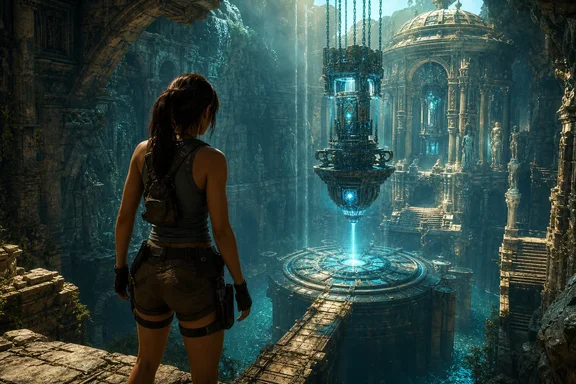
For PC players, the immediate confirmed point is straightforward. The game is due on Steam/PC, PlayStation 5, Xbox Series X|S, and Nintendo Switch 2 on February 12, 2027. Reports stating February 27 conflict with repeated official announcements and should not be treated as the current release date. Buyers of the Deluxe and Collector’s editions are set to receive access from February 10, two days before the wider launch.
“From the ground up” has a specific technical meaning
At a Gamescom Q&A reported by TechRadar, Crystal Dynamics Experience Director Jeff Adams said the project is in Unreal Engine 5 and that “no old code exists.” He described Legacy of Atlantis as something brought up from the ground up, rather than an exercise in carrying the 1996 game’s software forward.
The key caution is that this is a report of Adams’ statement, not independently established proof of the original game’s archival condition. The available material does not establish whether every usable component of the 1996 source code is unavailable, nor does it explain the preservation history of that code. It would be too strong to turn one quoted remark into a definitive public finding about the survival of a three-decade-old game’s development assets.
What is clear is the practical consequence for Legacy of Atlantis: the new game is not relying on the original codebase as a starting point. That puts it in a fundamentally different category from a port, a compatibility-focused re-release, or a remaster that retains old game logic while replacing rendering assets and interface elements.
A ground-up production means the developers must recreate and reconnect a broad set of interdependent systems: character controls, camera behavior, collision, enemy encounters, traversal, puzzle logic, animation, sound triggers, save behavior, menus, accessibility considerations, platform integration, and the technical rules governing how every space works. It also means they have greater latitude to change those systems when they no longer serve the new game’s goals.
That latitude is promising, but it is not automatically a guarantee. Original Tomb Raider was shaped by its controls, its measured movement, its angular spaces, and its particular tension between navigation and danger. Rebuilding those systems for current hardware gives the team room to reduce friction and modernize the experience. It also creates the risk of smoothing away the qualities that made the original distinctive. A successful reimagining has to decide which constraints were accidental products of 1996 technology and which were essential to the game’s identity.
Unreal Engine 5 is the foundation, not the whole story
The developers’ choice of Unreal Engine 5 is meaningful, but the engine name alone should not be treated as a promise of a particular visual feature, performance target, or PC hardware requirement. No supported information here establishes settings, ray-tracing support, frame-rate modes, upscaling technologies, system requirements, or Windows-specific optimization plans. Those details will need to come from the studio closer to release.
What Unreal Engine 5 does establish is a modern development foundation for a project aimed at current-generation consoles, Steam/PC, and Switch 2. It gives the co-development team a contemporary platform on which to build new environments and systems rather than attempting to retrofit technology designed for a vastly different era of hardware and game design.
Adams also reportedly said the game has a custom physics implementation within Unreal Engine 5. That wording is useful because it avoids the simplistic assumption that adopting a major commercial engine means using only its stock behavior. Engines supply tools and baseline systems, but games with a strong gameplay identity often depend on specialized work layered on top.
The example Adams gave was Lara’s braid, which reportedly reacts to her movement through custom technology. That detail may sound cosmetic, yet it illustrates the larger production approach. In a character-led game, movement, animation, camera presentation, cloth or hair behavior, collision response, and environmental interaction must work together. A braid that responds naturally can contribute to a more convincing sense of momentum. It does not, by itself, prove that Lara’s controls will feel right or that the entire game will be technically polished, but it is evidence that the team is investing in bespoke behavior rather than treating the remake as a basic asset replacement exercise.
For Windows players, the more useful conclusion is not “Unreal Engine 5 will make the game look good.” It is that a native modern rebuild gives the team a chance to develop contemporary PC support as part of the main project rather than as an afterthought imposed on old technology. Whether that opportunity becomes a strong PC release will depend on the unannounced basics: stable performance across a range of systems, sensible graphics options, control customization, display support, shader-compilation behavior, and the quality of post-launch maintenance.
The original spaces are being reconsidered, not just repainted
Official descriptions say puzzles in Peru have been redesigned from scratch and that spaces that were once separate are now interconnected environments. Other descriptions characterize the game as having expanded or rebuilt areas, redesigned puzzles, and modernized gameplay while retaining the original’s tone and spirit.
That is perhaps the clearest indication that Legacy of Atlantis is a reimagining in the substantive sense. The famous locations may return, but their layout, pacing, routes, and interaction rules need not mirror the 1996 game one-to-one.
Interconnected environments can improve continuity and make exploration feel more like a coherent expedition. They can also provide a natural structure for optional discoveries, alternate paths, or encounters that take advantage of contemporary level-design expectations. Similarly, redesigned puzzles can make better use of systems unavailable or impractical in the original game.
Yet these changes invite a legitimate concern from long-standing fans. Tomb Raider’s earliest levels often derived their impact from isolation, clear geometric challenges, and the player’s gradual understanding of a place. Expanding a level can make it richer, but it can also dilute its architecture or obscure the purposeful simplicity of the original route. Modernized combat can feel more responsive, but it may shift emphasis away from the deliberate platforming and puzzle-solving that many players see as central to the first game.
The studio’s promise to preserve the original’s tone and spirit therefore sets a high bar. Tone is not merely a collection of familiar names, artifacts, and visual references. It is conveyed through loneliness, scale, danger, discovery, music, movement, and the amount of time a game allows players to think before acting. The strongest case for Legacy of Atlantis will be whether its revisions reinforce those elements rather than merely adding more activity to recognizable locations.
Co-development deserves to be stated accurately
The project is being built by Crystal Dynamics and Flying Wild Hog. Describing it only as a Crystal Dynamics production leaves out a named co-developer and obscures the reality of how major games are made.
Co-development is not unusual for an ambitious multi-platform release, particularly one that combines a demanding technical rebuild with extensive redesign of familiar material. It can bring more specialization and production capacity to a project, while also requiring close coordination on design direction and quality standards. The public information does not assign each studio’s exact responsibilities, so conclusions about which team owns particular gameplay or technical systems would be speculation.
What can reasonably be inferred is that this arrangement reflects the breadth of the undertaking. The team is not simply updating textures or preserving an old executable. It is creating a new game across several platforms while negotiating the legacy of one of the most influential action-adventure titles of the 1990s.
What players should—and should not—expect now
The present evidence supports several concrete expectations. Legacy of Atlantis is a Unreal Engine 5 reimagining of Tomb Raider’s 1996 debut; it is co-developed by Crystal Dynamics and Flying Wild Hog; its environments and puzzles are being rebuilt and in some cases structurally expanded; and its target platforms include Steam/PC. It also supports February 12, 2027 as the worldwide release date, with eligible premium-edition access beginning February 10.
It does not yet support assumptions about PC specifications, advanced rendering features, mouse-and-keyboard design, controller options, Steam Deck compatibility, cross-save, mod support, or how closely every sequence will follow the original. Nor does the reported “no old code exists” remark conclusively settle the archival status of the 1996 game’s source code.
That uncertainty is normal at this stage, particularly for a game still some distance from launch. Players deciding whether the project fits their expectations should evaluate later demonstrations through the lens of what the developers are actually making: not a museum-style preservation release, but a new interpretation with the potential benefits and trade-offs that follow from rebuilding an old classic on modern technology.
Legacy of Atlantis has a difficult task. It must be recognizable enough to honor Lara Croft’s debut, modern enough to justify a full rebuild, and disciplined enough not to mistake scale or technical novelty for atmosphere. The reported custom work in Unreal Engine 5 and the stated redesign of the original’s environments suggest the team is pursuing a genuine reinvention. The remaining question is whether that reinvention will preserve the quiet confidence, architectural mystery, and careful sense of discovery that made the original worth revisiting in the first place.
References
- 'No old code exists': Tomb Raider: Legacy of Atlantis experience director confirms the 'reimagining' had to be built totally from the ground up on Unreal Engine 5 TechRadar
- Pre-Orders are Open for Tomb Raider: Legacy of Atlantis! Tomb Raider / Crystal Dynamics
- Tomb Raider: Legacy of Atlantis launches Feb 12, 2027 on PS5 PlayStation Blog