

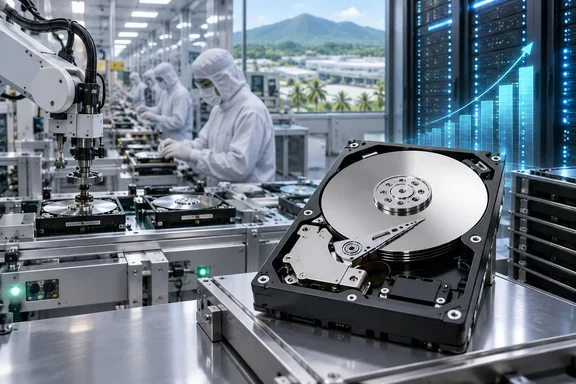
Tom’s Hardware, citing Nikkei, puts the manufacturing investment at approximately ¥60 billion, or about $380 million. The expansion accompanies reported plans for 30TB-class drives in 2027, 65TB-class models around 2030, and eventually 100TB-class HDDs. Those milestones describe a roadmap—not products already available to buy.
What Toshiba is actually expanding
Toshiba Information Equipment (Philippines), known as TIP, has added nearline HDD manufacturing at its Laguna Technopark facility, supplementing production at Carmelray Industrial Park. Toshiba says the Laguna site previously concentrated primarily on hard drives for personal computers; the expanded line serves high-capacity data-center storage for AI and cloud workloads.
That makes this a concrete manufacturing development rather than merely a promise to build a factory. However, Toshiba has not disclosed the line’s production rate, its current annual output, or an exact completion date within fiscal 2027. The first shipment should not be mistaken for confirmation that the expansion has reached full capacity.
The storage-based measurement also changes how to interpret the headline. As an illustrative calculation, shipping 40% more drives with 40% more capacity each would deliver 96% more total storage—almost a doubling without doubling unit production. That is an explanation of the metric, not Toshiba’s disclosed production mix.
Investment, automation and the shortage question
TrendForce’s account of Nikkei’s reporting describes the project as Toshiba’s first major HDD manufacturing investment in roughly five years. It also reports plans to automate more cleanroom operations and inspection, improving yields while reducing the additional workforce otherwise needed for the expansion by approximately 40%. That is not a reported 40% cut to the existing workforce.
The same reporting says nearline shortages are expected to continue for the time being and that Toshiba wants to increase its market share, measured by storage capacity, from just over 10% to 30% over the medium term. These are attributed reporting claims; Toshiba’s announcement does not establish them.
“Devastating shortages” is therefore stronger language than the available measurements justify. Neither the company announcement nor these accounts provides a quantified supply deficit, customer waiting times, or a demonstrated effect on consumer HDD availability. Tight data-center supply is the reported backdrop, but an immediate retail storage crisis is not established.
The roadmap: 30TB, 40TB and beyond
Tom’s Hardware associates the expansion with an M12-series, 30TB-class ramp in 2027, describing microwave-assisted magnetic recording, or MAMR, and up to 11 platters. Its suggestion that next-generation production could start at any time is an interpretation, not a launch date confirmed by Toshiba’s factory announcement.
There is a separate, stronger primary-source milestone. In October 2025, Toshiba announced that it had verified 12-disk stacking technology and aimed to introduce 40TB-class, 3.5-inch data-center HDDs using MAMR in 2027. The design adds two disks to its existing 10-disk nearline platform, with new stack components and thinner glass substrates replacing aluminum substrates.
Toshiba also said it was investigating combining that platform with heat-assisted magnetic recording, or HAMR. That remains a research direction, not a confirmed HAMR product launch. Likewise, the 65TB and eventual 100TB milestones come from Nikkei-derived reporting rather than the inspected company announcements.
A 30TB-class production ramp and a targeted 40TB-class introduction need not contradict each other. They could overlap, but the evidence does not settle shipment volumes or timing. The prudent reading is to keep factory expansion, technical verification and commercial availability in separate columns.
What this means for PC users and IT buyers
For enterprise storage planning, this is a meaningful supply-side signal—not a delivery guarantee. For Windows desktop and home-storage users, it is not evidence that consumer drive supply will double or prices will fall: the confirmed expansion specifically concerns nearline data-center HDDs.
The bottom line is encouraging but narrower than the dramatic headline. Toshiba has a newly shipping production line and a substantial capacity target. Whether that expansion meaningfully eases shortages will depend on the subsequent ramp, not simply the arrival of the first shipment.
References
- Toshiba to double HDD production capacity amid devastating shortages Tom's Hardware · 2026-10-02T16:00:45+00:00
- Toshiba Information Equipment (Philippines) Celebrates 30th Anniversary and First Shipment from Expanded Nearline HDD Production Line | Toshiba Electronic Devices & Storage Corporation | Asia-English toshiba.semicon-storage.com
- (News) Toshiba to Double AI Data Center HDD Capacity by FY2027 With $380M Expansion as AI Storage Demand Surges trendforce.com