

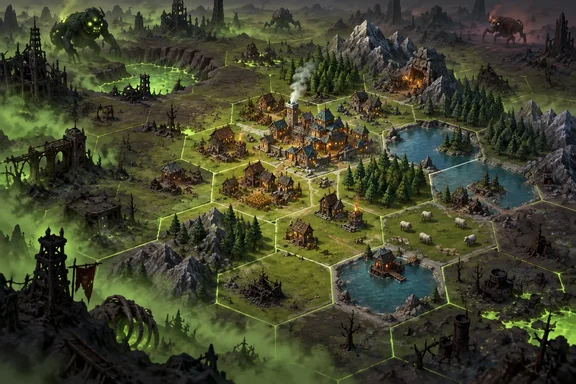
PC Gamer’s Issy van der Velde, who said they played the game ahead of the reveal, describes a loop built around placing cards for villages, forests, sheep, mountains, lakes, and other map elements. The Steam listing independently confirms the broad premise: players deploy cards across a hex grid to expand a colony and purify a ruined, toxic landscape.
The game is currently listed for Q1 2027 on Steam, rather than the “TBA” date included in the initial PC Gamer report. It is listed as a prerelease Windows title with single-player support and full controller support.
How the city-building system appears to work
The core building rule is adjacency, but not merely dropping matching cards onto the same space. PC Gamer reports that surrounding one village with other villages upgrades the central tile into a town; repeating the pattern can produce a city. That makes placement a spatial puzzle: a useful card now may occupy a hex needed later to complete an upgrade pattern.
This differs from a traditional city builder where players generally choose structures from a fixed construction menu and work around resource limits. In Toxic Frontier, the draw of cards appears to control the choices available at any moment. The strategic question is therefore twofold:
- Whether a card has a useful immediate placement.
- Whether holding space open can enable a larger combination later in the run.
The available material does not establish whether cards can be discarded, rerolled, saved indefinitely, or modified by a persistent progression system. Those details will matter substantially to how punishing individual runs feel, but they have not been announced.
The roguelike layer is based on limited runs
According to PC Gamer’s hands-on account, each level has semi-randomized objectives and a limited supply of cards. Placing cards earns points, which unlock additional cards; larger or more elaborate arrangements produce more points. In practical terms, that creates an escalating economy: efficient early combinations should increase later options, while inefficient placement can leave a run short of the cards needed to meet its goals.
The “roguelike” label, then, seems to describe run variation and constrained decision-making rather than combat-focused procedural dungeons. Players are expected to adapt a settlement plan around the objectives and card supply they receive instead of following one optimal build order every time.
PC Gamer also reports that failed attempts are likely to be part of the intended loop. That is an important expectation for players coming from more relaxed, sandbox-oriented settlement games: a clean-looking map alone may not be enough if it does not generate sufficient points or satisfy the level’s requirements before the card supply runs out.
The wasteland introduces pressure beyond tile optimization
Expansion is framed as pushing back toxic fog around the settlement. The deeper a player builds into the map, the more terrain and threats can be uncovered. PC Gamer says those hazards include polluted land that must be cleansed and roaming mutants capable of raiding lumberjack homes.
That setup gives exploration a cost-benefit trade-off. Expanding likely creates access to the space or terrain combinations needed for stronger settlements, but it can also expose the player to problems that interrupt the resource engine. The Steam description similarly emphasizes expanding the colony while purifying land in “noxious wastes,” reinforcing that cleansing is part of the game’s central progression rather than background flavor.
No detailed information has yet been published on combat, defensive units, resource chains, or whether mutants are handled through card placement, direct tactical control, or automated settlement systems. The reveal establishes the threat but not the exact response mechanics.
What PC players can conclude now
Toxic Frontier has enough defined mechanics to be more than a mood-piece announcement: it is a card-driven, hex-based city-building game with randomized objectives, a limited hand or deck economy, settlement-upgrade patterns, environmental cleansing, and hostile map events. Its clearest appeal is to players who enjoy optimizing a small board under pressure rather than managing a sprawling city over dozens of hours.
The key limitation is that the game has only just been announced. PC Gamer’s favorable early impression is a single hands-on account, not broad player testing, and no public demo, price, system requirements, or detailed progression model has been established. For now, the confirmed release window is Q1 2027 for Windows PC.