

For developers who target Windows and Xbox, this is one of the rare detailed accounts of how a small studio fit a physics-heavy PC game into the Series S hardware budget. The figures are the developer's own and come without benchmarks. Even so, the structure of the system and the order in which things were cut on the console are useful whatever engine a studio uses.
TRAIL OUT Splits Its Damage Model Into Morph Targets and Vertex Dents
TRAIL OUT is a FlatOut-style racer from Good Boys and publisher Crytivo. According to RacingGames.gg, the game first released in 2022 on PC, and aims to recapture the spirit of the original FlatOut games developed by BugBear Entertainment, which later created Wreckfest. Xbox Wire announced the Xbox release on April 10, 2024. Traxion later reported that a PlayStation 5 version was in development.
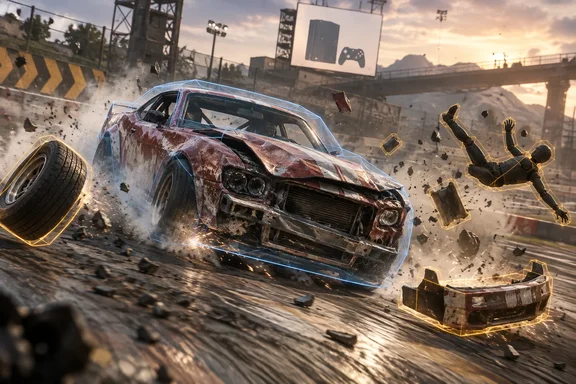
Gameindustry.com reports that the game's damage is built on a combination of morph targets, vertex deformation, and rigid bodies for detachable parts. The first two techniques deal with the car body, and each covers a different scale of damage.
Large damage uses morph targets. Major body damage — a crumpled hood, a caved-in roof, a buckled trunk — is handled via morph targets. These are pre-made mesh states that the engine interpolates between upon impact. Because artists author these shapes ahead of time, a crushed roof always looks like a believable crushed roof. The limitation is that the more morph targets a model has, the more damage variations the player sees. Every extra variation is another asset to build for every car.
The second layer is vertex deformation, where the engine moves the mesh's own vertices at the point of impact. Hirsch describes dents of roughly 15–30 cm that appear where the car was hit. They need no extra art assets because the mesh itself deforms, and they make it very unlikely that two crashes look the same. Both layers run together. The morph targets set the overall wrecked shape and the vertex dents add small random detail on top.
In the report, vertex deformation is called cheaper than authoring more morph targets and more convincing than looping damage animations. That is a design judgment, not a measurement. No mesh complexity, hardware setup or frame-time cost is given, so the 15–30 cm radius is best read as TRAIL OUT's tuning value, not a general rule.
Detachable Bumpers, Doors and Wheels Turn Into a Physics Budget
The third technique covers parts that can come off. Bumpers, fenders and doors are separate rigid bodies attached to the car with physical constraints. When the car is hit, a part first works loose. Once the constraint breaks, the part becomes its own physics object with its own mass, velocity and collision. Hirsch says the game can have up to 300 of these objects in a scene at once.
Wheels get full collision physics as well. In a destruction racer, a wheel that comes off is expected to roll down the track, and a simple visual stand-in would not do that. This is part of the genre's appeal. RacingGames.gg notes that the environments are fully destructible, allowing you to smash through buildings, barriers, and fences, littering the track with debris, and that there are even ragdoll physics challenges where you eject the driver through the windscreen to score points in novelty mini games from human bowling to high jumps.
Hirsch says debris alone is not the main cost. The heaviest load comes when body debris, ragdoll drivers, loose wheels and large environmental props all hit the physics engine together. For anyone planning a similar game, the useful unit is the total number of active simulated bodies in the busiest moment of a race, not the number of pieces one car can shed.
The 300-object figure has limits. The account does not say whether it is a hard cap or an observed peak, or whether ragdolls and scenery props count toward it. Treat it as the ceiling of the PC version, not a target for your own project.
A Stable Collision Mesh Keeps a Wrecked TRAIL OUT Car Racing
The central design choice concerns what the physics engine actually drives. Visually, a car can turn into a heap of twisted metal. However, the collision mesh — which the engine uses to compute impacts and driving physics — remains stable. The player continues the race.
Gameindustry.com calls this a conscious design choice favoring arcade playability. Damage still has gameplay effects: losing a wheel degrades handling, and a damaged engine reduces top speed. Those effects are driven by specific damage states. The visible deformation does not feed into the driving model. As the report puts it, the visual and gameplay damage models run in parallel: a car can look completely dead while remaining fully drivable.
Hirsch says the practical benefit is that artists can raise visual detail without affecting race balance. A deeper dent or a messier crumple zone changes how the car looks and leaves its handling alone. If the collision shape followed every dent, each visual tweak would also change handling, and designers would have to re-tune the game after art changes.
The trade-off is realism. A car that looks destroyed but drives nearly normally suits an arcade game and would feel wrong in a simulation. Not every player found TRAIL OUT's physics predictable. Saving Content's 2022 review of the PC version said the physics are often unreliable, and its reviewer said they would've liked to have seen a rewind feature for when the physics get wonky. That review came out years before the version Hirsch describes. Traxion's coverage of the v5.0 update in September 2025 listed improved car physics and stability, better glass-damage logic and fixed explosion-damage visuals on car bodies. The damage system has kept changing since launch, and the 2026 description should be read as a snapshot of that ongoing work.
The Xbox Series S Port Cut the Object Count, Not the Destruction
Hirsch says he ported the Xbox version himself and that it took about a year. The most concrete detail is the Xbox Series S, the lower-powered model of the current generation. On that console, he says, the number of objects simulated at once had to be cut roughly in half, and the physics tick rate was lowered, mainly for ragdolls.
A physics tick rate is how often per second the engine advances the simulation. Lowering it for ragdolls saves processor time on the flailing drivers while vehicle physics keeps its update frequency. Hirsch gave no baseline or final numbers, so "roughly half" should not be turned into an exact object cap or a specific tick rate.
Other savings came from rendering and memory:
- Large maps were split into streaming sectors, so a whole level is never loaded into memory at once.
- Resolution, shadow quality and draw distance were reduced.
- The destruction system itself was left alone, and morph-target deformation, detachable parts and vertex damage all carried over.
The order matters for developers facing the same problem. Good Boys reduced how much physics work runs at once and how much the renderer draws, and kept every mechanic. That matches the first principle in the report: on weaker hardware, it is better to cap the debris count than to turn off destruction completely. The report gives no settings, memory savings or frame-rate results, so the size of each saving is unknown.
The Xbox release is confirmed independently even though the internal details are not. RacingGames.gg reported the game is out now on the Xbox store for £24.99 / $29.99, and that the Xbox version also bundles all DLC released for the PC version. That fits Hirsch's claim of feature parity, at least for content.
Xbox Certification Flagged Gamepad Controls, Not Frame Rates
Hirsch says Xbox certification problems had nothing to do with performance. The main feedback was about controls: how the gamepad logic worked, how buttons behaved and how menus were navigated. TRAIL OUT was built for mouse and keyboard, and he says the biggest challenges were controls and the user interface, because consoles handle input very differently and have their own certification requirements.
This is a familiar pattern for PC-first games heading to Xbox. A menu built around a cursor has to work with directional focus. Buttons have to behave consistently across screens. Every path through the interface has to work without a mouse. Hirsch's account suggests the physics budget was the engineering problem and input handling was the certification problem, and a studio could easily budget for the first and underestimate the second.
He says the Xbox version shipped without mechanical compromises and includes everything from the PC version. The report does not list the features or share any certification documents. The bundled DLC is the part of that claim that can be checked from outside.
What this means for developers shipping physics-heavy games on Xbox and PC
If you are building a physics-heavy game for Windows with an Xbox port in view, decide early whether visual damage feeds into handling. Also treat active physics bodies as a budget from the start. Doing either after launch is much harder. Studios making simulation-style racers, where damage is supposed to change how a car drives, can learn less from TRAIL OUT's approach. Separating the two models is an arcade choice.
The figures here come from one developer's account of one game. Hirsch's 300 objects, the halved Series S load, the 15–30 cm dents and the year-long port timeline describe TRAIL OUT. They are not standards for other engines. The more portable lesson is what was preserved on the console and what was reduced.
- Keep visual deformation separate from a stable collision mesh when predictable arcade handling matters more than realism, and drive gameplay penalties such as lost wheels or engine damage through explicit damage states.
- Combine authored morph targets for large, readable damage with local vertex deformation for variety, since the vertex layer needs no extra art assets.
- Count all simultaneous physics bodies together, including debris, wheels, ragdolls and environmental props, because the combined peak is what stressed TRAIL OUT's physics engine.
- On Xbox Series S, reduce the active object count, lower tick rates for less important systems such as ragdolls, and stream large maps in sectors before you consider cutting destruction mechanics.
- Leave time in a PC-to-Xbox schedule for gamepad logic, button behavior and menu navigation, since those were the issues Xbox certification actually raised for this game.
Hirsch expects demand for destruction physics in arcade games to grow, arguing that over the past decade, major releases in the destruction racing segment have been rare. His evidence is TRAIL OUT's reported sales of more than 100,000 copies across PC, Xbox and PlayStation 5, a figure no other outlet has reported. Good Boys is already applying the lessons to its next game: Traxion reports that TRAIL OUT 2 is being developed from scratch with new physics, an online focus and an open-world story mode, targeting 2028 on platforms not yet announced. Whether the sequel keeps the split between visual and collision models will show if this is a lasting design approach for the studio or something that fit this one game.