

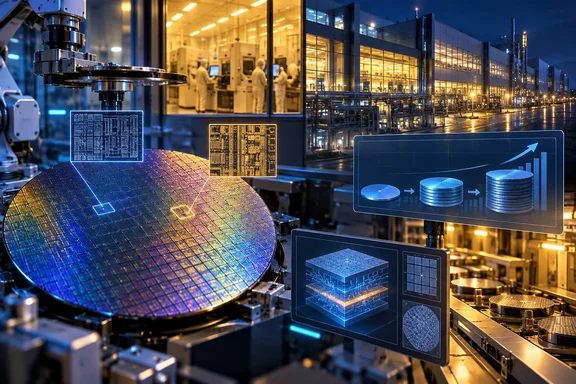
Wccftech’s September 22 report, citing Economic Daily News, combines an earlier potential A14 trial-production date with estimates that monthly 3nm output could exceed 200,000 wafers by the end of 2027. Separate reporting published by TrendForce the same day describes an early pilot-production site in Baoshan and a later start at the principal manufacturing site in Taichung. That location distinction helps explain why first-quarter and third-quarter 2027 dates appear in coverage of the same process.
TSMC’s A14 trial-production dates describe different factory milestones
The latest A14 reporting needs to be read factory by factory. According to TrendForce, citing Commercial Times, TSMC is expected to begin pilot production at Fab 20 in Baoshan. Its September 22 report describes the pilot schedule as potentially moving forward to the first quarter of 2027. Fab 25 in Taichung, described as the main production hub, is instead slated for completion in the second quarter, with pilot runs potentially starting in the third quarter. These remain reported schedules, rather than a newly verified TSMC production commitment.
That is a more precise account than treating “A14 trial production” as one company-wide starting gun. An early run at one facility and a later production-line start at another can coexist. The newer report therefore does not, by itself, invalidate earlier coverage placing Taichung’s pilot production in the third quarter of 2027.
In July, TrendForce reported that Central Taiwan Science Park Administration director Hsu Mao-hsin expected the first building at TSMC’s new 1.4nm site to be completed before April 2027. Supply-chain sources cited in that coverage placed pilot production as early as the beginning of the third quarter, conditional on equipment installation and production-line qualification proceeding smoothly. They anticipated mass production around mid-2028.
The September description of completion in the second quarter is not identical to July’s “before April” expectation. Neither account establishes an actual delay or acceleration without a consistent definition of the building and completion milestone being discussed. The useful conclusion is narrower: reports continue to put Taichung pilot activity in 2027 and volume manufacturing in 2028, while the newest coverage introduces an earlier pilot opportunity at a different location.
For hardware buyers, trial production is not a product-release date. The reported sequence itself includes construction, equipment installation, line qualification, pilot activity, and eventual mass production. July reporting explicitly makes the later milestones conditional on those intermediate steps. A 2027 pilot schedule consequently provides no basis for promising a 2027 A14 Windows PC, graphics card, or enterprise accelerator.
TSMC’s 3nm forecast concerns nearer-term supply, not completed expansion
The 3nm portion of the story is closer to the current manufacturing business. According to Wccftech’s account of Economic Daily News reporting, output at the Southern Taiwan Science Park is estimated to reach 170,000–180,000 wafers per month in the fourth quarter of 2026, then exceed 200,000 per month by the end of 2027.
Those numbers are forecasts. As of September 22, the fourth quarter of 2026 has not begun, and the end-of-2027 estimate is further out. Describing either figure as an achieved production record would turn an expectation into an observation.
The estimates also have a specific geographic scope. Wccftech attaches them to the Southern Taiwan Science Park; they should not silently become a statement about all TSMC factories worldwide. Nor does the reporting establish how much of that output would be allocated to any particular processor designer, PC vendor, or cloud provider.
The scale of the projected increase is nevertheless meaningful. Moving from 180,000 wafers monthly to more than 200,000 would represent growth of more than 11%; measured from 170,000, it would exceed 17%. Those percentages are arithmetic derived from the reported estimates, not additional analyst forecasts.
There is no independently established confirmation of those exact wafer totals in the available reporting. They are best understood as a supply-chain estimate carried by Wccftech and attributed to Economic Daily News, rather than official TSMC guidance.
The distinction matters to the competitive argument. A14 concerns progress toward a later manufacturing generation; the 3nm estimates concern expansion of an existing one. If both schedules are achieved, TSMC would be increasing nearer-term supply while preparing its next leading-edge production capability. That is a stronger, more concrete claim than treating every new process announcement as an immediate replacement for everything preceding it.
Samsung’s reported 2029 schedule cannot establish a permanent gap
The Samsung comparison has a supportable core and an unsupported conclusion.
TrendForce’s July coverage, citing The Bell, reported that Samsung had resumed efforts to commercialize its SF1.4 process, with mass production slated for 2029. The same coverage placed TSMC’s prospective A14 mass production around 2028. On those reported schedules, Samsung would arrive later in this manufacturing cycle. The 2029 timing remains attributed industry reporting, not a newly verified Samsung commitment.
A comparison also has to use equivalent milestones. Setting TSMC’s possible first-quarter 2027 pilot production against Samsung’s reported 2029 mass production would exaggerate the apparent lead by comparing different stages. The more relevant comparison is the reported 2028 versus 2029 volume-production window.
Even that comparison establishes timing, not the complete commercial outcome. The reports do not provide a matched assessment of production yields, customer pricing, available capacity, or finished products manufactured on both processes. Without that evidence, a calendar lead cannot quantify the overall advantage.
Wccftech goes further by suggesting Samsung may never close the gap and characterizing customers as choosing it only as a backup. Neither sweeping conclusion is demonstrated by the production dates and capacity estimates discussed here. The defensible finding is that current reporting puts TSMC ahead on this next-node manufacturing schedule—not that all future competition has been settled.
PC and enterprise buyers should separate foundry progress from purchase timing
Keep current purchasing decisions tied to available products and supplier commitments; use these foundry reports to inform longer-range planning.
There is no announced Windows hardware availability, price reduction, or enterprise delivery guarantee attached to the reported A14 pilot date. Likewise, the 3nm forecast supplies no customer-allocation breakdown from which an IT department could calculate its future access to AI accelerators. Treating either development as a reason to postpone an otherwise necessary deployment would go beyond the evidence.
For readers following processor roadmaps, the practical checkpoints are straightforward:
- Treat the first-quarter 2027 A14 pilot date as reported potential timing, and keep it separate from the third-quarter pilot window described for Taichung.
- Use the reported 2028 A14 mass-production window for manufacturing context, without converting it into a promised release date for a particular PC or server.
- Read the 170,000–180,000 and more-than-200,000 monthly 3nm wafer figures as geographically scoped forecasts, not achieved output.
- Compare TSMC and Samsung at equivalent production stages rather than contrasting one company’s pilot run with the other’s commercial ramp.
- Require product-specific availability, performance, and pricing before changing a hardware purchasing plan.
TSMC’s reported progress supports a clear conclusion: it is preparing a new leading-edge process while seeking more output from a generation that remains important to AI customers. The next concrete milestones are the projected fourth-quarter 2026 3nm output and the separate A14 pilot starts described for 2027. Their realization would strengthen the manufacturing case for TSMC’s lead; actual hardware availability will determine when that progress becomes useful to PC owners and enterprise buyers.