

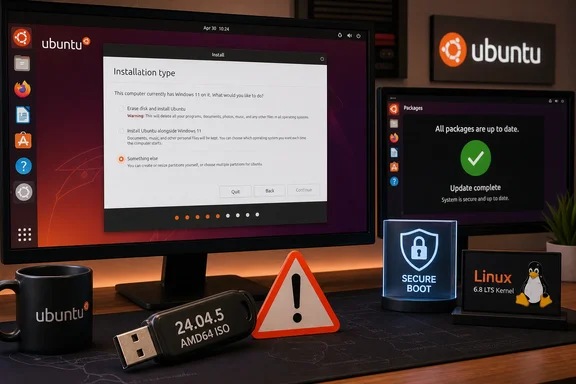
The Register first reported the withdrawal after the September 10 point-release launch. Canonical subsequently confirmed the problem in its Ubuntu Community Hub announcement, identifying Launchpad bug 2167127 as the tracking record and saying it pulled the image to prevent failed installations. That makes this a bad download, rather than a bad operating-system update: systems already running Ubuntu 24.04 can install the normal package updates and reach 24.04.5 without using the affected installer.
For Windows users preparing a dual-boot machine, testing Linux hardware compatibility, or setting up an Ubuntu workstation from scratch, the distinction is important. A current 24.04 installation is safe to update. A USB stick made from the original ubuntu-24.04.5-desktop-amd64.iso, however, can fail at precisely the stage where users opt into the broader installation path.
The failure is in the installation media, not the update channel
Canonical’s public explanation is unusually narrow: the crash occurs only in the desktop installer on the AMD64 image when the extended option is chosen. The company did not issue a broader warning for package upgrades, cloud images, servers, WSL instances, or Ubuntu flavors, and it explicitly says those remain on the 24.04.5 release.
That leaves a straightforward immediate workaround. Install Ubuntu Desktop 24.04.4, apply all available updates after first boot, and reboot. Canonical says that route reaches 24.04.5 without encountering the defective installer path.
There is one practical limitation that deserves more attention than it received in the initial reports. Ubuntu 24.04.5 refreshes the desktop hardware-enablement stack with Linux 7.0, while a 24.04.4 installation begins on older media and receives newer components only after it has a usable installed system and an online update source. On a very new laptop whose Wi-Fi, storage controller, graphics, or other essential hardware requires the newer stack simply to complete setup, “install the old ISO and update later” may be an inadequate workaround.
For ordinary PCs, the fallback is sensible. For bare-metal deployment work, air-gapped installations, field laptops, and machines being installed specifically because older images lack driver support, waiting for Canonical’s replacement image is the safer course.
Stale Secure Boot material appears to be the trigger
Canonical’s first announcement did not describe the technical cause beyond the installer crash. The Launchpad bug record and an Ubuntu bug-mailing-list update fill in the missing detail: the 24.04.5 desktop image retained remnants of the enhanced Secure Boot configuration even though the related components had been removed. Those stale references led the underlying Subiquity installation machinery into the failing extended-installation path.
That explanation matters because it narrows the risk. This is not evidence that Secure Boot itself is broken across Noble, nor evidence of a kernel-wide regression in Linux 7.0. It is a release-image assembly problem, localized to one image and one installer selection.
The remediation was already moving quickly. A Canonical contributor reported on September 12 that a smoke test of a repacked test image completed the extended installation path that had crashed with the official September 10 image. The test result is encouraging, but it is not the same thing as a public replacement ISO. Canonical’s release team said it would publish a respun desktop image after review and testing, with an expectation of early the following week.
Administrators should therefore verify both the filename and checksum of any newly downloaded image rather than assuming that an ISO labeled 24.04.5 is necessarily the repaired build. The version number will remain the same; the differentiator is the revised artifact and its published checksum.
Noble receives a substantial hardware refresh before its handoff
The withdrawn desktop image overshadows what 24.04.5 actually delivers. Canonical’s release notes show that the point release incorporates security fixes published through September 10 and a large set of fixes across installation tooling, desktop components, fingerprint readers, graphics behavior, multi-GPU boot handling, display reconnection, remote desktop settings, and Plymouth boot behavior.
The most consequential addition for desktop users is the Linux 7.0 hardware-enablement stack. Ubuntu’s HWE model lets a long-term-support release gain newer kernels and associated hardware support without requiring users to abandon the LTS branch for an interim release. The 24.04.5 release notes specifically include the Noble 7.0 kernel stack, which is why the repaired ISO matters more than a cosmetic respin.
The update also includes newer graphics components, with Mesa 26.2 cited in the release reporting. That combination makes 24.04.5 particularly relevant for recent AMD and Intel graphics hardware, newer laptops, and systems where the original 2024-era Noble media was too old to be a reliable installer baseline.
The value for existing machines is less dramatic but still real. An installed 24.04 desktop following the HWE track can obtain the newer kernel through normal updates. Before rolling it broadly across managed endpoints, IT teams should use their usual staged deployment process: test the new kernel against VPN clients, proprietary graphics drivers, endpoint-management agents, disk encryption tooling, USB peripherals, and any out-of-tree kernel modules.
The point release’s status as Noble’s last scheduled refresh also needs careful wording. Canonical has not described 24.04.5 in its public release announcement as the final point release, and Ubuntu 24.04 LTS remains in standard security maintenance through May 2029. What is ending is the regular cadence of installation-media refreshes as Canonical’s newer 26.04 LTS takes over as the primary long-term base.
Ubuntu 26.10 is entering its final development stretch
While Noble’s replacement ISO is being prepared, Ubuntu 26.10 “Stonking Stingray” is moving toward its September 24 beta and October 15 final release. Canonical’s published schedule confirms those dates and shows the project in the freeze-heavy period where new features become harder to admit and release engineering takes priority.
Snapshot 3 is already available for testers, including conventional AMD64 desktop media and an AMD64-v3 build aimed at newer x86-64 processors. Those images are development snapshots, not a substitute for an LTS deployment baseline, but they show where Canonical’s desktop and kernel work is headed next.
The kernel plan has changed during the cycle. Canonical initially targeted Linux 7.2 for Ubuntu 26.10, then announced on September 1 that it had raised the target to Linux 7.3 after upstream timing made the newer branch feasible. The organization says it is enabling Ubuntu-specific functionality on top of the 7.3 release candidate and intends to make packages available for early testing through the -proposed channel.
That is an aggressive late-cycle move, even if the calendar supports it. The Ubuntu Kernel Team’s earlier updates noted that kernel packages must migrate alongside Nvidia-related updates, and that signing infrastructure had slowed parts of the work. A newer kernel can materially improve support for new PCs, but it expands the validation burden close to a release freeze. Enterprises should treat the September beta as a test target, not as confirmation that 7.3-based deployments are ready for production.
Rust core utilities make 26.10 more than a routine interim release
Canonical’s preliminary 26.10 release notes also say the distribution is completing its switch to Rust-based uutils core utilities, including the remaining cp, mv, and rm programs that had been held back for compatibility reasons. This is the kind of change that will barely register for most desktop users and deserves deliberate scrutiny from administrators and developers.
Core utilities sit beneath package scripts, shell automation, build pipelines, recovery runbooks, and legacy deployment tooling. Canonical may ship compatible replacements, but compatibility claims need to survive real scripts with unusual flags, edge-case file names, error handling, locale settings, and assumptions inherited from GNU behavior. The 26.10 beta is where maintainers should run those tests.
Ubuntu 24.04.5, meanwhile, remains a useful LTS platform once Canonical restores a working desktop image. The immediate action is narrower: do not deploy the original AMD64 desktop ISO, update existing Noble systems normally, and wait for the respun media if a clean installation requires the 24.04.5 hardware stack.