

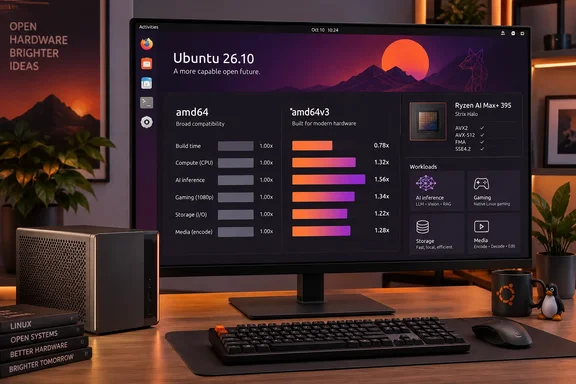
amd64v3 build gave AMD’s Ryzen AI Max+ 395 “Strix Halo” a measurable edge in a broad Phoronix test run, but the result is more useful as a deployment signal than as a promise of a universal 5 percent speed-up. On the Framework Desktop, Phoronix measured Ubuntu 26.10 at roughly 3 percent ahead of Ubuntu 26.04 LTS across more than 130 tests; using the x86-64-v3-optimized package variant expanded that aggregate advantage to about 5 percent.
The practical news is that Canonical is now publishing a bootable Ubuntu 26.10 amd64v3 desktop daily image, avoiding the former process of installing generic AMD64 Ubuntu and then reconfiguring APT to switch package variants. Canonical’s own image directory lists separate generic amd64 and amd64v3 images, while its developer documentation identifies amd64v3 as a supported architecture variant that assumes AVX2, FMA, BMI2 and other newer x86 capabilities.
Phoronix conducted the comparison on a Framework Desktop equipped with AMD’s Ryzen AI Max+ 395 and Radeon 8060S integrated graphics, testing Ubuntu 26.04 LTS, a September 16 Ubuntu 26.10 daily build, and Ubuntu 26.10 with the amd64v3 package set. That is a relevant test platform for high-end compact desktops and mobile workstations, including systems based on the same Strix Halo silicon. It is still one hardware configuration, however, and the benchmark does not establish that every Ryzen system—or every application—will see the same result.
The gain is real, but uneven
The overall result hides considerable variation. Phoronix found stronger results in selected graphics, storage I/O, networking, CPU-based AI inference and media-oriented workloads, while several compute tests showed little change or put Ubuntu 26.04 in front. In other words, the upgrade did not raise performance as a flat layer across the entire machine.
Storage testing on the Framework Desktop’s NVMe drive favored Ubuntu 26.10 in random-write tests and favored the amd64v3 configuration in sequential-write cases. Network tests also produced several Ubuntu 26.10 wins with the Linux 7.2 kernel, although one 32-thread bandwidth run remained faster on Ubuntu 26.04. These results are encouraging for developers compiling locally, running containers, moving large files, or using the machine as a workstation and small server—but they are not enough to claim that 26.10 changes Strix Halo’s underlying platform limits.
Gaming and graphics results follow the same pattern. Phoronix recorded notable gains in DDraceNetwork and reported a particularly large increase for the open-source shooter Unvanquished when moving to the amd64v3 binaries. Yet Unigine Superposition, running through the RadeonSI OpenGL driver, showed no meaningful difference from the operating-system upgrade. GPU-heavy software can spend most of its time in the driver or on the GPU itself, which limits how much a more aggressive CPU instruction baseline can help.
That distinction is important for Windows users evaluating a Linux dual-boot, WSL-adjacent development machine, or a dedicated Linux install on a Framework Desktop. A gain in a Vulkan game or a CPU-side image-processing stage does not imply that Radeon 8060S frame rates will rise by the same percentage in every Windows title under Proton, every native Linux game, or a GPU compute workload. The test points to better software maturity around the platform, not a replacement for application-specific testing.
amd64v3 is a package baseline, not a Strix Halo tuning switch
The amd64v3 label describes an x86-64 microarchitecture level. Canonical says the variant lets packages assume instruction-set extensions including AVX2, FMA and BMI2, features available on most compatible processors produced since approximately 2013. Ryzen AI Max+ 395 comfortably meets that requirement, so it can run software compiled with that higher baseline without falling back to the generic AMD64 compatibility target.
This matters because generic Ubuntu AMD64 packages have historically preserved compatibility with the earliest 64-bit x86 processors. That conservatism is good for keeping old hardware usable, but it can restrict compiler and library optimization choices on newer machines. A distribution-wide amd64v3 package set removes those limits for eligible systems, potentially improving hot code paths in compression, media encoding, cryptography, rendering, numerical work and applications built atop optimized libraries.
The benchmark’s better amd64v3 results in Darktable’s CPU-only RAW photo-processing tests, selected Llama.cpp prompt-processing runs, cryptography, video encoding and several games fit that model. They also explain why the biggest gains appeared in individual workloads rather than everywhere. Programs benefit only when their packaged code, linked libraries, data path and bottleneck can use the newer baseline; an application limited by storage latency, GPU execution, Java runtime behavior, memory bandwidth or algorithm design may gain little.
There is another caveat: amd64v3 is wider than AMD. It should also be viable on supported Intel systems, including processors with the required x86-64-v3 features. The Strix Halo measurements therefore demonstrate a potentially useful Ubuntu packaging direction, but they should not be read as an AMD-exclusive optimization program.
Ubuntu 26.10 changed more than the compiler target
Phoronix’s three-way comparison combines two separate variables: Ubuntu 26.04 LTS versus a pre-release Ubuntu 26.10 software stack, and generic packages versus amd64v3 packages inside 26.10. The first can capture updates to the Linux kernel, Mesa, AMDGPU, RADV, RadeonSI, GNOME’s Mutter compositor, libraries and user-space tooling. The second chiefly tests the higher x86 package baseline.
That means the 3 percent generic Ubuntu 26.10 result cannot be assigned solely to one component, and neither can every part of the amd64v3 lead. Phoronix itself attributed some game improvements to a likely mixture of AMDGPU, Mesa and Mutter changes. The network improvements were observed with Linux 7.2. Those are credible explanations, but the article does not provide a controlled component-by-component regression analysis, so they remain attribution rather than a definitive root-cause finding.
The result set also contains a caution for developers hoping that a newer distro immediately means a new compiler. Phoronix noted that Ubuntu 26.10 was still using GCC 15.3 by default rather than GCC 16 at the time of testing. The gain, then, did not depend on a wholesale GCC 16 transition. For organizations that build their own performance-sensitive binaries, distribution packages and local builds are separate decisions: an amd64v3 Ubuntu installation can improve packaged software while an in-house application still needs an explicit compiler target and validation plan.
AI and creator workloads show the most practical upside
CPU-based Llama.cpp inference is one of the more consequential areas in the testing because Strix Halo systems are increasingly used as high-memory local AI workstations. Phoronix found Ubuntu 26.10 ahead in several prompt-processing tests and amd64v3 ahead in some of them, including a Qwen3.5-9B Q8_0 run. But the same page also records Ubuntu 26.04 wins in certain token-generation tests, showing that model format, prompt ingestion, generation behavior and BLAS path all affect the outcome.
For local-model users, prompt processing and text generation should be treated as different workloads. Faster ingestion of a large context can improve interactive setup and retrieval workflows; faster token generation improves the visible response rate. The test indicates that Ubuntu 26.10 can improve the first category on this system, but it does not support a blanket claim that all local AI inference will accelerate.
The same discipline applies to GPU compute. Phoronix reports that the official ROCm packages were available on both Ubuntu releases, limiting the significance of the distribution comparison for GPU-based ROCm performance. Owners using the Radeon 8060S for supported GPU acceleration should confirm their ROCm, PyTorch, kernel and Mesa combinations instead of assuming the amd64v3 image is the decisive upgrade.
The release is close, but the image is still pre-release software
Canonical’s Ubuntu 26.10 schedule sets the mandatory beta for September 24, 2026, with final release planned for October 15, 2026. The tested daily image was from September 16, placing the measurements before the beta freeze. Canonical’s release notes still describe 26.10 as in development, and several major version fields remain incomplete in the public documentation.
That timing makes the benchmark a good reason to test hardware compatibility and workload behavior, particularly for enthusiasts and administrators planning a clean installation on a Strix Halo machine. It is not a reason to replace a stable Ubuntu 26.04 LTS production deployment this week. Daily images can change materially before release, and the test does not establish long-term update behavior, third-party repository compatibility, or an officially supported in-place migration path from generic AMD64 packages to amd64v3.
The useful conclusion is narrower and stronger: Ubuntu now has a straightforward test image for modern x86 systems, and on a Ryzen AI Max+ 395 it has already delivered a modest aggregate improvement with much larger gains in selected tasks. Strix Halo owners who rely on local AI prompt processing, CPU image work, software builds, storage-heavy development or specific Linux games have a concrete candidate to evaluate before October 15; everyone else should wait for the final 26.10 release and measure the applications that actually define their workload.