

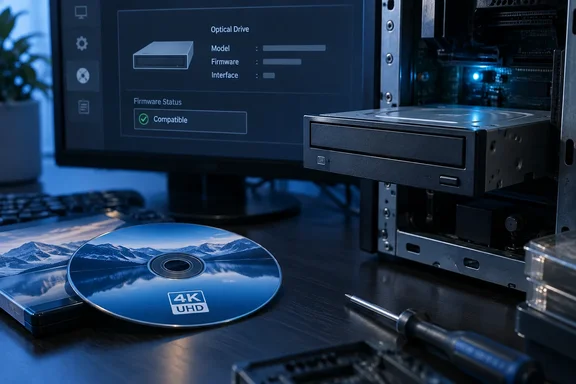
The headline goes further than the evidence. The underlying problem is still real. Here is what is confirmed, what is still a forecast, and what Windows users with disc collections should check before they buy hardware.
The core problem: a Blu-ray drive is not a UHD ripping drive
Many people assume that any Blu-ray drive will handle any Blu-ray disc. How-To Geek explains why that is wrong:
- Most drives on sale read standard Blu-ray only. Butler says the easily available internal and external drives read standard Blu-ray discs up to 50GB. With suitable player software, those discs play on a PC without much trouble.
- Reading a UHD disc is not the same as playing or ripping it. Some high-capacity BDXL drives can physically read UHD discs. FlatpanelsHD describes PC drives that write CD, DVD, BD-R, BD-RE and BDXL formats, and notes that some of them can also read BD-ROM 3.0 discs, commonly known as Ultra HD Blu-ray.
- Stock firmware blocks ripping. Butler says these drives cannot rip commercial discs out of the box, because of protections in the firmware and in the hardware.
- Only a few models can be modified. Enthusiasts depend on a short list of LG, Pioneer and ASUS drives that can be flashed with custom LibreDrive firmware and then used with ripping software such as MakeMKV.
Playback is a separate headache. Butler argues that modern PCs lack the security hardware needed to play 4K discs. That fits the wider industry picture: UHD Blu-ray playback on Windows depended on Intel's SGX technology, which Intel dropped from its newer consumer processors. That background comes from general industry knowledge, not from the sources reviewed here. Butler's view that ripping is the only way to watch a UHD disc on a PC is his opinion, not something verified here.
Summary: Owning "a Blu-ray drive" means little for UHD work. What matters is the exact model, its hardware revision, and whether its firmware can be replaced.
What's confirmed: Pioneer is out, and LG's shelf is emptying
Pioneer's exit
Pioneer's departure is the biggest supply blow, and it is well documented. StereoNET reported that Pioneer transferred all shares of its subsidiary Pioneer Digital Design and Manufacturing (PDDM), which was responsible for optical disc-related businesses, to Shanxi Lightchain Technology Industrial Development Co., Ltd., a subsidiary of China's Shanxi Group, on April 30 2025. The same report said sales of Pioneer branded (optical) products are scheduled to close on May 30, with the production of Blu-ray drives and other products already ceased for both commercial and retail products.
TechPowerUp reported that Pioneer has quietly confirmed that it has ended production of internal and external Blu-ray optical disc drives (ODDs), for computers. The timing surprised people. The BDR-X13U-S BDXL Blu-ray recorder—was launched only six months ago when the news broke. Pioneer's own Japanese business-drive page now says that manufacturing and sales of all its business drive products have ended.
FlatpanelsHD pointed out a common misreading. The announcement was not about the (Ultra HD) Blu-ray Disc hardware business. It was about the business of optical disc drives for PCs. For rippers, though, the PC drive business is the part that matters.
LG's discontinued models
LG's U.S. product page for the WH16NS40 internal Blu-ray rewriter now says "DISCONTINUED." How-To Geek says LG also lists the WH16NS60 as discontinued, and both models are familiar MakeMKV choices. The WH16NS40 status is confirmed directly on LG's site. The WH16NS60 status comes from How-To Geek and was not separately confirmed here.
Summary: Two of the most common routes to a new UHD-friendly drive, Pioneer burners and certain LG internals, are closed or closing at the manufacturer level.
The firmware lifeline and its limits
Some of the recent news is good. On May 6, 2025, MakeMKV's lead administrator posted on the project's forum that all Pioneer drives would be supported as LibreDrive drives "in a relatively near future." The post said there was no precise ETA and that a custom firmware flash with the project's sdftool would be required. It also pointed people who were unsure about buying discontinued but still available drives back to that commitment.
Forum regulars saw this as a big deal. Some had complained that Pioneer's later firmware updates seemed designed to block LibreDrive. One longtime member said the promised support would cover drives whose owners had already installed those updates without realising what they did.
Butler's section title sums up the limit: firmware breakthroughs can rescue a drive, but they cannot replace one. A forum member made the same point within a day of the announcement. Pioneer is not making new drives, so "all Pioneer drives" really means all the Pioneer drives that already exist.
Summary: Firmware work increases how many existing drives are usable. It adds no new drives, and support depends on the exact model and firmware version.
Not every drive is disappearing
The "going extinct" framing needs one correction. Blu-ray drive manufacturing has not stopped everywhere:
- On July 1, 2026, Buffalo said it would keep selling three portable Blu-ray drive series in Japan: BRXLPT6U3E, BRXLPTV63B and BRXLPTWOU3. It had planned to end sales that month but secured more components.
- Buffalo's notice says sales will continue only until the extra production run and remaining stock are gone. It also confirms price increases from July 1, blamed on semiconductor shortages and higher material costs.
- Buffalo says the drives are sold only in Japan.
Nothing in Buffalo's notice suggests these drives can read UHD discs or run LibreDrive. They should not be treated as a way around the ripping problem. They do show that the wider optical drive market is shrinking and getting more expensive rather than vanishing overnight.
The legal picture is less simple than "no grey area"
How-To Geek says that circumventing DRM on a disc is illegal wherever the DMCA applies, with "no grey area." For U.S. readers, that is broadly correct but too absolute.
The U.S. Copyright Office explains that Section 1201 of the DMCA generally makes it unlawful to bypass technology that controls access to copyrighted works, including movies. The same law has the Librarian of Congress consider, every three years, whether to grant limited temporary exemptions. The most recent round ended with a final rule on October 28, 2024.
Those exemptions are narrow. The motion picture exemption covers lawfully made and acquired DVDs, AACS-protected Blu-ray discs and protected digital streams. It applies only to using short portions of films for listed purposes, such as teaching, criticism, comment and scholarship by educators and students, and some accessibility work by educational institutions. There is no general exemption for making a full personal backup, building a Plex or Jellyfin library, or sharing rips. The exemptions are not a defence for torrent distribution either.
Butler also notes that the DMCA does not apply everywhere, so laws on personal backups vary by country. This is not legal advice. If you need to know what is allowed where you live, check your local law or ask a lawyer rather than rely on forum opinions.
Summary: The narrow exemptions exist, but they do not cover home-library ripping. What is allowed outside the U.S. depends on local law.
Practical guidance for Windows users with disc collections
If you have a UHD disc collection and are weighing your options, these steps follow from the evidence:
- Check the exact model, not the product name. Hardware revision and firmware version decide whether a drive can be flashed. Compare them against the current documentation and drive lists in the MakeMKV community before you buy.
- Do not install manufacturer firmware updates without checking first. Forum users describe Pioneer updates that appeared to block LibreDrive. Only the promised future support was expected to fix that.
- Be wary of claims in secondhand listings. A listing saying "UHD compatible" does not prove a drive can be flashed. Ask for the model number and firmware version before paying.
- Look after the discs. Butler's point about preserving the originals holds up. If drives get scarcer, the discs become the long-term master copy, so store them carefully.
- Remember the player option. Butler expects standalone UHD players to stay available for some time. If you only want to watch UHD discs rather than archive them, a standalone player avoids the PC drive problem entirely.
The verdict
Is high-quality UHD Blu-ray ripping about to become impossible? The evidence does not support "impossible." It does support saying that a specialised activity now depends on a small pool of ageing, firmware-sensitive drives, and that pool is no longer being refilled.
The confirmed facts are Pioneer's exit, LG's discontinued WH16NS40, and support that depends on specific firmware. MakeMKV's Pioneer commitment helps existing owners. Buffalo's extended production in Japan shows optical drives are not gone overnight. Neither changes the main trend: no manufacturer is replacing the drives that UHD rippers rely on.
How-To Geek's claim that streaming versions are "objectively inferior" to the disc is the writer's view. Streaming quality varies by title and service, and no comparison measurements were provided. Butler's more basic point stands: a bit-for-bit rip matches the disc exactly. Whether PC users can still make those copies depends on finding a suitable drive, while supplies last.
References
- Soon, high-quality Blu-ray ripping might be impossible How-To Geek · 2026-09-29T21:30:14+00:00
- Pioneer Has Ended Production of Computer Blu-ray Drives - Transfers PDDM Business to Shanxi Group | TechPowerUp techpowerup.com
- All Pioneer drives will be LibreDrive supported - www.makemkv.com forum.makemkv.com