

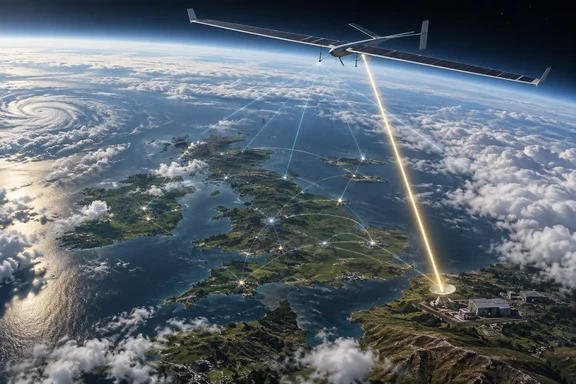
As first reported by The Register and detailed by ARIA on September 15, the effort is not a near-term national broadband rollout. It is a technology programme with a deliberately narrow proof point: continuous delivery of 300 watts to a payload at altitude for seven days, while maintaining line of sight with a fixed location on the ground. ARIA’s own earlier programme solicitation puts that energy total at 50.4 kWh and asks successful system teams to show a credible route to 3 kW for a week later.
That difference is important for anyone reading “flying broadband stations” as a promise of consumer service. ARIA has funded the engineering required to make such a service conceivable: energy generation and storage, aircraft endurance, weather prediction, autonomous operations, airspace integration, radio architecture and business models. It has not announced a coverage map, retail provider, spectrum assignment, handset compatibility list, customer launch date or target broadband speed.
The funded milestone is power aloft, not a network launch
HAPS are intended to occupy the layer between terrestrial towers and satellites, generally above conventional commercial aviation but still within the atmosphere. The proposed benefit is straightforward: a platform at roughly 15 to 20 kilometres can provide a shorter radio path than a satellite and potentially be repaired, recovered or redeployed rather than launched on a rocket.
But altitude does not remove the problems that make rural connectivity hard. Aircraft must survive and operate in thin, cold air, resist stratospheric winds, stay within an operating area, carry useful radio equipment, connect back to the core network and hand traffic over cleanly when a vehicle lands or is replaced. Every one of those requirements has to work together before a coverage footprint becomes meaningful.
ARIA’s own success criteria are more revealing than its broad connectivity language. The programme seeks a payload of 20 kg, a gross hourly operating cost below £500 by the programme’s end, and a plausible later path below £100 per hour. Those are serious constraints, particularly because the gross cost is meant to include aircraft amortisation, maintenance, monitoring and external power or fuel.
The agency also expects a recovery-and-redeployment rate greater than 95 percent. That is a practical admission that a persistent service may be delivered by a fleet rather than an indestructible aircraft. Menapia’s CAROUSEL proposal, for example, would rotate high-altitude multirotor aircraft through service so replacements arrive while others return for charging, maintenance or payload changes.
The critical point is that a £50,000 manufacturing-cost target cited by VFP Aerospace for its proposed relay drone does not establish the cost of a functioning telecoms service. A network still requires multiple airframes, ground sites, staff or automation, backhaul, spectrum, maintenance, safety assurance and regulatory approval. ARIA’s £500-per-hour threshold is the more relevant early test, and even that is a programme goal rather than an independently demonstrated operating figure.
Power beaming is one route, and it has not yet been flown
The headline-grabbing part of the programme is power beaming, but ARIA is backing several distinct approaches rather than declaring a winner. Its funded-project list includes Scalable Laser’s LIVINGSTON project, which pairs laser diodes with photovoltaic receivers, and Space Solar Engineering’s HAWK project for radio-frequency power beaming. MuWave is also funded for BEACon, or Beamed Energy for Airborne Continuity.
Space Solar says HAWK will send power at 5.8 GHz from a ground transmitter to a lightweight rectenna — a receiving antenna that converts radio-frequency energy to DC power — integrated into a HAPS wing. The company has a £1.3 million ARIA contract, while BAE Systems says its Prismatic subsidiary’s PHASA-35 solar aircraft will be the flight-demonstration platform under a separate £15.7 million contract.
The power-beaming proposition addresses a genuine weakness of solar HAPS over the UK: short winter days, long nights and variable weather make a purely solar-and-battery design difficult to operate continuously. Separating generation from the aircraft could allow the platform to carry less stored energy, though the system then becomes dependent on accurately pointing a ground transmitter and maintaining an unobstructed, safe energy-transfer path to a moving receiver far above it.
The record supports only a development claim at this stage. Space Solar says it plans to advance its rectenna from Technology Readiness Level 3 toward TRL 7 during a 36-month programme ending in an integrated flight demonstration. TRL 3 is proof-of-concept territory; it is not an operational airborne power network. The company’s cited prototype testing occurred in an anechoic chamber, a controlled radio-testing environment, rather than in a stratospheric flight.
Laser power transfer presents a separate set of performance and safety challenges, while hydrogen fuel cells, high-density storage and improved solar materials may prove more practical for particular airframes. Hypanode is developing the FlightDrive-HAPS fuel-cell system, and the University of Sheffield is working on perovskite photovoltaic material integrated with carbon fibre. ARIA has correctly treated the energy problem as unresolved rather than betting all £70 million on a single beam-from-the-ground design.
Weather and airspace are part of the engineering problem
The HAPS concept is often compared with satellites because both can cover large areas, but its operational reality looks much more like aviation. It must contend with weather and controlled airspace every day, and it must do so around the United Kingdom’s seasons rather than in an idealized test environment.
The University of Bath’s STRAT-NAV project is designed to predict atmospheric gravity waves — rippling air movements created when weather systems or terrain push air upward and gravity pulls it back — and use them to improve endurance. Bath says its researchers plan high-resolution, AI-enhanced atmospheric modelling with forecasts up to 72 hours ahead, followed by observational work in late 2026 and 2027 before HAPS flight trials later in the programme.
Imperial College London is also funded to improve local weather forecasting and system design. Its researchers identify the wind environment at stratospheric altitudes as a major unknown for slow-flying HAPS. That is a more concrete obstacle than broad claims about replacing satellites: a platform may have enough energy to fly but still fail the programme if it cannot hold station over a useful service area.
The Civil Aviation Authority has already identified HAPS as an expected source of demand in higher airspace. Its airspace-modernisation work says the United Kingdom needs foundational requirements for integration and operations as new users seek to fly above the usual altitude range of conventional aircraft. In other words, the regulatory track is not an afterthought; ARIA’s deployment work must solve a live air-traffic-management problem.
ARIA’s programme solicitation anticipates this. It explicitly includes regulatory pathways, constellation design, backhaul hardware, deployment concepts and operating economics in its communications-architecture work. The final systems must demonstrate stationkeeping without leaving segregated test airspace and cope with UK weather conditions regardless of season.
Broadband claims will need a spectrum and capacity answer
A persistent aircraft with 300 W available to a payload is not automatically a high-capacity cellular base station. The aircraft still requires appropriately licensed spectrum, antennas, radio units, backhaul and a network design that determines how many users it can serve and at what speeds. The energy budget must cover more than a transmitter: it also supports computing, thermal control, steering, networking and the platform’s operational needs, depending on system design.
The University of York’s funded concept is among the few proposals that has described the end-user direction explicitly. It envisages solar aircraft around 70,000 feet carrying radio units able to cover areas up to 120 km wide, intended to integrate with existing ground networks and potentially low-Earth-orbit satellites. York says its programme designs target payload growth from the roughly 5 kg historically associated with lightweight HAPS to 20 kg.
Those are design ambitions, not deployed service specifications. Neither ARIA nor its funded teams have announced which mobile bands would be used for a nationwide service, how interference with terrestrial networks would be managed, what capacity a platform could provide at a given coverage radius, or which operator would sell access. Ofcom remains responsible for spectrum management, and radio coordination will be a separate hurdle from demonstrating power aloft.
This makes ARIA’s commercial requirement unusually useful. The programme will judge success partly on whether teams win launch customers and raise investment for wider rollout. That shifts the test from an impressive one-week flight to whether somebody will pay for a repeatable, regulated and capacity-constrained network service.
The programme runs toward a 2030 decision point
ARIA has launched a diversified portfolio rather than a finished communications network. It is testing fixed-wing solar aircraft, fuel-cell systems, fleet rotation, atmospheric-energy forecasting, laser receivers, RF beaming and communications architectures in parallel, with down-selections intended to concentrate funding on approaches that deliver results.
The agency’s original solicitation described power beaming as the largest single blocker whose solution would make the rest of the problem considerably easier. That is why the ground-to-air experiments deserve attention — but they are still experiments. A successful RF flight demonstration on PHASA-35 would validate one engineering path, not prove that rural Britain has acquired a new nationwide mobile network.
By roughly March 2030, ARIA’s work should have delivered the evidence that is missing today: whether any of these aircraft can keep a 20 kg communications payload powered at the required level for a week, remain usable in British conditions, operate within an airspace framework and do so at a cost that can compete with towers, fibre extensions and satellite backhaul. Until then, the practical result is £70 million spent buying 18 attempts at a difficult infrastructure breakthrough — not broadband service in the sky.
References
- UK funds flying broadband stations with power beamed from below The Register · 2026-09-16T08:30:00+00:00