

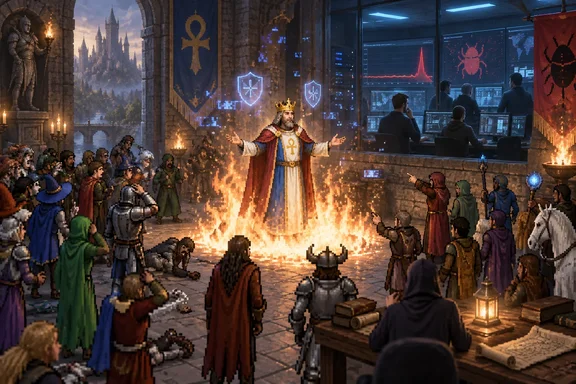
PC Gamer highlighted the clip after it circulated through Webknower’s edited YouTube shorts, while GamesRadar also traced it to Newell’s January 2013 appearance at the University of Texas at Austin’s LBJ School of Public Affairs. Newell argued that developers too often classify a “genuinely entertaining action” as hacking, then cited Origin Systems’ handling of Lord British’s death as a missed opportunity for emergent storytelling.
His core point remains sound. The historical details are less clean than the viral retelling suggests.
What actually happened in the Ultima Online beta
The event took place during Ultima Online’s beta test in August 1997, shortly before the MMORPG’s commercial launch. Richard Garriott, the series creator who played the in-game monarch Lord British, appeared before a large player gathering with producer Starr Long’s Lord Blackthorn.
The gathering itself stressed the still-unfinished service. Contemporary accounts and later recollections by Garriott agree on the central technical failure: after a server crash or reset, Lord British’s invulnerability state was not restored. A player known as Rainz used a stolen Fire Field spell scroll, created a patch of fire near the speech, and Garriott’s avatar walked into it. The supposedly unkillable king died in front of the crowd.
That was not an exploit in the modern sense of bypassing a security boundary, altering a client, or tampering with the server. Rainz used an available in-game ability against a character whose intended protections had failed. The distinction matters for developers: the bug was the missing invulnerability flag; the player interaction that exposed it was normal gameplay.
The incident also did not simply vanish through a rollback. Newell’s shorthand gets at the feeling of the response—an extraordinary player-created moment was treated as an operational problem—but it compresses several events. Rainz was banned from the beta, and accounts from players describe a forceful response from staff at the scene. The assassination became famous precisely because the community saw it, remembered it, and argued about what Origin did next.
Origin’s official explanation conflicts with the popular story
The popular version says Rainz was banned for killing Lord British. Origin’s own 1997 statement said otherwise. The company acknowledged that the assassination was legendary and said the ban was tied to previous conduct and complaints associated with the account, not the killing itself.
That is an important discrepancy. It does not make Origin’s response look uncomplicated: a player who had just become central to the beta’s most memorable unscripted event was still removed, and the timing naturally convinced many participants that the assassination triggered the decision. But it means it is inaccurate to state as settled fact that Rainz was punished for killing Garriott’s character.
Later reporting has preserved both sides of the dispute. Wired reported at the time that Garriott maintained the ban was not for the assassination. In a 2018 Ultima Online post-mortem, former developers reportedly acknowledged, in hindsight, that banning Rainz was a mistake. Those accounts support Newell’s broader criticism while also showing why this is not a simple tale of a player being punished for discovering a bug.
For today’s live-service teams, the lesson is not “never discipline someone who finds a defect.” Repeatedly abusing an issue that damages other players, crashes services, corrupts progression, exposes personal data, or creates an economic exploit can require intervention. A game operator also has to distinguish between the player who reports a weakness, the player who probes it, and the player who industrializes it.
The real failure is treating every surprising result as hostile behavior before determining what the player actually did.
The design question Newell raised still applies
Newell’s argument was about product judgment, not merely moderation policy. If players use a system in an unforeseen but entertaining way, the development team has to ask whether it has found a defect to patch, a feature to formalize, or a story worth preserving.
That question has only become more relevant as online games have grown more tightly managed. Live-service titles now rely on telemetry, automated anti-cheat, server-side validation, content moderation, account enforcement, and battle-pass economies. Those controls are often necessary. They also make it easier for a studio to see unusual activity as a rules violation first and a design signal second.
A player defeating a supposedly invincible NPC because a server configuration was wrong is not a sustainable mechanic. Leaving the vulnerability unpatched would invite copycats, disrupt future events, and weaken the operator’s ability to run the world. Yet restoring technical integrity and erasing the social meaning of the incident are separate decisions.
A better response would have been technically routine but narratively ambitious:
- The service could restore or protect the affected character while preserving a public account of the event.
- The team could make the death an official legend, reward or recognize the participating players within clear limits, and ensure the same configuration error could not recur.
- The operator could explain why the account action, if any, was taken, rather than allowing the community to conclude that creativity itself had been punished.
That approach does not romanticize every bug. It acknowledges that in a shared world, the public response becomes part of the game’s content. A rollback may repair state; it cannot undo a collective experience that hundreds or thousands of players watched unfold.
“Emergent” does not mean automatically good
There is a risk in repeating Newell’s quote as a slogan. Emergent gameplay is valuable when it expands player expression, produces stories, or reveals interesting interactions. It is not automatically valuable when it depends on harassment, inequitable access to an exploit, cheating software, or a failure that leaves other players unable to participate.
The necessary discipline is classification. Developers should establish, before an incident occurs, who decides whether unexpected behavior is a security issue, a gameplay balance issue, an operations incident, or a community event. Those decisions should draw on engineering, design, player-support, and community teams rather than defaulting to whichever group can disable accounts fastest.
This is especially significant for multiplayer PC games, where a client modification can be both a creative modding tool and an unfair advantage depending on the environment. Valve itself has lived on both sides of that boundary: its PC business has benefited enormously from player-made content, mods, and communities, while competitive games require meaningful anti-cheat enforcement. The useful distinction is not whether an action was authorized in advance. It is whether it undermined the game’s integrity, harmed others, or revealed a direction players genuinely want to take the product.
Newell’s formulation is strongest when read as a prompt for investigation: before calling it hacking, find out whether players have exposed an exploit, invented a game, or done both.
A technical error became the durable story
The enduring irony is that Ultima Online’s intended royal speech is largely forgotten, while Lord British’s accidental death remains one of PC gaming’s foundational MMO anecdotes nearly three decades later. The moment survived because it showed what persistent online worlds promise: players can turn a developer-controlled setting into something the developers did not script.
PC Gamer is right that the old clip still lands. Newell identified a tendency that remains common in game development and enterprise software alike: organizations often prioritize restoring the expected state over understanding what an unexpected use case reveals about their system.
But the Lord British story supports a more practical conclusion than “embrace chaos.” Fix the broken flag. Protect the service. Enforce rules when actual abuse warrants it. Then preserve the human event when players have created something worth remembering.
Origin could not keep an invulnerability setting from failing in August 1997. What it could have controlled was whether that failure became only an embarrassing outage—or a piece of official history.
References
- Over 10 years later, Gabe Newell's advice to devs still holds up PC Gamer · 2026-09-20T04:31:29+00:00