

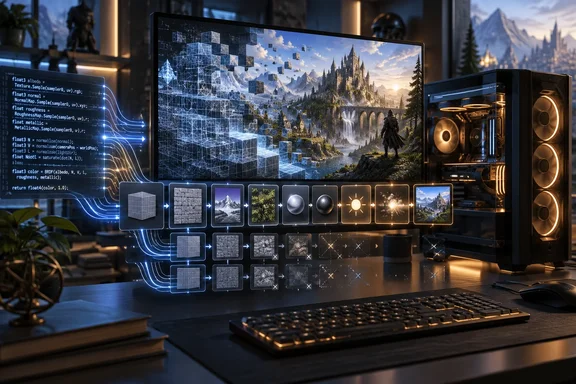
Here is what an engine actually does, what the build-versus-license decision costs, and what Unreal Engine 5.8 changes for the shader stutter that PC players know too well.
An engine is much more than a renderer
The renderer is the part everyone notices. It takes geometry, textures, materials, lights, shadows, particles and post-processing and turns them into a frame. Wccftech's point is that rendering is only one part of a much larger platform. A modern engine also handles:
- Simulation: physics, collision detection, animation and AI
- Interaction: input, UI, scripting, save systems and networking
- Data: asset management and streaming, which in an open world can mean loading terrain, textures, geometry, NPCs, animation, audio and gameplay state at the same time as the player moves
- Production tooling: editors, profilers, asset importers, shader tools, debugging utilities, automated builds and pipelines that connect tools like Maya, Blender, Houdini and Substance to the game
The tooling is the unglamorous part, but it may be where the most money is saved or lost. A designer who can change an encounter and test it in seconds, without waiting for a rebuild, saves time on every change. Across hundreds of staff and several years of production, that adds up fast.
Engines are also seldom fully in-house. Wccftech lists common outside components: Wwise or FMOD for audio, Havok for physics, SpeedTree for vegetation, and NVIDIA DLSS, AMD FSR or Intel XeSS for upscaling and frame generation. These are examples, not a fixed stack. A better picture of an engine is a coordinator for many systems, some built internally and some licensed.
Havok is also where Microsoft comes in. Unity's pricing page says that from Unity 6.3 LTS, Havok Physics for Unity is no longer included with Pro, Enterprise or Industry plans. The Microsoft Havok team can keep offering the integration as a regular third-party extension publisher. Unity will continue technical support for Havok on Unity 2022 LTS and 6.0 LTS for the rest of those support windows.
The frame budget
The key number for PC players: at 60 FPS, the engine has about 16.67 ms to produce each frame, and at 120 FPS about 8.33 ms. Wccftech is careful to add that subsystems don't all run one after another inside that window. CPU and GPU work overlap heavily. Even so, one slow stage can hold up the frame.
That explains a problem you have probably seen: a high average frame rate that still feels bad. Averages hide spikes. If one stage misses the budget, even briefly, you feel it.
Section summary: An engine coordinates rendering, simulation, streaming and a large set of production tools, many of them licensed from outside vendors. For players, its most important constraint is the per-frame millisecond budget.
Why engines keep getting more expensive
Building an engine is costly. Keeping it competitive is often costlier. Wccftech uses hardware ray tracing as an example. It isn't a single switch. It requires managing acceleration structures (BVHs), new shader paths, denoising, material support, memory management, fallbacks for hardware that can't run it, profiling tools, and integration with the rest of the pipeline.
Open worlds add a different problem. Geometry, textures, collision, audio and gameplay objects have to move in and out of memory without a visible hitch. The article notes that poor streaming can cause traversal stutter or pop-in even when the GPU has headroom to spare. That is why lowering graphics settings sometimes does nothing for a stuttering game.
Then there is platform coverage. PC means several CPU generations and GPUs from three vendors. Consoles have fixed but very different hardware. Every target needs its own testing, debugging, certification and optimization. Behind all of that sits a permanent staff of engine programmers, tools programmers, technical artists and build engineers.
Wccftech makes the right economic point here: past spending on an engine is sunk cost. What matters is how much it will take to keep that engine competitive over the next five to ten years. Switching engines has its own costs, including retraining staff, rebuilding tools, migrating workflows, rewriting custom systems and losing accumulated knowledge. Neither option is cheaper in general. The answer depends on the studio.
Section summary: The real cost of an engine is keeping up with new rendering techniques, open-world streaming and multi-platform support. Staying and switching both carry large, ongoing costs.
Proprietary, commercial or open source: who controls the roadmap?
These labels overlap more than people assume. Remedy's Northlight and Capcom's RE Engine are proprietary and used in-house. Unreal and Unity are proprietary too, but licensed commercially. Godot is open source under the MIT license. Having access to Unreal's source code does not make Unreal open source. Its use is still governed by Epic's license.
Here is how the current terms compare, based on each vendor's official pages:
| Engine | Model | Key terms |
|---|---|---|
| Unreal Engine | Royalty (standard EULA) | 5% of worldwide gross revenue above the first $1 million per product; 3.5% through "Launch Everywhere with Epic" if the game ships on the Epic Games Store at the same time as or before other stores on the same platforms; custom deals available |
| Unity | Subscription tiers | Personal up to $200,000 in revenue and funding; Pro required above that; Enterprise at $25 million or more; 5% Pro/Enterprise price increase from January 12, 2026; Runtime Fee cancelled September 12, 2024, and never applied to any game |
| Godot | Open source (MIT) | No engine royalties; source can be modified and redistributed; console export requires authorized platform SDKs or third-party porting providers |
Epic's release page says its custom licenses can include lower royalties, no royalties, or a different basis for calculating them. The 3.5% rate is therefore a conditional incentive, not a general discount.
Wccftech also names the risk that Unity's 2023 Runtime Fee episode exposed. When your studio's multi-year work depends on someone else's platform, a pricing change can matter more to you than any feature. Unity cancelled the fee, and Unity's own FAQ says no game was ever charged it. The trust damage is harder to undo.
Section summary: The engine owner controls its direction. Owning your engine means you fund every feature. Licensing one means someone else can change the terms.
Why some studios still build their own
If Unreal can already handle open worlds, ray tracing and every major platform, why keep an in-house engine at all? Wccftech's answer is specialization. A general-purpose engine has to serve thousands of very different projects. An internal engine only has to serve one studio's games.
The article's examples:
- Remedy's Northlight: powers Quantum Break, Control, Alan Wake 2 and CONTROL Resonant. Remedy says Resonant is out now on PS5, Xbox Series X|S, PC via Steam and the Epic Games Store, and GeForce NOW, with Mac to follow later in 2026. Wccftech reports that Alan Wake 2 drove changes to Northlight's entity component architecture and added a voxel-based character controller for moving through dense environments.
- id Tech 8: introduced with DOOM: The Dark Ages, which id promoted with fully dynamic ray-traced lighting and shadows, larger environments, more destruction and a 60 FPS target on consoles.
- Others: Ubisoft's Snowdrop, Guerrilla's Decima, Capcom's RE Engine, Valve's Source 2 and Rockstar's RAGE.
The downside, as Wccftech puts it, is that "somebody has to build all of it."
Why Unreal Engine 5 keeps winning anyway
GDC's 2026 State of the Game Industry report, based on responses from more than 2,300 industry professionals, found:
- 42% of developers named Unreal as their primary engine, versus 30% for Unity
- Unreal adoption was 59% at AA studios and 47% at AAA studios
- 54% of developers at older indie studios still use Unity
- Godot reached 11% among newer indie developers
One caution: GDC widened and restructured its survey this year. Part of the apparent shift from Unity to Unreal may come from a different respondent pool, not from studios actually changing engines.
The reasons for Unreal's lead are easy to list. It has a mature renderer, Nanite virtualized geometry, Lumen global illumination, World Partition for large maps, MetaHuman, and a large pool of people who already know the editor. CD Projekt Red's move from its own REDengine is the clearest example. CDPR's press material says the 2025 Witcher 4 tech demo ran at 60 FPS on PlayStation 5. It showed FastGeo Streaming, Nanite Foliage, the Unreal Animation Framework and Mass AI crowds, with those tools released to all Unreal developers starting with UE 5.6. It was a tech demo, though, not a shipped game, and it doesn't guarantee how the final game will perform.
Epic's State of Unreal 2026 recap gave more examples of studios switching. Riot moved Teamfight Tactics from internal technology to UE5 across PC and mobile. Microsoft's The Coalition showed MegaLights in Gears of War: E-Day handling hundreds to thousands of shadow-casting lights at 60 FPS on Xbox Series X.
The stutter problem, and what UE 5.8 changes
Unreal's popularity also means its problems show up in more games. The familiar complaints are shader/PSO compilation stutter, traversal hitches, CPU bottlenecks, artifacts from temporal upscaling, and the heavy cost of Lumen and Nanite. Wccftech rightly says that not every bad Unreal port proves the engine is broken. Developers decide how shaders are prepared, what content loads when, and how much time goes into optimization.
Epic's own technical write-up shows why shader stutter is so hard to eliminate. Fortnite Battle Royale compiles about 30,000 PSOs for a match and uses about 10,000 of them, but that's a very small portion of the total combination space, which contains millions. Epic also admitted a gap: its precaching mechanism covers global compute shaders too, but as of UE 5.5 doesn't handle global graphics shaders. These types of PSOs can still cause rare one-time hitches when they are first used.
There is a practical takeaway for PC players. Drivers save compiled PSOs to disk, so they can be loaded directly when they are encountered again during subsequent game sessions. For Unreal Engine titles using PSO precaching, it means the loading screen will be noticeably shorter on the second run. Fortnite takes around 20-30 seconds longer to load into a Battle Royale match when the driver cache is empty. If the first launch of an Unreal game after a fresh install takes a long time, that is usually expected behavior, not a sign that something is broken.
UE 5.8, released June 23, 2026, goes after this directly. Inven Global's coverage of the launch says Epic optimized the shader compilation process by improving the shader compiler and enhancing 'de-duplication' performance to identify and remove redundant tasks. When applied to Fortnite, the shader count dropped by 68%, resulting in faster cooking, loading, and reduced memory usage. Additionally, the PSO (Pipeline State Object) precaching system was refined. Epic's release notes also add Lumen Lite, a lighter global illumination mode that Epic says runs at twice the speed of Lumen High Quality, targets 60 FPS on Switch 2, and is supported on PC.
Epic's documentation is equally clear that developers still have to do the work. Precaching is configurable, not automatic protection. One setting, for example, can make the engine only wait for high-priority PSOs during loading. All non-essential PSOs will still compile during gameplay. The PC versions of games built on 5.8 will still depend on how their developers configure and test these systems.
Section summary: UE 5.8 addresses shader stutter at the engine level with fewer shaders and better precaching. Shipped games will only improve if developers upgrade, configure precaching properly and test on real hardware.
AI moves into the editor, and UE6 is next
Epic calls UE 5.8 the last planned major UE5 release, though it hasn't ruled out a 5.9. UE 5.8 ships an experimental Model Context Protocol (MCP) plugin that lets any language model connect to a project's Blueprints, assets, levels, materials and meshes. Epic warns that experimental features aren't production-ready. Its UE6 plans include MCP integrations with Claude, Gemini and others, a gameplay programming model based on Verse, and merging UE5's AAA tooling with Unreal Editor for Fortnite. Early Access is targeted for the end of 2027.
Developers are skeptical. In GDC's survey, 36% of respondents use generative AI at work. The figure is 30% at studios but 58% in publishing, support and marketing roles. Meanwhile, 52% say generative AI is hurting the industry, up from 30% the year before. Wccftech's conclusion matches the evidence: in the near term, AI will mostly assist developers inside the editor. In-game AI characters still face problems with latency, predictability, cost and legal questions.
The bottom line
Wccftech's closing point is the right one: better technology doesn't automatically make better games. It's also worth watching whether an industry built mostly on one engine ends up with fewer different approaches to rendering and game design. For now, PC players have a simple question to ask about new releases: which engine version is it on, and did the studio use the shader and streaming tools that version provides?
References
- Game Engines Explained: How They Work, Why They Cost So Much, and Where They’re Going Next - Wccftech Wccftech · 2026-09-30T22:00:00+00:00
- Press Center press.cdprojektred.com
- Changes to Unity subscription plans and pricing unity.com