

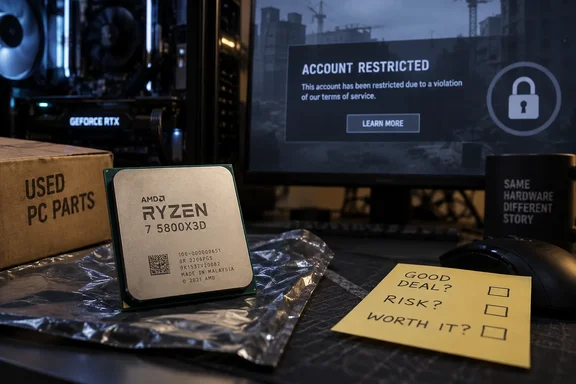
The individual incident remains a player’s account, not a publicly confirmed Riot investigation. But the underlying risk is more than internet folklore: Riot’s own support documentation confirms that hardware-ID bans can affect another person who signs in on restricted hardware. That distinction matters when judging both the alarming headline and what buyers should do next.
What the used-CPU report actually establishes
According to PCWorld’s Michael Crider, the player said Riot support would not remove the restriction. The player also reportedly said their motherboard and storage had become blacklisted after the processor was installed.
Those are significant allegations, but they do not establish precisely which identifier Vanguard detected, whether the CPU alone caused the restriction, or whether every other component would now be blocked independently. The evidence supports describing a reported secondhand-hardware ban, not declaring that Vanguard automatically contaminates every component connected to a banned processor.
PCWorld also says it contacted Riot, Valve and Epic Games about hardware identification, buyer safeguards and appeals, with no responses before publication. That unanswered request should not be mistaken for confirmation that their respective anti-cheat systems behave identically.
Hardware bans are different from account bans
Riot’s “Understanding Hardware ID (HWID) Bans” explains that these restrictions target a computer’s physical components rather than only a user account. Their purpose is to prevent access from the restricted device regardless of which account signs in.
Crucially, Riot says another account used on an HWID-banned computer will be blocked on that device and banned for a set period because the system interprets the login as an attempt to circumvent the original restriction. Riot therefore advises against signing in with any account if a computer is suspected of carrying a hardware ban.
That gives buyers a practical warning beyond the reported CPU incident: using your main account as a blacklist detector is not a safe troubleshooting strategy.
How could a processor be associated with a ban?
Riot provides relevant technical context in its “Vanguard On-Demand” explanation. The company describes a Trusted Platform Module’s Endorsement Key as a persistent hardware identity and explains that TPM functionality can be provided by a discrete module or firmware-based implementation. It explicitly discusses the possibility of banning that identity.
This makes hardware-linked enforcement technically plausible. It does not prove that Vanguard read the used Ryzen processor’s ordinary serial number, or that a TPM identity caused this particular incident.
Likewise, PCWorld’s list of potentially identifiable components is not a confirmed inventory of Vanguard’s blacklist inputs. Without a case-specific explanation, confidently naming the CPU, graphics card, SSD and Windows license as separately banned identifiers would outrun the evidence.
Security requirements are a separate issue
Riot’s published VALORANT specifications explicitly require TPM 2.0 and UEFI Secure Boot on Windows 11. That is a version-scoped requirement, not grounds for saying every Vanguard configuration has identical requirements.
More importantly, satisfying a security requirement and clearing a hardware ban are different tasks. A PC can meet the game’s technical prerequisites and still have an access restriction.
What to do if a used upgrade triggers a restriction
The useful first step is to identify the exact error rather than launching into the traditional Windows troubleshooting marathon.
- Record the error code and message. Riot says VAN 152 indicates an HWID restriction. Its documentation explicitly rules out reinstalling Vanguard, reinstalling the game, changing the connection or restarting the PC as ways to remove it.
- Do not test additional accounts on suspected banned hardware. Riot’s published warning covers other people’s accounts too, not just the account associated with the original enforcement action.
- Request a review through Riot support. Riot allows reevaluation requests for hardware bans associated with suspected cheating or negative behavior, but does not guarantee removal. It asks users to submit separate tickets for multiple affected accounts; clearing a hardware restriction does not automatically restore previously banned accounts.
- Preserve the purchase evidence. As practical recordkeeping—not a promised Riot remedy—save the listing, seller messages, payment record, installation timeline and support correspondence. Ask the seller about return options rather than assuming another component purchase will solve the problem.
A warning, not a verdict on used hardware
The central uncertainty is ownership: a hardware identity may persist even when the person using it changes. Anti-cheat enforcement is designed to resist repeat offenders, but that creates a difficult distinction between ban evasion and a legitimate secondhand purchase.
The reported Ryzen case does not establish how often this happens, prove that used CPUs generally carry restrictions, or confirm a permanent account ban for the buyer. It does justify taking suspected hardware bans seriously.
A processor can pass a benchmark without answering every question about its history. For VALORANT players, Riot’s own guidance makes the most important precaution clear: do not risk additional accounts trying to diagnose a suspected HWID ban.
References
- Your used CPU might come with someone else’s Valorant ban PCWorld · 2026-10-02T16:58:52+00:00
- Used Ryzen 7 5800X3D came with an unexpected extra: a Riot hardware ban - VideoCardz.com VideoCardz.com · 2026-10-02T17:58:23+00:00
- Error VAN 152 - Riot Games Support support.riotgames.com