

Here's what the laptop is, what it costs, and a closer look at the benchmark numbers that came with the launch coverage.
What VAIO actually launched
The Kachi-iro Special Edition belongs to VAIO's VCTNN1 VAIO T family. VAIO announced the T range on September 10, including the consumer VAIO T and the business VAIO T Work. According to Notebookcheck's announcement report, orders opened September 18 and the standard models were scheduled for release on September 22. That report also said the launch covered Japan only, with no international plans announced.
Japanese coverage matches that timeline. Kunkoku lists the Kachi-iro edition as a customizable consumer model with orders opening at 10:00 on September 18, 2026, and fastest delivery on September 30. VAIO's own store page lists it as the September 2026 model with product code VCTNN18.
Key facts:
- Market: Japan, sold through VAIO's official online store
- Model family: VAIO T (VCTNN1); store product VCTNN18
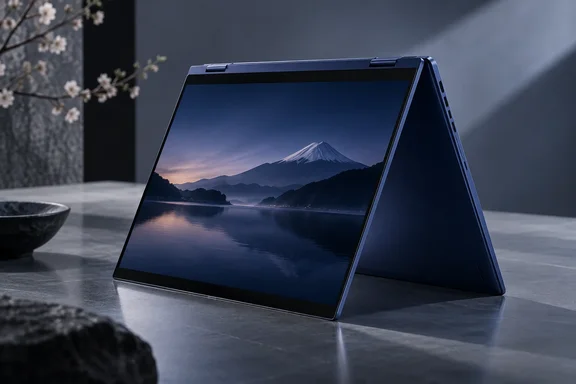
- Form factor: 13.3-inch convertible with VAIO's "multi-flip" hinge
- OS: Windows 11 Home or Pro, sold as a Copilot+ PC
Two chips, one clear upsell
VAIO's official spec sheet for the special edition offers two processors:
| Core Ultra X7 358H | Core Ultra 7 356H | |
|---|---|---|
| Cores/threads | 16/16 (4P + 8E + 4LP-E) | 16/16 (4P + 8E + 4LP-E) |
| Max P-core clock | 4.8GHz | 4.7GHz |
| TDP (VAIO listing) | 25W | 25W |
| L3 cache | 18MB | 18MB |
| NPU peak | Up to 50 TOPS | Up to 50 TOPS |
| Integrated graphics | Intel Arc B390 | Intel Graphics |
VAIO says the 358H is the top processor offered anywhere in the VCTNN1 range, and only the special edition gets it. Both chips use VAIO's TruePerformance tuning. VAIO's footnotes add that processor performance varies with use and that maximum clocks depend on Intel Turbo Boost Max Technology 3.0, so treat the 4.8GHz figure as a peak, not a sustained speed. The official page also warns that processor performance changes depending on usage conditions.
One configuration rule is easy to miss. Kunkoku reports that when you choose the X7 358H, the 16GB memory option can't be selected. In practice, the Arc B390 model starts at 32GB.
On paper, the two chips share the same core layout, cache and power rating. The real difference is graphics. Notebookcheck's processor database describes the Arc B390 as a 12-core Xe3 integrated GPU with ray-tracing support. It's still integrated graphics sharing system memory, not a discrete GPU, so don't expect a gaming laptop.
Section summary: Pay for the X7 358H if you want the stronger integrated graphics. On CPU-only work, the two chips are much closer.
About those benchmark numbers
Notebookcheck's release report compares the two chips: 4,164 vs. 3,769 in Cinebench 2026 multi-core, and 18,806 vs. 18,586 in Cinebench R23 multi-core, both favoring the X7. Two caveats apply.
- These results don't come from the VAIO T. In Notebookcheck's processor database, 4,164 is the X7 358H's average Cinebench 2026 multi-core score across tested laptops such as Dell's XPS 14 and XPS 16, and 3,769 is the 356H's average. They describe the chips in general, not this 25W convertible chassis.
- The R23 comparison doesn't match the database. The same database lists the X7 358H's Cinebench R23 multi-core average as 18,086, below the 356H's 18,586. The 18,806 in the news report may be a transposition, but we can't confirm that. The database also shows the 356H narrowly ahead in Cinebench 2024 multi-core (1,059 vs. 1,015) and R20 multi-core (7,286 vs. 7,167).
So on multi-core CPU work, the two chips are roughly tied depending on the test. Cinebench 2026 is the main exception, where the X7 leads by about 10%. Notebookcheck hasn't published VAIO T–specific results, and the laptop's thin chassis could change the picture either way.
VAIO has published its own comparisons against the earlier VAIO SX14-R with a Core Ultra 7 155H. Its footnote says it measured a prototype in laptop mode, and that you need to set "CPU and Fan" to performance priority in the VAIO settings app to get maximum performance. Expect the out-of-box default to be tuned more conservatively.
Memory and storage: decide at checkout
VAIO offers 16GB, 32GB or 64GB of dual-channel LPDDR5X, all soldered to the board. The spec sheet says outright that capacity can't be expanded later.
Storage options, per VAIO:
- 512GB, 1TB or 2TB fifth-generation "high-speed" NVMe SSD on PCIe x4 (128 GT/s, i.e., PCIe 5.0), with OPAL 2.0 self-encryption
- 512GB "standard" NVMe SSD on PCIe x4 (64 GT/s, i.e., PCIe 4.0)
VAIO says no encryption software comes with the laptop. To use the OPAL self-encrypting drive, you need either the HDD password in BIOS Setup or OPAL 2.0–compatible encryption software you supply yourself. IT admins should check whether their existing disk-encryption policy supports hardware OPAL before assuming the drive's encryption does anything out of the box. The 2TB drive is also an upgrade, not the default.
Practical advice (general industry guidance): Soldered LPDDR5X means you can't add memory in two years. If you plan to run local AI models, large VMs or heavy creative apps, buy the capacity you'll need at the end of the laptop's life, not what you need today.
Display, hinge and design
The screen is a glossy 13.3-inch WQXGA touch panel, 2,560 × 1,600 pixels at 16:10, with finger touch. "2.5K" is marketing shorthand for that resolution. VAIO doesn't list HDR support.
The multi-flip hinge gives three modes: laptop, tablet and "view" mode for watching or sharing the screen. Notebookcheck notes it's a different design from a typical 360-degree 2-in-1, and that VAIO says the hinge passed MIL-STD-810H testing. VAIO lists the screen's opening angle as about 145 degrees.
The special-edition touches:
- The lid and flat aluminum palm rest are anodized in Kachi-iro. VAIO says it tested dye and dyeing-time combinations to get the shade on high-brightness aluminum.
- An optional "hidden legend" keyboard (Japanese or English layout) puts black lettering on black keys. The legends show faintly when the backlight is on. Standard-legend keyboards are also available.
Size and weight: about 312.0 × 224.6 × 14.6–19.6 mm, and 1.290kg to 1.368kg depending on battery and SSD. That's heavier than the roughly 1.253kg starting weight VAIO quotes for the standard VAIO T.
Ports, wireless and security
For a 13.3-inch machine, the port selection is generous. VAIO lists:
- 2 × USB-C with Thunderbolt 4, USB4, USB Power Delivery and DisplayPort 2.1
- 2 × USB-A 5Gbps (one with charging)
- HDMI (up to 4K 60Hz)
- Gigabit Ethernet
- Headset jack
Over USB-C DisplayPort, VAIO rates external output up to 5,120 × 2,880 at 60Hz, and up to four displays at once including the built-in panel. Wireless is Wi-Fi 7 with WPA3/WPA2 Personal and Enterprise, plus Bluetooth 5.4. There's no SD slot, cellular modem or GPS.
Security includes TPM 2.0, Windows Hello face login via a 9.2MP camera, and a lock slot. There's no fingerprint reader and no camera privacy shutter. AI user sensing works only in laptop mode; VAIO says it's disabled in the other two modes. The spec sheet also mentions Absolute Persistence support, but the agent isn't preinstalled. Enterprise buyers should note that VAIO markets features like Secure-core PC support on the separate T Work model.
Battery claims
VAIO's JEITA 3.0 estimates:
| Battery | Video playback | Idle |
|---|---|---|
| Standard | ~11.5–12.5 hours | ~19.5–21 hours |
| Large-capacity | ~16.5–18 hours | ~28–29 hours |
These are the manufacturer's figures, not independent tests, and VAIO says results depend on configuration, settings and OS updates. It quotes about three hours to charge with the included 65W adapter. Notebookcheck also reports that VAIO's WellnessCare feature, which uses the camera, is scheduled to become available from September 30.
Pricing: what "from ¥390,500" means
Notebookcheck quotes ¥390,500 for the base configuration (Core Ultra 7 356H, 16GB, 512GB SSD) and ¥797,500 for the top configuration (X7 358H, 64GB, 2TB SSD). Both are Japanese retail prices including tax. Other options, such as the large battery and Windows 11 Pro, cost extra.
The ¥390,500 figure already includes a launch discount. Elmitage Akihabara reported the special edition's base price as ¥423,500 including tax. VAIO's store advertises a ¥33,000 launch discount through 9:59 on December 1, 2026, and ¥423,500 minus ¥33,000 is exactly ¥390,500. Expect the base price to go back up after the promotion ends.
For comparison, the standard VAIO T customizable model starts at ¥374,000 including tax before the same kind of launch discount, so the special edition carries a real premium even at its lowest spec.
The WindowsForum take
The VAIO T Kachi-iro is a niche machine, but it shows three things about the Windows laptop market:
- Panther Lake is reaching premium Japanese designs. The Core Ultra X7 358H's main selling point is integrated graphics that are good enough to matter.
- "Copilot+ PC" doesn't settle the CPU question. Both chips here have the same 50 TOPS NPU. You're choosing a GPU, not a better AI PC.
- Soldered memory keeps getting more common. High-capacity LPDDR5X is increasingly the norm in thin laptops, so the order you place is effectively permanent.
Is it worth roughly ¥800,000 fully loaded? For most buyers, no. For VAIO fans in Japan who want the hinge, the ports and the best graphics VAIO offers in this chassis, it's the only way to get them. Everyone else should wait for VAIO T–specific reviews before assuming the X7 is worth the extra money for CPU-heavy work.
References
- Vaio releases special-edition laptop with 2.5K display, up to 64 GB RAM and 2 TB SSD - Notebookcheck Notebookcheck · 2026-09-27T19:51:00+00:00
- Intel Panther Lake Ultra X7 358H Notebook Processor - Notebookcheck.it notebookcheck.it
- Vaio unveils laptops with 2.5K display, up to 64 GB RAM and 18-hour battery life - Notebookcheck News notebookcheck.net