

What Valve actually said
The key quote comes from Valve engineer Pierre-Loup Griffais. Ars Technica reported on September 16, 2026 that he had given it to Rock Paper Shotgun. He said: "I think one of the things that we want to do, and that the Frame is kind of paving the way for, is just more general SteamOS for Arm, right?" Ars Technica also reported that he described a set of devices that could run SteamOS well but that belong to an "adjacent ecosystem." In his view, that ecosystem is only slightly different from the x86 PC world.
Ars quoted Griffais on the goal. Buyers should be able to consider an Arm device on its specs and value without worrying that they will "leave a portion of my catalog behind." Technology.org's summary of the same reporting says that with FEX finally ready for the Frame, Valve says it is actively exploring versions of SteamOS for other Arm devices.
NeoTeo's article describes what that could mean in practice: ultraportable laptops, 2-in-1 PCs, mini PCs and other desktop-like ARM systems. Those form factors come from NeoTeo's reading of the plan. Valve has not named any hardware.
The same article adds: "That is a development direction, not a general-purpose ARM installer. Valve's public SteamOS download page offers a Deck image, while the ARM path remains tied to ongoing work around hardware support and compatibility." Valve's own download page confirms this. It labels the image available to the public as the Steam Deck image.
Section summary: Valve has stated an intention, not a shipping product. The only official Arm device running SteamOS is the Steam Frame.
Why the Steam Frame is the test bed
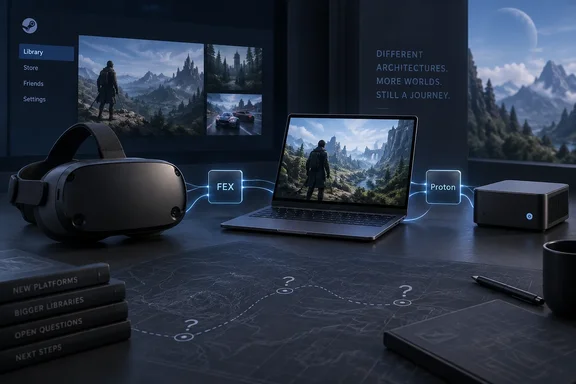
The Steam Frame is Valve's standalone VR headset. Valve's Steamworks developer documentation says it runs SteamOS natively on a Snapdragon 8 Gen 3 (Arm64) chip and ships with several compatibility layers. That makes it the first Valve product that has to run a large x86 PC game library on non-x86 hardware. Every problem Valve solves there applies to a future Arm laptop or mini PC.
This project has been building for a while. Last year, Notebookcheck reported on Griffais's interview with The Verge. He said Valve is funding several open-source projects that make it possible to play Windows games on ARM-based smartphones, and that by combining Fex and Proton, the gap between Windows and Linux and the divide between x86 and ARM can be bridged. In the same report, Valve is not actively developing a native Steam or SteamOS version for Android smartphones. So the new comments point toward PC-shaped Arm devices, not phones.
The compatibility stack: three layers, three jobs
People often treat these layers as one thing. They each handle a different problem:
| Layer | What it solves | What it does not solve |
|---|---|---|
| FEX | Translates x86 (32- and 64-bit) CPU instructions into Arm64 | Windows-to-Linux API differences |
| Proton | Runs Windows games on Linux using modified Wine plus graphics translation such as DXVK (Direct3D to Vulkan) | CPU architecture differences |
| Lepton | Runs Android APKs on SteamOS inside a container | Windows games (it's a separate path) |
A typical Windows game on Arm-based SteamOS needs two of these at once. Proton handles the Windows/Linux boundary and FEX handles the x86/Arm boundary. Valve's Steamworks documentation says this is the route it recommends to most developers. It would rather studios put their effort into one strong Windows x86 build running through Proton and FEX than maintain a separate native Arm version that may fall behind.
FEX itself has a long history. Ars Technica describes it as Valve's port of the open-source fex-emu project. Valve's documentation says it passes graphics API calls to native OpenGL or Vulkan libraries to cut overhead, and uses code caching to reduce stutter. Griffais said last year that the company had funded FEX lead developer Ryan Houdek, even though the technology was little more than a prototype. According to Ars, Valve expected back then that it would take close to a decade of work before FEX was reliable enough for people's game libraries.
Lepton matters most on the headset. Ars Technica cites a VR.org analysis showing that 52 of the first 120 "Great on Frame" games run as Android executables through Lepton. Valve has not ruled out using Lepton for ordinary Android applications and non-VR games, although games remain the priority.
Section summary: FEX handles the CPU and Proton handles the operating system. Together they are how Valve hopes to avoid asking every developer for a separate Arm build.
The community demo: interesting, not proof
NeoTeo also points to a community project: a community setup already runs Linux-native Steam on selected ARM handhelds with RockNix, Proton 11 Beta and FEX. NeoTeo says the demo showed games including Silksong, Half-Life 2 and Cuphead running on Snapdragon-powered handhelds.
Keep that in context. The setup was built by the community, it is not a Valve release, and the versions and results have not been checked independently. A game running on one handheld with one set of drivers tells you about that exact combination and nothing wider. It is a proof of concept, not a compatibility list.
The hard parts translation can't fix
The following is general industry knowledge, not something Valve has said. Translating CPU instructions is only the first hurdle. Four other problems remain even when FEX works perfectly:
- Hardware variation. x86 PCs mostly follow firmware and discovery standards. Arm devices often depend on board-specific descriptions of their hardware (device trees) and on vendor-specific kernel support. A single image that installs on everything is much harder to build.
- Graphics drivers. Mobile GPU drivers were mostly written for phone workloads, not DirectX 11 and 12 desktop games translated to Vulkan. Proton's DXVK path depends on strong Vulkan drivers.
- Performance. Translation costs CPU time. Integrated Arm GPUs also vary a lot, so the same software can run very differently on different devices.
- Anti-cheat and game quirks. Anti-cheat systems and games with unusual behaviour can fail no matter how good the translation layer is.
A fair counterpoint: Valve has handled problems like these before. When Proton launched, many people doubted Windows games would run well on Linux, and the Steam Deck proved a lot of them wrong. Valve's history suggests it will fix these issues gradually and on a timeline it doesn't announce.
What this means for Windows on Arm
This is the part most relevant to WindowsForum readers. Arm laptops today mostly ship with Windows on Arm, which has its own built-in x86 emulation. That is general knowledge, not something Valve's comments touch on. A general SteamOS for Arm would give the same hardware a second way to play games. It would run Windows games through Proton and FEX on Linux, instead of through Microsoft's emulation on Windows.
Tom's Guide has noted the momentum on the hardware side, reporting the Snapdragon X2 Elite for laptops playing games like Cyberpunk 2077 and Black Myth: Wukong running as high as 90 frames per second (FPS) after testing. It also suggested a future Steam Deck could move to Arm. That is speculation, and Valve hasn't confirmed anything like it.
Would that competition be good for Windows users? Probably. Gaming compatibility has been the most common complaint about Arm PCs. If Valve gives Arm hardware a credible SteamOS option, Microsoft, Qualcomm and game studios all have more reason to close the gap on Windows too.
Practical guidance for Arm PC buyers today
- Don't buy an Arm laptop expecting to install official SteamOS on it. No such image exists. The only public download is the Steam Deck image.
- Judge the whole device, not just the CPU. GPU drivers, Linux support, anti-cheat compatibility and how individual games behave matter as much as instruction translation.
- Treat community builds as experiments. Projects like the RockNix setup are useful to watch, but they only show that specific hardware and software combinations work.
- Watch the Steam Frame. How well Proton and FEX perform on the headset is the best early indicator of what a wider Arm release could deliver.
The bottom line
Valve has told everyone where it wants to go without saying when it will get there. With FEX ready, Proton rebuilt around the Frame and Lepton covering Android games, SteamOS depends less and less on the platform a game was written for. Whether that reaches Arm laptops, 2-in-1s and mini PCs depends on problems that translation doesn't solve: drivers, device support and anti-cheat. Until Valve ships something, SteamOS on general Arm hardware is a stated goal, not a product.
Update: Modders reportedly bring SteamOS Game Mode to Android handhelds (October 2, 2026)
Community experiments have reportedly moved beyond the Linux-native Steam setup described above to running Arm-based SteamOS on selected Android handhelds, according to Pocket Tactics’ September 30 report. The outlet says modder MaSieS4Fun has made Game Mode work on the Ayn Odin 2 using software developed for the Steam Frame.
Pocket Tactics also reports that hashtagbasit is testing SteamOS on the Pocket S2, while transentient is developing a version called Holodor for the Ayn Odin 3. These are reported community efforts, not a Valve announcement of supported hardware, and the report does not establish broad game compatibility or independently verified performance.
The practical distinction is that these projects reportedly bring the SteamOS environment itself to additional Arm devices, rather than merely running Steam with Proton and FEX under another Linux distribution. However, Pocket Tactics cautions that installation requires substantial software tinkering, compatibility varies between handhelds, and wider testing remains underway.
For Windows users considering an Arm gaming device, this expands the experiments worth watching—not the list of devices buyers can confidently purchase for official SteamOS support. It does not establish an installer or support path for Snapdragon Windows laptops.
References
- Valve explores broader SteamOS support for ARM - NeoTeo NeoTeo · 2026-09-25T22:37:16+00:00
- SteamOS is running on some Android handhelds, but don't get too excited yet - pockettactics.com pockettactics.com · 2026-09-30T14:29:50+00:00
- Valve's FEX and Lepton Expand SteamOS on Arm - Technology Org technology.org