

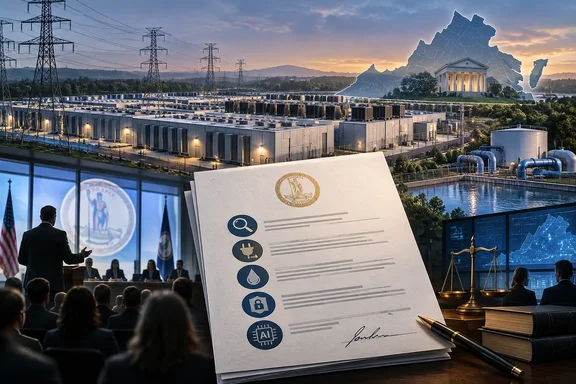
As first reported by The Verge and confirmed in the text of Executive Order 22, issued September 18, Virginia is separating its response into two tracks: agency actions the administration can begin now, and a broader Data Center Accountability Framework whose biggest restrictions depend on regulations, local governments, state utility regulators, or the 2027 General Assembly.
For Windows and enterprise IT readers, the practical message is more concrete than the rhetoric around an “AI crackdown.” Virginia remains a critical location for hyperscale cloud capacity, colocation, network interconnection, and AI infrastructure. The state has not closed that market. It has raised the prospect of longer development timelines, fuller public disclosure of proposed facilities’ resource needs, more scrutiny of generator fleets and cooling-water consumption, and a policy preference for developments that arrive with cleaner power and less grid burden.
The immediate order is narrower than the framework
Spanberger’s framework calls for eliminating by-right approval for data centers using more than 25 megawatts, requiring local approval, ending certain state subsidies, and allocating more infrastructure costs to large-load customers. Those are consequential proposals. They are also not all directives that Executive Order 22 can impose on its own.
The executive order’s immediate land-use and development restriction is specifically aimed at state-controlled discretionary programs. The Virginia Economic Development Partnership must stop providing assistance through the Virginia Business Ready Sites Program, expedited permitting programs, or similar discretionary site-readiness and expedited-review programs for new data center projects expected to draw 25 MW or more. That takes state economic-development acceleration off the table for a class of large facilities, but it does not replace county or city zoning authority.
The distinction matters for projects already moving through a local planning process. A project with valid local approvals does not lose them under EO 22. Nor does the order create an automatic statewide requirement that every large data center obtain a special-use permit or rezoning. Reuters similarly reported that parts of the framework will be subject to approval by state legislators next year.
The Piedmont Environmental Council, which has advocated a moratorium, put the limitation more bluntly: it says the framework largely addresses new facilities and does not resolve the impacts of what has already been built or is already in the development pipeline. The group says much of the framework remains contingent on legislation, regulations, budgets, local action, and voluntary private-sector conduct.
That is a fair reading of the document. The order establishes direction, deadlines for agency work, and eligibility rules for state programs. It is a meaningful intervention in Virginia’s development policy, but it is not a statewide data-center freeze.
Transparency rules will reach state agencies, not every private deal
The headline NDA provision is real, but it is also targeted. Executive-branch agencies, departments, boards, commissions, authorities, and employees under the governor’s supervision may no longer enter, enforce, or require an NDA that prevents public disclosure of material information about a proposed commercial data center, its public incentives, projected resource requirements, or possible community impacts.
That should make it harder for a developer to keep basic project facts out of public view when dealing with state executive agencies. The planned community-engagement toolkit is supposed to give local governments model requests and disclosure templates covering electricity demand, water and wastewater, backup generation, air emissions, noise, traffic, and public-service impacts. The Chief Energy Officer’s office has 120 days to publish the initial version.
However, existing confidentiality commitments remain in place. EO 22 explicitly says state agencies are expected to honor existing contracts and NDAs. It also carves out “extraordinary circumstances,” including national security, from the prohibition on future agreements.
The order also does not purport to ban every confidentiality agreement a private data-center operator may sign with a locality, utility, contractor, or landowner. Those arrangements could be governed by separate laws, public-records rules, local contracts, or regulatory procedures. Readers should treat the action as a state-agency transparency rule, rather than as a blanket public-disclosure mandate across the industry.
For IT organizations evaluating Virginia capacity, the likely effect is that proposed large facilities will face more early-stage questions in public—particularly around power, water, generators, and local benefits—before they reach the rack-availability stage customers usually see.
Diesel generators and cooling water are moving onto the regulatory calendar
EO 22 directs the Virginia Department of Environmental Quality to accelerate work on data-center noise regulations and, within 180 days, submit a timeline, work plan, and stakeholder-engagement plan to the governor. It also orders a cumulative-impact review of diesel and other backup-generation operations associated with data centers.
That review is broader than a typical permit-by-permit look. DEQ is directed to assess the number, capacity, fuel type, operating hours, and geographical concentration of generators, along with cumulative emissions and localized air-quality impacts in communities that host multiple facilities. The agency must examine measures ranging from generator retrofits to battery storage, fuel cells, cleaner firm generation, and non-diesel alternatives.
The order does not ban diesel generators or force an immediate equipment replacement cycle. It asks DEQ to return within 180 days with recommendations touching permitting, monitoring, reporting, enforcement, emissions controls, and public disclosure. The first binding changes, if any, will depend on the agency’s regulatory authority and later decisions.
Water receives a faster and more specific signal. EO 22 directs DEQ to develop criteria for “cooling water scarcity areas” and explicitly designates the Eastern Virginia Groundwater Management Area as one. That designation follows a state-commissioned groundwater study reported by the Associated Press in July, which concluded that water availability in the eastern coastal plain is likely to decline and recommended stronger regulatory tools for industrial withdrawals. The report also acknowledged limited public information about data-center water use and did not attribute the aquifer’s condition solely to the industry.
Virginia Energy must also identify lower-impact sites and models, including brownfield redevelopment, adaptive reuse, edge data centers, reclaimed-water use, and projects that can use data-center waste heat. That work has a 240-day deadline. It signals that the administration wants to influence where compute is built, not merely what equipment goes inside it.
Energy cost policy has already begun shifting, but this order cannot set rates
Virginia’s strongest data-center accountability action may not be inside EO 22. In August, the State Corporation Commission ordered data centers to cover the cost of transmission infrastructure built exclusively for their facilities, following an intervention by the Spanberger administration. The governor’s office said the ruling would keep hundreds of millions of dollars in costs from being shifted to households and smaller businesses.
EO 22 builds on that direction but does not itself establish a new utility tariff or dictate PJM market rules. It tells the Chief Energy Officer to work with utilities, the SCC, PJM Interconnection, and other stakeholders on ways to protect households from infrastructure costs attributable to data-center loads. It specifically calls for assigning certain PJM reliability-related costs to large data-center loads that cause them, where applicable.
For operators, the policy risk is clear: Virginia is moving toward making large facilities carry more of the transmission, generation, and reliability costs associated with their demand. For enterprise buyers, higher infrastructure obligations can eventually influence colocation pricing, cloud-region expansion choices, power reservation terms, and the willingness of providers to commit to aggressive delivery dates.
The order also contemplates emergency curtailment procedures for facilities that have not brought new capacity under PJM’s Interim Resource Adequacy Service program, if the relevant proposal is approved by the Federal Energy Regulatory Commission. Facilities that provide clean energy or peak-shaving investments are to receive consideration for lower-impact curtailment treatment. That is still a prospective policy path, not an operating rule data-center customers can plan around today.
Virginia’s AI task force has a broad remit but no new rules for vendors
The second half of EO 22 creates a “rapid-response” AI Task Force, co-led by the state’s Chief Transformation Officer, Counsel to the Governor, and Secretary of Administration. It will be supported by a new AI Policy Planning Unit.
Its remit includes workforce displacement, personal-data privacy, cybersecurity threats to state systems and critical infrastructure, and an examination of existing Virginia law and legal precedent for enforcement options. The task force is also told to coordinate with AI developers including Anthropic, OpenAI, xAI, Meta, Amazon, and Microsoft.
The order’s language is unusually confrontational toward AI companies, accusing the federal government of failing to constrain unsafe development. Yet the operative provisions establish a state planning and coordination mechanism; they do not create new model-safety requirements, procurement bans, audit obligations, notice rules, or penalties for private AI vendors.
That does not make the task force irrelevant. Its work could become the basis for executive procurement standards, cybersecurity guidance, agency-use restrictions, or bills in the next legislative session. But there are no named members beyond the government co-leads, no fixed public report deadline, and no defined rulemaking calendar. The task force reports to the governor continuously until she terminates it.
EO 22 also rescinds former Governor Glenn Youngkin’s January 2024 AI executive order and September 2023 directive, while preserving policies, standards, and guidelines issued under the earlier order unless a future action replaces them. State agencies and vendors therefore should not assume that prior Virginia AI guidance disappeared on September 18; the governance structure changed, but the order expressly keeps earlier standards alive for now.
Virginia has begun to use its leverage over the infrastructure that supports cloud and AI services: permitting assistance, public disclosures, environmental reviews, state economic-development programs, and electricity-cost allocation. The immediate compliance effect is limited for private operators. The more consequential changes will emerge from DEQ’s 180-day work, Virginia Energy’s site and grid recommendations, SCC and PJM proceedings, and the 2027 legislative package that determines whether the framework becomes enforceable law.