

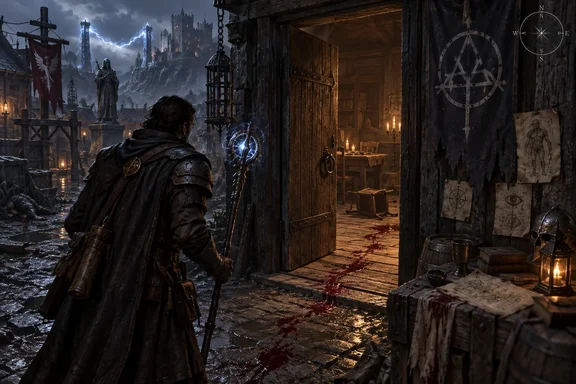
The practical promise is straightforward: a player who finds a disturbing clue before entering a settlement should arrive with different suspicions, options, and priorities than one who learns about the problem from an NPC inside town. PC Gamer highlighted Guay’s explanation that Invoke wants discoveries to feel earned through player action rather than through “blindly trusting a waypoint.”
There is independent support for the broader design. Xbox Wire’s Gamescom hands-off demonstration described a bloody trail behind an open door that was deliberately not signposted and could be missed by a player who did not investigate closely. TechRadar, following its own Gamescom interview with Guay, likewise reported that Warlock will use a toggleable HUD and limited guidance to encourage exploration. The underlying feature is real; the unanswered question is whether the game gives players enough usable evidence to solve its Mysteries without turning exploration into brute-force searching.
Mysteries replace the usual map checklist
Invoke’s term for optional content is “Mysteries,” but the distinction will matter only if the system changes how information flows through the game. A conventional open-world side quest typically begins with a marked NPC, adds a destination to a map, and updates that destination as the player advances. The player may have choices in combat or dialogue, but navigation is settled before the investigation begins.
Warlock’s stated approach reverses that order. Players are meant to hear rumors, speak with townspeople, spot unusual details, and piece together what is happening before they receive anything resembling a destination. Xbox Wire described Mysteries as the game’s take on side quests, built around accruing information and exploration instead of moving players to the next cutscene.
That design can produce a stronger sense of place than a map crowded with icons. It can also let a studio reuse a location more effectively: a village can be a setting for separate discoveries rather than a menu of errands waiting above character heads. More importantly, it gives players a reason to retain details from dialogue and environmental clues, rather than treating every conversation as a delay before the navigation marker appears.
Guay told IGN that Mysteries can have multiple entry points. Finding a clue outside a settlement may change how the player reads people and events within it, while discovering the same problem through conversations in town creates a different sequence of revelations. That does not necessarily mean the game will branch into radically different quest outcomes; Invoke has not made that claim. It does mean the studio is presenting the path into a story as part of the story, rather than as disposable setup.
The UI decision raises the burden on world design
Removing a waypoint is easy. Replacing its function is not.
Quest markers do more than direct a player from point A to point B. They communicate which clue matters, prevent a player from forgetting a location after a long break, and protect the pacing of a game that may otherwise spend too much time on travel or trial-and-error. When a developer takes them away, dialogue, geography, lighting, environmental storytelling, journals, maps, and interaction design have to carry that information clearly.
The brief Gamescom material suggests that Invoke understands part of that burden. Xbox Wire’s example of the bloody trail behind an open door is a physical clue placed in the world rather than a highlighted mission start. The appeal lies in the possibility that players notice it because it looks wrong, not because their UI orders them to inspect it.
But the difference between discovery and obscurity is often mundane. Does a conversation record names and locations in a journal? Can players revisit key information after leaving a town? Will the game distinguish a meaningful clue from the background chatter of an open-world settlement? Are important objects readable in darkness, during combat, or from the camera’s third-person distance? Neither IGN’s interview nor the Gamescom previews provides those operational details yet.
For PC players, those omissions matter more than the marketing language about player agency. A mouse and keyboard can make map inspection and interface navigation quick, while controller-first games often rely more aggressively on on-screen prompts and contextual highlighting. TechRadar reported that Invoke designed its spell selection around controller accessibility, while Warlock is also coming to PC. The studio has not described separate keyboard-and-mouse interface options, remapping depth, journal tools, or how much of the compass can be customized.
A minimal interface can be excellent on a large monitor with a readable in-game map. It can be frustrating on a handheld display or at a living-room distance if clues are tiny, text-heavy, or easy to lose. Turning off the compass is meaningful only if the game is navigable without it.
Spellcasting is supposed to be the other half of exploration
Warlock is not positioning Mysteries as a standalone detective system. Its larger pitch is that Dungeons & Dragons-inspired spells should work as tools for exploration, problem-solving, and combat. IGN’s Gamescom video framed the game around converting abilities associated with tabletop play into real-time actions that can solve puzzles in several ways.
Xbox Wire’s demo offered the clearest example: Kaatri could use a ritual to change the weather, then redirect an electrical spell through a metal object rather than simply casting at enemies. That is the kind of interaction that makes no-waypoint exploration plausible. If magic changes the player’s relationship with terrain, objects, and people, a clue can invite experimentation rather than merely identify a destination.
It also exposes the biggest risk in the concept. A game with numerous spell interactions needs a way to tell players what is possible without surrendering to the same intrusive prompts it is rejecting elsewhere. If every viable object glows, every NPC spells out the answer, and every Mystery funnels toward one obvious solution, Warlock will have hidden the waypoint rather than removed the guided path.
Conversely, if the game expects players to test every spell on every object, the absence of clear guidance becomes tedium. The successful middle ground is legible possibility: players should understand why an approach might work, then be allowed to test it. The Gamescom footage and descriptions indicate Invoke is aiming for that result, but they do not establish how consistently the game can sustain it over a full campaign.
A 2027 PC release still has basic unknowns
Warlock: Dungeons & Dragons is scheduled for 2027 on PC, PlayStation 5, and Xbox Series X|S. The Steam listing confirms the PC edition and identifies Invoke Studios as developer and Wizards of the Coast as publisher, but it currently lists the operating-system, processor, and graphics requirements as to be determined.
There is no announced release date beyond the year, no price, and no published performance target. Steam also does not yet offer a Steam Deck compatibility assessment, which is normal for a game this far from launch but leaves handheld players without a useful expectation. IGN has said the PC version is planned for both Steam and the Epic Games Store.
The more revealing missing detail is accessibility. A game that removes persistent navigation cues needs alternatives for players who need directional support, stronger objective reminders, more readable text, or clearer contrast. Guay’s comments say the compass can be disabled, and TechRadar reports a toggleable HUD, but Invoke has not yet said whether waypoint guidance can be enabled at different levels of intensity. An all-or-nothing setting would undermine the flexibility the studio says it wants.
Warlock’s strongest idea is not that it lacks waypoints. It is that the game wants discovery to alter a player’s understanding before it alters their objective list. If Invoke can make its clues persistent, its environments readable, and its spells intelligible as investigative tools, Mysteries could give its Dungeons & Dragons setting a more convincing sense of player-led adventure than another map full of errands. Until the studio shows the journal, map, accessibility settings, and PC interface, that promise remains a well-supported design direction rather than a proven solution.
References
- Warlock: Dungeons & Dragons won't have waypoints, so that players can figure things out without 'blindly trusting' a UI PC Gamer · 2026-09-16T10:42:58+00:00