

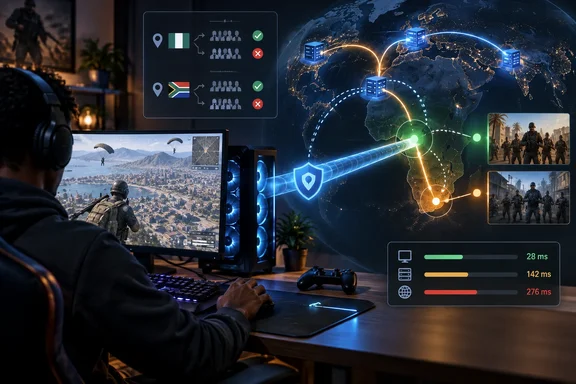
Its comparison of NordVPN, Proton VPN, ExpressVPN, Surfshark, and Private Internet Access reports substantial differences between advertised destinations and the routes observed from a Windows 11 PC in Europe. But the bigger question—whether any of those routes reliably produces easier Warzone lobbies—remains unanswered.
For PC players, the valuable takeaway is not a shopping podium. It is how to separate an IP address’s advertised geography, actual network routing, and the connection quality experienced inside the game.
What the five-provider test found
Gizmodo tested locations commonly promoted as destinations for Warzone “bot lobbies,” including Nigeria, South Africa, Egypt, Kenya, and Cambodia. Its country-by-country findings were:
| Advertised country | Providers Gizmodo identified as having local physical servers | Other reported locations or limitations | Reported target-city ping |
|---|---|---|---|
| Nigeria | NordVPN, Proton VPN, Surfshark: Lagos | ExpressVPN and PIA routed outside Nigeria; the article reports Spanish IP addresses | 146–147 ms |
| South Africa | NordVPN, ExpressVPN, Surfshark, PIA: Johannesburg | Proton VPN routed through Marseille | 210–223 ms |
| Egypt | None among the five tested | Marseille, Bucharest, or Frankfurt, depending on provider | 82–122 ms |
| Kenya | None among available locations tested | Frankfurt or London; Surfshark and PIA had no Kenya location | 163–180 ms |
| Cambodia | None among the five tested | Singapore for four providers; Hong Kong for Surfshark | 197–262 ms |
These are Gizmodo’s reported measurements and location assessments, not independently replicated WindowsForum results. The publication used a European Windows 11 PC and reported a 10 ms no-VPN baseline.
That geographical boundary matters. A player in the United States should not expect the same latency, and a target-city Speedtest result is not necessarily the latency of a subsequent Warzone match. The figures characterize the tested connections; they do not establish a universal gaming-performance ranking.
A physical server does not guarantee an easier lobby
Activision’s The Role of Skill in Matchmaking white paper identifies connection quality as the most heavily weighted factor in core Call of Duty multiplayer matchmaking, followed by time to match. It also describes skill as one component of a multidimensional system. That scope is important: the paper is not a disclosure of Warzone’s precise current matchmaking rules.
Activision’s official matchmaking explanation adds another useful detail: its multiplayer system evaluates “Delta Ping,” the difference between a player’s best data-center latency and the latency to the data center hosting the selected lobby. In other words, matchmaking involves more than reading a country name from an IP lookup.
The supported conclusion is narrower than “choose Lagos and get easier opponents.” Gizmodo’s observations show that some advertised destinations appeared to route through other countries. Activision’s documentation establishes that connection quality matters greatly in its documented multiplayer system. Neither proves that a particular VPN endpoint guarantees a Warzone region, weaker opponents, or AI bots.
An IP-country label is a clue, not a boarding pass to a specific lobby.
What distinguishes the providers in Gizmodo’s results
Rather than treating the publication’s award labels as universal recommendations, consider what each service contributed to this particular Windows test:
- NordVPN: Gizmodo reports local Lagos and Johannesburg endpoints, with 146 ms and 210 ms respectively. It also observed occasional connection trouble when another VPN was installed and an unexpected sign-out after restarting the app.
- Proton VPN: Its strongest reported distinction was location transparency. Gizmodo says the Smart routing badges matched the virtual locations it investigated, while Lagos appeared local at 147 ms.
- ExpressVPN: The tester reported one-to-two-second Windows connections with automatic protocol selection. Johannesburg measured 221 ms; its Nigeria location did not appear physically Nigerian.
- Surfshark: Gizmodo reports Lagos and Johannesburg endpoints at 147 ms and 222 ms, along with an unlimited-device allowance. Its Cambodia destination appeared to route through Hong Kong and measured 262 ms.
- Private Internet Access: Johannesburg measured 223 ms. Gizmodo also observed roughly 2.3 seconds between a WireGuard connection being established and traffic beginning to flow.
The Johannesburg results span just 13 ms, from NordVPN’s 210 ms to PIA’s 223 ms. Without repeated measurements and variability data, that spread is insufficient to establish a lasting performance advantage.
Likewise, Gizmodo’s favorable port-forwarding assessment of PIA should not become a promise of an Open NAT type. PIA describes port forwarding as opening a specific port on the VPN connection for incoming traffic; that feature alone does not demonstrate compatibility with every game’s networking requirements.
Cloudflare trace is useful—but not a server-location certificate
Gizmodo used Speedtest, Cloudflare’s trace output, and additional ping checks to investigate routing. This is a useful diagnostic approach, provided its limits remain visible.
Cloudflare’s own documentation says the trace endpoint identifies the Cloudflare data center serving the request. The colo field represents that Cloudflare point of presence—not the VPN provider’s server inventory.
Therefore, interpreting a Johannesburg Cloudflare result as conclusive proof of a VPN server physically residing in Johannesburg goes too far. It is supporting routing evidence, not a physical-location attestation.
There is another practical wrinkle in Gizmodo’s setup: the publication says it routed Battle.net through the VPN while leaving the browser outside it. A browser-based trace in that configuration examines the browser’s route, not necessarily the game’s route.
Practical inference: perform browser diagnostics while the browser is included in the tunnel. Once split tunneling excludes it, do not use its results to certify where Call of Duty traffic exits.
A sensible Windows 11 comparison procedure
Gizmodo’s PC setup involved connecting to a selected endpoint, configuring split tunneling for the launcher and game, and checking Warzone’s ping telemetry. A more cautious comparison keeps the baseline and diagnostic boundaries explicit:
- Record normal gameplay first. Note in-game latency without the VPN, using the playlist you intend to compare.
- Test one endpoint at a time. Record the advertised location and any virtual-location label.
- Keep browser diagnostics inside the tunnel. Treat Cloudflare output as evidence about that request’s routing, not definitive proof of hardware location.
- Configure split tunneling deliberately. Gizmodo included Battle.net or Steam and the Call of Duty executable. Check your provider’s instructions rather than assuming every application uses the same inclusion rules.
- Judge the connection inside Warzone. Gizmodo recommends enabling the game’s ping telemetry. Compare actual matches, not merely a download-speed headline.
- Stop if the route performs worse. A successful VPN connection is not itself a successful gaming outcome.
These steps are a comparison framework, not a verified recipe for manipulating matchmaking. Gizmodo’s 10 ms baseline and 146–223 ms African target-city results make the latency trade-off particularly important for its European test setup.
Consoles, free plans, and account safety
Gizmodo did not test Warzone on consoles. Its proposed PS5 and Xbox Series X|S arrangements use a VPN-capable router or a Windows PC sharing the VPN connection, rather than a native console VPN application. Those configurations should not inherit the PC test’s performance claims.
The article also discusses PS4 and Xbox One retirement, but VPN configuration cannot override a platform’s game-availability restrictions. Establish that the game remains supported on the console before troubleshooting its VPN route.
For free plans, Gizmodo reports that Proton VPN Free cannot target the African destinations in this comparison, while Windscribe and PrivadoVPN offer limited selectable locations and capped data. Those are reported plan restrictions, not evidence that a free subscription can reproduce the paid-server tests.
Account safety is equally unresolved. Activision’s Security and Enforcement Policy defines spoofing broadly and describes penalties including limited matchmaking, but the inspected policy does not specifically name VPNs. That does not establish either an automatic VPN ban or guaranteed permission.
Gizmodo reports successful Battle.net sign-ins across its tested servers, with three CAPTCHA challenges. A working login demonstrates access at that moment—not an account-safety guarantee.
The practical verdict
For players specifically seeking AI opponents, Activision’s Season 02 announcement documented Battle Royale Casual and Resurgence Casual as modes mixing players and bots. It also instructed players to follow playlist updates, so that announcement does not establish permanent availability today. Check the current game menu before assuming either mode is present.
Gizmodo’s comparison is most useful as a warning against taking VPN country labels literally. Its reported Lagos and Johannesburg endpoints deserve consideration as routing findings, not as proven shortcuts to easier Warzone matches.
For Windows players, the deciding measurement belongs inside the game: does the connection work reliably, and is its latency acceptable? A subscription ranking cannot answer that for your PC, your ISP, and your next lobby.
References
- Best VPN for Warzone and COD in 2026: Lobby Countries Tested - gizmodo.com gizmodo.com · 2026-09-30T19:35:34+00:00
- Call of Duty Security and Enforcement Policy support.activision.com
- Call of Duty Security and Enforcement Policy support.activision.com