

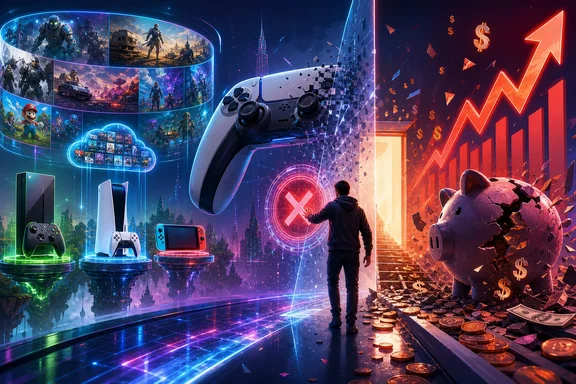
Circana’s Mat Piscatella said that more than 40% of U.S. respondents cancelling these services cited cost as a primary reason, a higher share than in the first quarter. For households balancing game purchases, hardware, and several recurring entertainment bills, that result is a useful warning: a subscription can be valued and still be the first recurring charge cut when its use no longer feels sufficient for its price.
What the survey actually indicates
The reported result concerns why former subscribers said they cancelled. It does not say that more than 40% of all subscribers cancelled, nor does it demonstrate that overall cancellation rates have risen.
That might sound like a technicality, but it changes the story considerably. A service could have a stable—or even growing—subscriber base while a greater proportion of the people who do leave say budget pressure influenced the decision. Conversely, even a relatively small number of cancellations could produce a notable change in the motivations reported by cancellers.
The available public material also does not provide key methodological details, including the survey sample size, fieldwork dates, weighting, margin of error, the definition of a “recent” cancellation, or whether respondents could choose more than one reason. As a result, the figures are best treated as a directional view of consumer sentiment rather than a complete measurement of churn across the subscription business.
That caution matters for a market where users often rotate services around a game release, a school term, a holiday period, or a personal backlog. Cancelling for a time is not necessarily a rejection of a platform or an indication that a subscriber will not return later.
Nintendo showed the biggest reported shift
Nintendo Switch Online had the largest reported change in the cost-or-budget explanation among the three named services. Half of recent cancellers reportedly pointed to cost, compared with 40% in the first-quarter comparison.
For Xbox Game Pass Essential and PlayStation Plus Essential, secondary reproductions of Circana’s result differ slightly on the current figure: one puts it at 40% and another at 41%, both compared with 37% in the first quarter. Without the underlying Circana chart or table, the responsible conclusion is simply that the share was above 40%, rather than treating either precise figure as settled.
Nintendo’s increase is especially important because it illustrates the limits of a simplistic “subscription price hikes caused this” narrative. Nintendo’s U.S. support materials list the base 12-month Nintendo Switch Online individual membership at $19.99. The survey result therefore does not, by itself, document a recent U.S. price increase for that base membership.
A respondent can say a service is hard to justify within a budget even if its listed price is unchanged. The household may be facing higher bills elsewhere, may be playing less often, may have exhausted the benefits they value, or may be choosing between several digital subscriptions. “Cost” can capture the perceived value of a subscription in the context of the whole household budget, not merely a change on the renewal invoice.
Why “rising costs” is too strong as a causal claim
There is a real affordability backdrop in gaming. Sony announced higher U.S. recommended retail prices for PS5, PS5 Digital Edition, and PS5 Pro consoles effective April 2, 2026. Circana has also warned that rising prices for components such as RAM, GPUs, CPUs, and storage could constrain hardware availability and affordability.
Those facts make broader consumer pressure plausible. But they do not establish that hardware costs, game prices, accessories, and every subscription are all rising in a way that directly caused these cancellations. Nor do they prove that a particular service’s price was the deciding factor for an individual respondent.
The evidence supports a narrower, more useful conclusion: among people who cancelled the three specified services, the share identifying cost as a primary reason increased versus the first-quarter comparison. That signals greater budget sensitivity among cancellers. It does not isolate the cause of that sensitivity.
Other explanations can coexist with budget pressure:
- A subscriber may have joined for one game or a short period of online play and cancelled after getting what they wanted.
- A library may not have enough games relevant to that household at the time of renewal.
- Less gaming time can turn a modest monthly or annual fee into an expense that feels unnecessary.
- Users with overlapping services may decide that one subscription duplicates benefits available elsewhere.
- A cancellation could reflect a temporary spending cut rather than a long-term shift away from subscriptions.
This is also why the finding should not be expanded beyond its stated scope. It names Game Pass Essential, PlayStation Plus Essential, and Nintendo Switch Online. It does not establish equivalent patterns for Game Pass Ultimate, PC Game Pass, PlayStation Plus Extra or Premium, or Nintendo Switch Online + Expansion Pack.
Xbox cloud-gaming limits are a separate issue
Microsoft has announced a product change that could become important to the perceived value of Game Pass for some users, but it should not be folded into the survey result as though causation had been demonstrated.
Beginning in November 2026, Microsoft says Game Pass Ultimate, Premium, and Essential will include 15, 10, and five cloud-gaming hours per month, respectively. Additional playtime will be available to purchase. Microsoft expects the change to affect 4% of Game Pass subscribers.
The limits are confirmed prospective changes. However, the available Circana material does not show that they caused any of the reported cancellations, influenced the answers in the survey, or will raise Game Pass cancellation rates after they take effect. The two records address different questions: one describes a stated cancellation reason among surveyed former subscribers, while the other describes an upcoming service-policy change.
Still, the announcement provides a practical example of how perceived value may become more individualized. A player who uses cloud gaming occasionally may never approach the monthly allowance. A player who relies on it frequently could need to calculate whether their likely use, plus any purchased additional hours, still fits the subscription’s value proposition. The eventual impact will depend on details Microsoft has yet to provide, including the price of added hours and the applicable features and availability by market.
For Windows users, that calculation may be particularly relevant when cloud gaming is part of a broader device strategy: for example, playing away from a primary gaming PC or using a lower-powered machine. But the expected 4% affected figure is Microsoft’s estimate, and it should not be mistaken for a prediction about cancellations.
A practical subscription audit for players
The survey’s most actionable lesson is not that every player should cancel. It is that auto-renewing entertainment costs are easier to keep when their benefits are visible and frequently used. Before a renewal, players can make the decision more deliberate.
Start with the exact tier, not just the brand. Game Pass Essential and Ultimate have different benefits, just as PlayStation Plus Essential differs from higher PlayStation Plus tiers. Grouping them together can hide whether a household is paying for features it does not use.
Then examine use over the actual billing period. Questions worth asking include:
- Did the subscription enable regular online play, cloud play, or access to games that would otherwise have been purchased?
- Is there a specific game, multiplayer community, or upcoming release that justifies keeping it through the next renewal?
- Are several household members benefiting, or is one person carrying a recurring charge for occasional use?
- Is an annual membership genuinely better value if gaming activity is seasonal or likely to drop?
- Would pausing one service free enough budget to buy a game that will be played for months?
For Game Pass members who use cloud gaming, it is sensible to watch for Microsoft’s November details before assuming the new hours will or will not matter. The key unknown is not merely the cap but how a person’s own play pattern compares with it, and what extra hours will cost where available.
Players should also check renewal dates and current plan terms directly in their account settings. A subscription review works best before an annual charge posts, particularly in households where multiple console, PC, video, music, or storage services renew at different times.
What to watch next
The next meaningful evidence will be data that separates motivation from scale. Industry observers and consumers would need subscriber counts, cancellation rates, retention figures, or comparable time-series data to determine whether the stated cost concerns are translating into higher aggregate churn.
It would also help to see Circana’s full methodology and underlying visual, both to clarify the 40% versus 41% discrepancy for Game Pass Essential and PlayStation Plus Essential and to understand how broadly the results can be generalized. Until then, “more than 40%” is the soundest description of the reported figure.
For now, the finding is best read as a consumer-value signal. More recent cancellers are saying that the expense is harder to justify. That does not prove a universal price-driven flight from gaming subscriptions, but it does show why providers will face sharper scrutiny over price, benefits, flexibility, and the difference between a service users like and one they decide to keep paying for.