

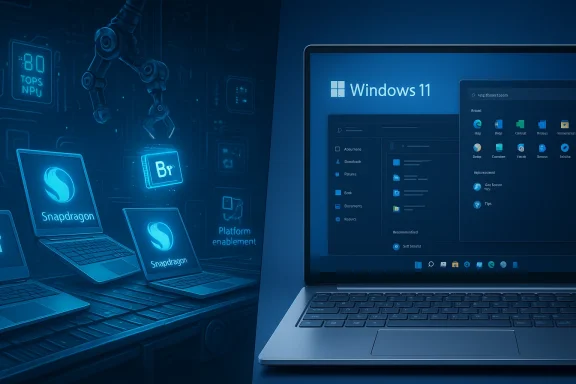
Windows 11’s roadmap for 2026 is starting to take shape: Microsoft has split this year’s work into a narrow, hardware-focused spring release that primes the OS for next‑generation Arm chips and a bigger, user‑facing feature wave planned for the second half of the year. What that means in practice is a short, OEM‑only “platform” build arriving with Snapdragon X2‑powered laptops in early April 2026 and a broader Windows 11 26H2 feature update later in H2 2026 that will carry the headline user features most people will notice. Both moves are deliberate: one solves silicon integration logistics, the other continues the annual feature cadence users expect. ](])
Background / Overview
Microsoft’s release strategy for 2026 breaks into two clear parts:
- A spring release, Windows 11 26H1, built on a new platform internally codenamed Bromine, intended exclusively for certain Arm64 OEMs (not a mass upgrade path for existing Intel/AMD PCs).
- A standard annual feature update, Windows 11 26H2, scheduled for the second half of 2026. This is the consumer‑facing update that will bring the majority of new UI and productivity features to the broader installed base.
This split echoes Microsoft to Copilot and Snapdragon‑based rollouts: when silicon changes demand deep platform plumbing—kernel adjustments, power domains, NPU runtimes and firmware integration—Microsoft ships a specialized OEM image so devices can leave the factory stable and performant. Think of 26H1 as a factory‑image OS baseline, not as a normal Windows update.
What 26H1 (Bromine) actually is — and what it is not
Platform enablement, not feature expansion
26H1 exacerbation Arm silicon—primarily Qualcomm’s Snapdragon X2 family and potentialally NVIDIA’s N1X class of chips—by shipping an OS image that accommodates new power states, scheduler logic, NPU runtimes, and firmware/driver validation. Microsoft has been explicit: 26H1 “only includes platform changes to support specific silicon.” In short, it’s an OEM tool to make sure those new laptops boot, sleep, update, and deliver consistent battery and AI behavior out of the box.
Who gets 26H1 — and who doesn’t
- Devices shipping with Snapdragon X2 (and likely the first wave of N1X devices) will come with 26H1 factory‑installed by April 2026. Existing Intel and AMD laptops will not be updated to 26H1; they remain on the standard 25H2/26H2 servicing path. treat 26H1 images like device‑specific OEM images: validated for particular SKUs, not a general deployment target. IT admins won’t need to push 26H1 widely unless they’re buying those specific devices.
Why Microsoft chose this route
Modern SoCs are far more than faster CPUs: they integrate large NPUs, heterogenous core clusters, and new firmware domains that affect scheduling, power and secure runtimes. Retrofitting those changes across the entire Windows fleet risks destabilizing millions of devices; a Bromine image lets Microsoft and OEMs test, sign, and factory‑image the code without changing the update path for everyone else. This pattern reduces risk for consumers while enabling OEMs to ship devices on time.
The silicon story: Snapdragon X2 and the NPU arms race
Snapdragon X2: what Qualcomm promises
Qualcomm’s Snapdragon X2 family (X2 Elite, X2 Elite Extreme and the X2 Plus variants) is positioned as a major step forward for Windows on Arm. Key public claims backed by Qualcomm and mainstream press coverage:
- NPUs rated around 80 TOPS for many X2 SKUs—substantially higher than prior generations and designed to accelerate local AI, Copilot+ workloads and semantic search.
- Oryon CPU core updates (3rd‑gen Oryon) and improved Adreno GPUs, combined with higher memory bandwidth LPDDR5x packages for faster CPU/GPU/NPU data movement.
- Shipping timelines: Qualcomm and OEM signals point to first Snapdragon X2 laptops arriving in Q1/Q2 2026, with Microsoft’s 26H1 image enabling them to ship from the factory by April 2026.
These claims are widely reported by outlets covering Qualcomm’s CES and Snapdragon announcements; the 80 TOPS figure appears repeatedly in press coverage and vendor datasheets. Independent benchmarking for retail SKUs will be essential to validate the real‑world NPU throughput and energy characteristics once devices ship.
Nvidia N1X and other Arm entrants — promising but uncertain
NVIDIA’s N1X platform has been reported as another Arm contender for Windows on Arm laptops; however timelines and specs vary across sources. Industry re1X launch window in early 2026 for some vendor SKUs, but note that public details remain fragmented and timelines may slip. Treat N1X coverage as plausible but not yet fully confirmed.
Copilot+, NPUs, and Windows features tied to hardware
Microsoft’s Copilot+ features and some on‑device AI functions require a hardware NPU capable of 40+ TOPS to run semantic models locally and deliver snappy, private AI experiences. That threshold dictates which devices can lot+ experience locally without cloud fallback. The company’s developer guidance and hardware partner lists reflect that requirement. Implications:
- Devices with 80 TOPS NPUs like many Snapdragon X2 SKUs should support advanced on‑device AI features (recall, semantic indexing, local model inference) more comfortably than previous generation chips. s or older Intel/AMD systems may rely more on cloud processing for the heaviest Copilot+ operations, or run a reduced local feature set. This creates a tiered user experiencecosystem.
What mainstream users will actually notice — the 26H2 feature roadmap
While 26H1 is under‑the‑hood, the consumer feature set most users will interact with is slated for 26H2 in H2 2026. Based on public previews, insider notes, and continuing trends from 24H2/25H2 cycle, expect the following themes in 26H2:
- AI everywhere, but sensibly scoped: semantic Windows Search, AI assistants for document recall and task automation (Recall, Click‑to‑Do style tools), and expanded Copilot integration with richer contextual suggestions. These features will be widely available but may offer fuller, lower‑latency local experience.
- Polish and productivity: File Explorer tabs and tab behavior improvements, Start menu layout options (grid and categorized views), refined Quick Settings, and taskbar/tray tweaks (battery percentage on the tray, condensed clock display). These are quality‑of‑life updates that continue Microsoft’s effort to bridge elegance with utility.
- App improvements: upgraded system apps—Photos with super‑resolution tools, Paint with generative fill, a consolidated Outlook app replacing Mail/Calendar in some builds, and updated Notepad and Snipping Tool features.
- Connectivity and hardware support: Wi‑Fi 7, USB‑4/USB‑4 2.0 support in enabled hardware, and improved hotspot and Bluetooth device options for modern laptop designs.
These are not speculative wishlists: ve appeared in Insider build notes and community writeups for the 24H2/25H2 cycles and are expected to be refined and more broadly distributed in 26H2. However, final ship lists can change up until the release window.
Strengths: Why this approach makes technical and practical sense
- This approach: shipping Bromine/26H1 only on validated OEM devices prevents a mass rollout of platform changes that could destabilize millions of existing machines. This is prudent engineering and decreases the odds of widespread regressions.
- Faster OEM time to market: OEMs can factory‑image devices and ship hardware on Qualcomm’s schedule without waiting for a universal servicing pipeline to incorporate the new platform changes. That helps the PC ecosystem move with silicon timelines.
- Local AI enablement: higher‑TOPS NPUs enable meaningful local LLM inference and semantic services that are and usable offline—an important differentiator as on‑device AI becomes table stakes.
Risks and potential downsides
- Fragmentation and customer confusion
Having a Bromine/26H1 branch for factory images and a separate 26H2 mainstream release increases surface area for customer confusion. Users could see different behavior depending on a device’s factory image and the update cadence. IT teams must be particularly careful mapping which devices they approve for enterprise deployment. - Driver and software complexity
OEMs and ISVs will need to test drivers, NPUs, and platform services against Bromine images in addition to the mainline branch. That increases QA workload and may delay third‑party optimizations for Arm devices until vendors complete Bromine testing. - Hardware gating of features
Requiring 40+ TOPS NPUs for some Copilot+ features means users with older or cheaper hardware will see a degraded AI experience compared to those with Copilot+ devices. That creates a multi‑tier user experience and could drive frustration or pressure toward hardware upgrades.
ity considerations with local AI**
Local model inference reduces cloud exposure, but big NPUs and more complex model runtimes increase the attack surface for firmware, drivers, and third‑party model integrations. Microsoft and OEMs must keep tight controls on secure enclaves, attestation, and update signing to manage risk.re that must be defended both in hardware and software.
- Uncertain timelines for competing silicon (e.g., N1X)
Some press reports suggest NVIDIA’s N1X and other Arm entrants may ship early 2026, but public details remain inconsistent. Microsoft’s Bromine strategy appears to anticipate multiple Arm vendors, yet variable timelines and delayed silicon could complicate the roadmap. Treat N1X timelines as provisional until vendors publish full specs.
Practical guidance: what to do now
For regular users
- If you’re buying a new laptop in Q1–Q2 2026 and it’s advertised as having a Snapdragon X2 or Copilot+ branding, expect it to ship with a factory image based on Windows 11 26H1. That’s normal and means the device is tuned for its silicon.
- If you are happy with your current Intel/AMD laptop, you don’t need to chase 26H1. The mainstream 26H2 update in H2 2026 will be the release that matters for day‑to‑day feature improvements.
For power users and enthusiasts
- Wait for early reviews of Snapdragon X2 retail laptops before buying if local AI performance matters to you—benchmarks will reveal real NPU throughput and battery tradeoffs.
- If you plan to tinker with Insider builds, remember 26H1 is intended for OEM validation; installing it manually on unsupported hardware may create instability.
For IT professionals and device managers
- Treat 26H1 images as device‑specific OEM baselines. Validate drivers, security baselines, imaging procedures, and firmware update flows in a lab environment before rolling devices into production. Plan device procurement timelines to coordinate with OEM‑validated Bromine images.
- Update device lifecycle policies to account for differentiated Copilot+ capabilities and document which machines will provide the full local AI stack versus those that will rely on cloud fallback.
What to watch next (calendar and checkpoints)
- April 2026 — Expected shipping window for first Snapdragon X2 laptops factory‑loaded with Windows 11 26H1. Watch OEM launch events and early reviews for device‑level performance and battery characteristics.
- H2 2026 (26H2) — Consumer feature update: the larger set of UI and AI features targeted at all supported machines. Expect semantic Search improvements, Recall/Click‑to‑Do style AI tools, File Explorer and taskbar polish, plus app upgrades. Insider channels will preview features in the months prior.
- Post‑launch validation — Look for Microsoft and OEM guidance on when Bromine devices will be upgraded to 26H2 and whether any Bromine‑only platform behaviors remain tied to factory images. Microsoft has stated it seeks feature parity where possible but has not committed to identical servicing models across branches.
Final analysis: pragmatic evolution, not a wholesale break
Windows 11’s 2026 plan is pragmatic: Microsoft is balancing the need to support dramatically more sophisticated silicon with the reality of maintaining stability across an enormous device base. The Bromine/26H1 route gives OEMs the control they need to ship new Arm devices with tuned drivers and verified NPU runtimes. Meanwhile, 26H2 will remain the universal feature vehicle for most users.
This strategy has clear benefits—safer device rollouts, better local AI on capable hardware, and faster OEM shipping cycles—but it also introduces complexity: device‑specific images, potential user confusion, and a hardware‑gated feature set that fragments the user experience. Enterprises and developers will shoulder extra validation work, and consumers should wait for independent benchmarks before choosing a new Copilot+ laptop if on‑device AI performance matters.
The long view: Windows is evolving into a more modular, silicon‑aware platform where hardware capabilities determine the shape of local AI experiences. For users this year, the headline is simple: if you buy a Snapdragon X2 Copilot+ laptop in early 2026, expect a Bromine/26H1 image that’s built to make that device sing; if you stay on your current PC, the big consumer features will arrive in 26H2 later in the year.
The next few months—OEM launches, hands‑on reviews, and Microsoft’s 26H2 insider previews—will clarify how well this strategy pays off in everyday use. In the meantime, plan purchases around the experience you need: battery‑efficient AI and local inference on new Copilot+ machines, or broad feature availability and a mature update path on existing Intel/AMD devices.
Source: YouTube