

The split, as Microsoft describes it
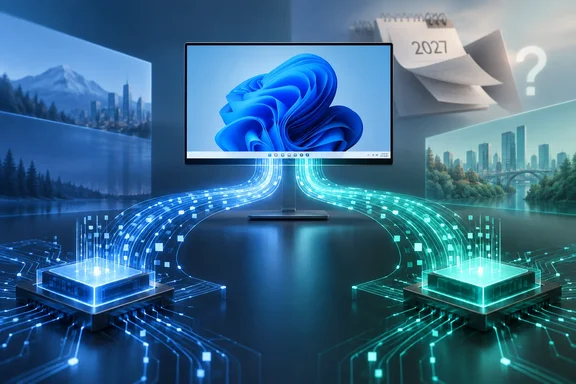
Most Windows 11 PCs run on one shared codebase. Microsoft's September 29, 2026 announcement of the Windows 11 2026 Update says version 26H2 ships as an enablement package for eligible devices on 24H2 and 25H2. Those three versions share a servicing branch and codebase, so most of the new bits are already on your PC before the update arrives. The install is a small download and a single restart. Microsoft's Windows IT Pro Blog puts it this way: "The difference between versions is simply which features are enabled."
Version 26H1 sits apart from all of that. Microsoft's IT-pro documentation calls 26H1 a specialized release built with device makers and silicon partners. It comes only preinstalled on select new devices, starting in early 2026, and the first of those use Qualcomm Snapdragon X2 Series processors. Windows Update doesn't offer it, you can't install it in place on an existing PC, and Microsoft says it isn't meant for broad deployment. Windows Latest reports that the 26H1 group also includes Nvidia RTX Spark PCs. It adds that the Snapdragon X2 side covers Snapdragon X2 Plus, X2 Elite, and X2 Elite Extreme PCs.
Microsoft is blunt about what this means for upgrades: devices running Windows 11, version 26H1 won't be able to update to version 26H2. Instead, they'll have a path to update to a future Windows release. This is because Windows 11, version 26H1 is based on a different Windows core than Windows 11, versions 24H2, 25H2, and 26H2. The Windows Insider blog used the same wording in June. BleepingComputer's coverage of the 2026 Update repeats it.
Notice what that statement leaves out. Microsoft promises "a future Windows release" and nothing more. It doesn't name the release, give a date or say which platform it will use.
Section summary: Microsoft confirms the split. It has not said how or when it ends.
Why the split happened, according to Windows Central
Windows Central uses Microsoft-adjacent codenames here, and none of them appear in the official material reviewed for this article. In that telling, 24H2, 25H2 and 26H2 run on the "Germanium" platform, which has been shipping since 2024. Version 26H1 runs on a newer platform called "Bromine."
Bowden's sources say Bromine exists mostly because of timing. The new Arm chips needed extra kernel-level work, and it was easier to build that into a new platform release than to retrofit it into Germanium. He also reports that Bromine gets no optimizations for older PCs. Existing hardware can run it, but gains nothing from doing so, which is why Microsoft kept most users on the older platform.
That explanation fits Microsoft's own positioning of 26H1 as "intentionally scoped" for specific hardware. Microsoft hasn't confirmed the details, though, so read it as sourced reporting rather than an official statement.
The 27H2 forecast, claim by claim
Here is what Windows Central expects, with a note on how well each claim is supported:
| Claim | Status |
|---|---|
| 26H1 devices will eventually move to a newer release | Confirmed by Microsoft ("a path to update in a future Windows release") |
| That release will be 27H2, in 2027 | Windows Central sources; independently reported by Windows Latest; not confirmed by Microsoft |
| Release window of September or October 2027 | Windows Central inference from Microsoft's second-half cadence |
| Phased rollout | Educated guess based on Microsoft's standard practice |
| Full OS upgrade, not an enablement package | Windows Central analysis; not confirmed |
| Built on a platform newer than Bromine, possibly "Strontium" | Windows Central speculation |
| Snapdragon 850 support dropped | Reported by Windows Central; not found in the official sources reviewed |
| Features exclusive to 27H2 | None known |
The corroboration matters. Windows Latest reported in August that 26H1 and 26H2 will merge with Windows 11 27H2 in the second half of 2027. The same outlet admitted Microsoft wouldn't confirm Windows 11 27H2's plans when I asked, so this isn't official yet. Two outlets relying on their own sources and landing in the same place is a reasonable signal. It still isn't a Microsoft roadmap.
Why a full upgrade would make sense
The "full OS upgrade" prediction follows from how enablement packages work. A package can only switch on code that's already on the PC. If 27H2 has to serve both a Germanium-based 26H2 machine and a Bromine-based 26H1 machine, at least one of them needs a different core underneath. That's a full OS swap that keeps your apps, files and settings, not a flipped switch.
Windows has done this before. 22H2 was a full upgrade over 21H2, and 24H2 was a full upgrade over 23H2. For IT teams, expect the heavier routine to return: bigger downloads, longer installs and more reasons to test first.
Why "Strontium" is plausible, and nothing more
Bowden points to a pattern. Germanium was finalized in the first half of 2024 and shipped as 24H2 later that year. If the next platform, which he suspects is called Strontium, is finalized in the first half of 2027, a 27H2 release would follow the same schedule.
Microsoft's public record shows next-platform work is happening. It doesn't show what that work will become. In April 2026 the Insider team moved Canary 29500-series builds into a new "Experimental (Future Platforms)" channel. The team described those builds as the earliest Windows previews and said they are not aligned to any retail version. By June, Microsoft was shipping Experimental (Future Platforms) – Including Canary 29600 series: Build 29613.1000, and September builds are in the 29600s.
Bowden's strongest clue is the Snapdragon 850 report. He says the chip can still run Bromine builds, so a next version that drops it would likely be built on something newer than Bromine. We couldn't find that Snapdragon 850 claim in the official material reviewed for this article.
Section summary: The broad direction, a 2027 release that reunites the two groups, now has two independent outlets behind it. The platform name, the exact timing and the upgrade method are still informed guesses.
Features: don't expect a 27H2 showcase
Under Microsoft's "Continuous Innovation" approach, features ship when they're ready, not when a version number changes. Version 26H2 shows this well. Windows Central notes that it includes no new features on the surface that aren't also rolling out to those older releases, but it does act as a checkpoint that enables all the new features rolled out over the last 12 months.
Bowden also explains why 26H1 owners often get features later. Most mainline development still happens on the Germanium codebase and is merged into newer codebases afterward. So a feature may reach 25H2 and 26H2 first and show up on 26H1 later. Owning the newest silicon doesn't guarantee you see the newest Start menu first. If 27H2 does unify the platforms, one side benefit could be that this lag goes away.
And Windows 12?
Nobody outside Microsoft knows. A Windows 12 launch also wouldn't rule out a Windows 11 27H2. In 2021, Windows 10 got its own 21H2 update in the same year Windows 11 21H2 launched.
Bowden argues that Windows 12 is unlikely while Windows 11 is still split. Upgrading from two different platforms at once would complicate support. His view is that Microsoft would rather get everyone onto one Windows 11 platform first. That's analysis, not reporting, but it's hard to argue with. Few IT managers want a major version change on top of a platform split.
What to do right now
1. Check which version you're running.
- Open Settings > System > About and look at the OS version, a step Windows Latest also recommends. If it says 26H1, this year's 26H2 rollout isn't for your PC.
- You can also type
winverin the Run box.
2. On 24H2 or 25H2:
- Microsoft says you can go to Settings > Windows Update and turn on Get the latest updates as soon as they're available to get 26H2 sooner.
- The rollout is controlled. Safeguard holds may block PCs with known compatibility problems, so an update that doesn't appear yet isn't necessarily broken.
- Installing 26H2 resets your support clock: Home and Pro editions receive 24 months of support, while Enterprise and Education editions get 36 months.
3. On 26H1 (Snapdragon X2 or RTX Spark PCs):
- Nothing is wrong with your PC. Keep installing the monthly security and preview updates, which Microsoft says 26H1 continues to receive.
- Under Microsoft's documentation, 26H1 Pro gets 24 months of servicing from its February 10, 2026 release and Enterprise gets 36 months. That leaves plenty of time before a 2027 upgrade path becomes pressing.
4. For IT administrators:
- Microsoft still names 24H2 and 25H2 as its recommended enterprise releases. Treat 26H1 as a hardware-specific choice, not a fleet standard.
- Deploy 26H2 through your existing tools, such as Windows Autopatch, update rings and policies, starting with targeted pilot groups.
- Plan 2027 budgets on the assumption that the next platform move is a full upgrade. If it turns out to be lighter, good. If you planned for a small package and got a full reinstall, that's a bad week.
The bottom line
Microsoft has confirmed that 26H1 devices can't take 26H2 and will get "a future Windows release." Windows Central and Windows Latest, each citing their own sources, say that release is 27H2 in the second half of 2027, bringing both groups back onto one platform. The platform codename, the full-upgrade mechanics, hardware cutoffs like the Snapdragon 850 and the Windows 12 question are all still speculation.
For now, 24H2 and 25H2 users can take 26H2 when it's offered, and 26H1 users can keep patching and wait.
References
- Windows 11 version 27H2: Everything we know so far - Windows Central Windows Central · 2026-09-30T14:00:00+00:00
- We're moving to Experimental and Beta! Announcing new builds for 24 April 2026 | Windows Insider Blog blogs.windows.com
- Get ready for Windows 11, version 26H2 - Windows IT Pro Blog techcommunity.microsoft.com