

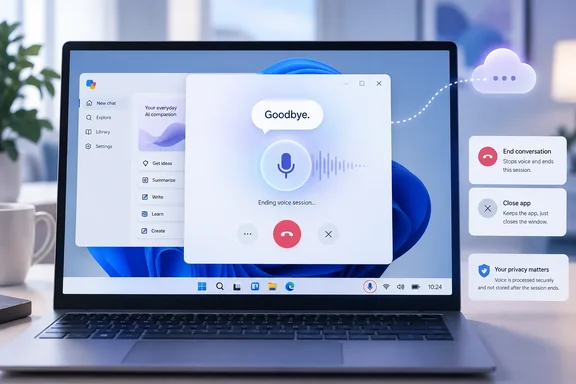
But the roadmap entry’s dates tell a messier story than its newly updated status suggests. It lists preview availability in November 2025 and general availability in December 2025, even though Microsoft’s Windows Experience Blog said on October 16, 2025 that new wake and goodbye words were generally available for Windows 11 PCs. That makes the September 15, 2026 roadmap update useful confirmation that the item remains classified as launched, but a poor source for determining when the feature actually reached users.
“Goodbye” ends the voice call, not Copilot itself
The behavior is narrower than some of the coverage around a “Bye, Copilot” command has implied. Microsoft’s consumer Copilot support documentation says saying “Goodbye” ends a Copilot Voice conversation, after which the voice interface disappears. It is equivalent to tapping the X in the voice UI or allowing the session to time out; it does not quit the Copilot application, sign the user out, disable microphone access, or turn off the “Hey Copilot” listener.
That distinction is operationally relevant. A Windows PC can keep the Copilot app running in the background after a voice call has ended, and a user who enabled the wake phrase can still start another session later with “Hey Copilot.” The goodbye phrase removes an active-session control step. It is not a privacy kill switch.
Microsoft’s own wording also uses “bye or goodbye,” while its support page specifically documents “Goodbye.” Windows Latest and Windows Report both independently reported successful tests with variations including “Bye, Copilot” on Windows PCs in late 2025. Microsoft has not published a detailed list of accepted farewell phrases, language variants, confidence thresholds, or the behavior when the word is spoken as part of normal conversation.
The roadmap’s Microsoft 365 label obscures the app boundary
Roadmap ID 529864 is filed under Microsoft 365 and Microsoft Copilot for Microsoft 365, but the surrounding documentation points to a feature controlled through the Microsoft Copilot app on Windows, rather than a setting in the Microsoft 365 desktop apps such as Word, Excel, Outlook, or Teams.
Microsoft’s support instructions for work and school users say the wake phrase is enabled inside the Copilot app’s Quick View settings. The feature requires the Windows PC to be on, unlocked, online, and running the Copilot app. Microsoft further says the wake phrase is Windows-only, supports English for activation, and cannot initiate a new chat while the screen is locked or while another app is playing audio.
For Microsoft 365 administrators, this means the roadmap item should not be read as a new voice command inside every Copilot-enabled Office app. Microsoft has not identified a Microsoft 365 admin-center policy, Intune setting, or Teams policy specifically governing the goodbye phrase. Nor does the roadmap say whether it applies to every commercial tenant configuration beyond Worldwide standard multi-tenant environments.
Microsoft’s voice-feature FAQ adds a more material limitation: voice features were not available to users without a Microsoft Copilot license when that documentation was published, while GCC and GCC High availability was described only as a future plan with no announced date. The roadmap listing itself is scoped to Worldwide standard multi-tenant cloud instances. Government tenants should therefore not assume that the feature’s “Launched” label means it is available in their environment.
The hands-free flow still depends on an opt-in cloud service
Microsoft frames “Hey Copilot” plus a semantic goodbye as a complete hands-free experience. In day-to-day use, it is closer to a voice-session convenience feature than an offline Windows voice-control system.
The wake-word detector runs locally, according to Microsoft’s Copilot documentation. Microsoft says it holds a 10-second audio buffer in local memory for wake-word detection and does not record or store that buffer. Once “Hey Copilot” is detected, however, the audio beginning with detection is sent to Copilot Voice in the cloud to establish the conversation and answer the request. An internet connection is therefore mandatory for a useful voice interaction.
Microsoft also says Windows shows microphone use in the system tray when wake-word listening is enabled and the Copilot app is running, whether open, minimized, or in the background. That visual indicator is more meaningful to users and support teams than the goodbye command itself: it tells them the wake listener remains active even when no full voice conversation is underway.
The company acknowledges practical limitations. Accents and language variation can cause accidental activation, and Microsoft says background noise can keep an active voice chat open after a person has stopped speaking. Its consumer support page also warns that some Bluetooth headsets can suffer reduced playback quality while “Hey Copilot” is enabled, recommending updated device firmware or drivers and, if necessary, switching off the wake phrase in favor of push-to-talk.
The goodbye capability can reduce exposure to the latter problem by offering a quick spoken close rather than relying on inactivity detection. It does not solve accidental wake-ups, poor headset behavior, or the fact that nearby speech may be captured during a live Copilot Voice session.
Microsoft’s documentation has not moved in lockstep
The clearest inconsistency is between Microsoft’s newer consumer-facing Copilot documentation and portions of the Microsoft 365 Copilot support material. The former explicitly says a conversation can end by saying “Goodbye.” A Microsoft 365 Copilot FAQ still tells users to mute or dismiss a voice chat and explains that it automatically ends after one minute of inactivity, without documenting the farewell command.
That could reflect separate documentation update schedules, product surfaces, or a feature that is enabled unevenly between consumer Copilot and the commercial Copilot experience. Microsoft has not publicly explained the mismatch. What it should not be taken to mean is that the roadmap alone guarantees identical behavior on every Windows device signed into a work account.
The October 2025 Windows Experience Blog made a broad Windows 11 claim: wake and goodbye words were generally available for Windows 11 PCs. The roadmap, by contrast, labels this as Microsoft 365 Copilot and gives a later November/December schedule. Neither item supplies app version numbers, Windows build requirements, hardware requirements, or a rollout percentage. Those omissions leave help desks with no definitive compatibility matrix to consult when a user says “Goodbye” and nothing happens.
What users and administrators should check
Users who want the promised hands-free start-and-stop flow should first verify that they are using the Microsoft Copilot app on an unlocked Windows device, are signed in with the appropriate account, and have enabled “Listen for ‘Hey Copilot’” in the app’s settings. Saying “Goodbye” should be tested only after the visible Copilot Voice interface has opened; it is an active-session command, not an app-launch command.
Administrators should treat it as a user-experience feature with privacy and support implications rather than a material new tenant capability. In particular:
- The wake word is opt-in, but it requires the Copilot app to remain running and the PC microphone to be available.
- Voice conversations require cloud processing after the local wake-word detection stage.
- The roadmapped scope excludes government cloud instances, and Microsoft has not announced equivalent availability for GCC or GCC High.
- No dedicated management policy for the goodbye phrase is identified in Microsoft’s current public documentation.
The useful news in Roadmap ID 529864 is that Microsoft considers spoken session closure part of its shipped Windows Copilot experience. The more important finding is that the roadmap’s December 2025 general-availability date is already contradicted by Microsoft’s own October 2025 Windows announcement, while the Microsoft 365 documentation still does not consistently describe the command. For users, “Goodbye” is a faster way to end a live Copilot Voice session. For IT teams, it is not evidence of a newly deployable Microsoft 365 control—and it should not be documented internally as one until Microsoft publishes the missing administration and eligibility details.