

What was announced
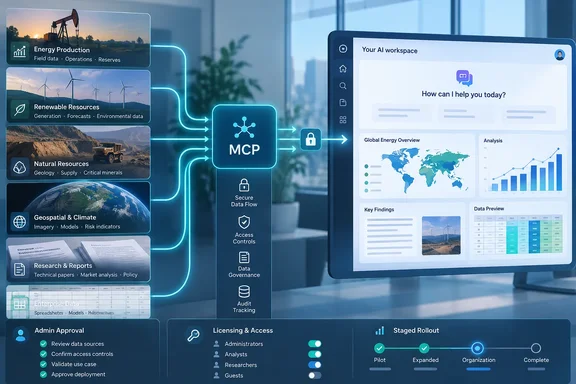
Wood Mackenzie announced that customers can now reach its proprietary content, data and analytical capabilities inside their Microsoft Copilot environment. The offering, called Wood Mackenzie for Microsoft Copilot, gives authorised users research, data and analytical insight through natural-language prompts.
The capability is built on the Model Context Protocol (MCP), an open standard that lets AI environments discover and use external intelligence dynamically. The release is dated October 5, 2026 and was issued from London, Houston and Singapore.
According to the company, users can:
- Ask natural-language questions and surface Wood Mackenzie written analysis.
- Retrieve content without manually searching across separate platforms.
- Bring Wood Mackenzie insights into documents, spreadsheets and internal workflows, all within Copilot.
The intended uses are screening, benchmarking, strategic analysis and decision preparation. The company says the output is grounded in its datasets, models and analyst expertise, and is "enhanced by Synoptic", its own AI application.
Availability is "now", but expansion is phased. More data and analytical capabilities will arrive as additional datasets and models become "MCP-ready". The company calls this the first step in a wider AI connector strategy for other platforms.
What the release doesn't say
The release is a vendor announcement, so treat the benefits as claims rather than measured results. Faster decisions, less exporting and reconciling, and "more confident" choices are all assertions. The release gives no customer examples, performance figures or independent evaluation.
It also leaves out several things an IT team would want to know:
- Which Copilot surfaces and plans are supported.
- Which datasets and models are included at launch.
- How the connector is enabled and authenticated.
- Pricing, and whether a separate Wood Mackenzie entitlement is needed.
- Whether it is listed in Microsoft's connector gallery.
I found copies of the release on GlobeNewswire and several syndication sites. I did not find a separate Microsoft announcement or Wood Mackenzie documentation page that adds technical detail. The quotes from Wood Mackenzie's Bernardo Rodriguez and Microsoft's Chantrelle Nielsen therefore appear only as attributed in the release.
How Microsoft's connector model works
Microsoft's documentation explains the platform this connector would sit on. It is general guidance and not a statement about Wood Mackenzie's implementation.
Microsoft describes two connector models for Microsoft 365 Copilot. Synced connectors index external content into Microsoft Graph, while federated connectors retrieve content in real time over MCP without indexing it into Graph. Microsoft's Learn pages list the federated model as the one suited to dynamic data or content that must stay in the source system.
For partner-built federated connectors, Microsoft's submission page describes a gated route:
- The partner submits a remote MCP server to Microsoft.
- After Microsoft approves it and adds it to the Connectors Gallery, tenant admins review and approve it for their organisation.
- Only then does Copilot connect to the partner's server over a public HTTPS endpoint.
Microsoft's docs say approved federated connectors can surface content in Copilot Chat, Copilot in Excel, Cowork and the Researcher agent, with Word and PowerPoint listed as coming soon. They also say custom federated connectors use MCP servers exposing read-only tools. Authentication options include Microsoft Entra single sign-on and OAuth 2.0.
The release doesn't say whether Wood Mackenzie's connector follows this gallery route, a Copilot Studio route or something else. Nobody should assume it is a federated connector, gallery-listed or Microsoft-certified without confirmation.
Questions for admins before enabling
Treat this as an entitlement and governance check, not just a new button in Copilot.
- Which experience is supported? Confirm with Wood Mackenzie whether it works in Microsoft 365 Copilot Chat, Excel, Researcher or Copilot Studio agents.
- Who can use it? The release says "authorised users". Ask how Wood Mackenzie subscription rights map to Entra identities, so Copilot only returns content a user is licensed to see.
- Is data fetched live or copied? Ask whether content is retrieved at query time or indexed, and where any retained copies live.
- What is switched on at launch? The phased rollout means the available datasets may be narrower than the marketing suggests.
- How is it rolled out? Microsoft's admin centre supports staged rollout to selected users or groups for custom connectors. Ask whether the same applies here.
- What about outputs? Content pulled into spreadsheets and documents may carry licence restrictions on redistribution. Check Wood Mackenzie's terms.
Why it matters
The announcement fits a wider trend. Data and research vendors are packaging their products as MCP servers so Copilot can use them alongside Microsoft 365 content. The main selling point is not the AI itself but the governed, licensed source behind it.
The counterpoint is that the connector doesn't remove existing governance work. Admins still have to manage entitlements, approvals and data handling. The benefit will depend on how well the connector respects those controls and how much of Wood Mackenzie's catalogue is actually exposed at launch.
For now, this is a credible but thinly documented launch. Energy and natural-resources customers should ask for the technical and licensing details before treating it as production-ready.
References
- Wood Mackenzie connects trusted energy intelligence with Microsoft Copilot - Indovizka.com Indovizka.com · 2026-10-05T15:18:37+00:00
- Wood Mackenzie connects trusted energy intelligence with Microsoft Copilot globenewswire.com
- Microsoft 365 Copilot connectors overview | Microsoft Learn learn.microsoft.com