

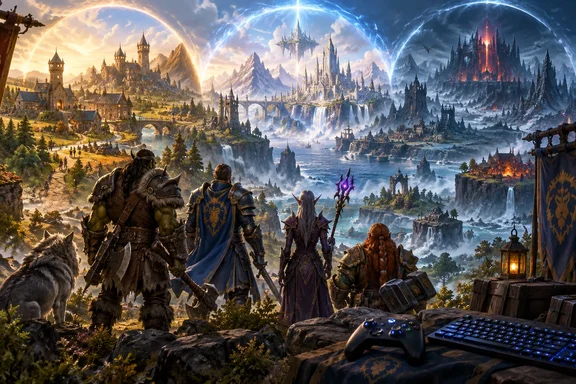
The distinction deserves more care than the “WoW 2 is dead” framing suggests. Blizzard has not announced a formal cancellation of a sequel, nor has it said that its current technology can never be replaced. But Kris Zierhut, principal designer on WoW: Forever, told IGN that the team sees little benefit in discarding the systems continuously improved across the game’s history. PC Gamer and GamesRadar independently reported the same interview and quotation, leaving little ambiguity about Blizzard’s present direction.
Wccftech’s take is right on the central point: Forever is Blizzard’s answer to the desire for a reset and an alternate future for Azeroth. It is not an engine reboot, a new client designed around a new combat model, or an announced path to consoles. For Windows players, that means Blizzard is extending the familiar PC foundation while selectively modernizing the presentation and controls around it.
The 25-year claim describes development, not the retail engine’s age
Zierhut’s argument has been compressed into a claim that Blizzard is unwilling to replace a “25-year-old engine.” That is not quite what he said. His point was that WoW’s game, world, design, engine behavior, and server systems have been under continuous development for roughly 25 years; he specifically cited upgrades to graphics, rendering, lighting, player movement, spell handling, and combat systems.
The dates matter. World of Warcraft launched in North America on November 23, 2004. On September 16, 2026, the retail game is just under 22 years old. Blizzard’s broader 25-year figure reasonably reaches back into the project’s pre-launch development, but it should not be read as an admission that players are running the exact 2001-era engine unchanged.
That may sound semantic, but it changes the technical reading of Blizzard’s position. The company is defending a long-lived codebase that has been repeatedly modified, optimized, and extended—not preserving a museum piece because it cannot be touched. Blizzard’s own Forever materials point to new rendering work, including water flow, mist, and lighting effects designed to retain the original Azeroth art style while making scenes look less static.
For an MMO, the less visible half of that claim is arguably more consequential than improved foliage, water, or shadows. A sequel would require Blizzard to recreate, migrate, or redesign systems for persistent characters, inventories, guilds, social functions, combat responsiveness, world-state management, matchmaking, security, and service operations. Zierhut’s “Why would you throw that away and start over?” is a statement about that operational risk as much as graphics technology.
Forever is a new branch, not a replacement for retail WoW
Blizzard describes World of Warcraft: Forever as a permanent home operating alongside modern WoW and WoW Classic. Its official BlizzCon recap says the new game begins in the original Azeroth era, with the player journey focused on levels 1 through 60, then expands through new stories, regions, dungeons, raids, systems, and future updates.
That makes it closest to what the community has often called “Classic+”: a version based on the early-world premise, but one permitted to make new official content instead of progressing through the historical expansion sequence. Blizzard is calling it a “full new World of Warcraft game,” yet the company is also deliberately anchoring it to the established platform and design lineage that Zierhut says it does not want to abandon.
The split matters for players deciding where to invest their time. Retail WoW remains the continuously advancing mainline game. WoW Classic preserves and revisits historical versions. Forever starts from original Azeroth but is intended to develop into an alternate, evergreen progression path. A character built in one of those products should not be assumed to transfer to another; Blizzard’s announcement emphasizes a clean-slate economy and a fresh beginning rather than continuity with existing characters.
Blizzard has also laid out an early roadmap rather than treating Forever as a one-time nostalgia release. The company says new raids are scheduled to begin unlocking on December 9, followed by further raids, dungeons, PvP updates, outdoor content, quests across the leveling experience, Hardcore support, and a reworked iconic raid. Those are meaningful commitments, but they are still a roadmap, not a substitute for a detailed multi-year content schedule.
Modernization is selective—and controller support is not a console announcement
The strongest evidence that Blizzard is modernizing Forever without making a sequel is in the feature mix. Its official announcement promises optional transmog, modern and Classic visual presets, high-definition and standard-definition character models, restored older animations for HD models, refreshed rendering, and official gamepad support.
Official gamepad support is a substantial quality-of-life change for a game historically built around a mouse-and-keyboard interface. It should make the title more practical on Windows handheld PCs, couch setups, accessibility-focused configurations, and users who prefer controllers for questing or casual content. It also removes one of the common friction points that previously pushed controller users toward add-ons and custom bindings.
But gamepad support is not proof of a console version. Neither Blizzard’s BlizzCon announcement nor its Forever panel recaps announces PlayStation or Xbox editions, cross-platform matchmaking, console account migration, or console-specific UI and certification plans. Microsoft owns Blizzard, which naturally makes Xbox speculation tempting, but ownership does not turn a controller-ready Windows and Mac game into a confirmed console release.
This is where the sequel debate risks becoming muddled. A full WoW sequel could theoretically be built around consoles, an overhauled input model, different world simulation rules, a more action-driven combat structure, or a clean onboarding flow for players who have never encountered two decades of WoW systems. Blizzard has not said those goals are impossible. It has said Forever, combined with the ongoing modernization of WoW, gives it no compelling reason to sacrifice the systems already working at scale.
That is a conservative strategy, but it is not irrational. MMOs have a long history of troubled re-platforming efforts, particularly when a developer tries to replace technology and preserve a live community at the same time. Blizzard’s choice is to keep the service continuity and improve pieces of it—rather than demand that players, developers, and operations teams cross a single high-risk technical divide.
What Windows players can test on September 17
The Forever beta begins Wednesday, September 17, 2026. Blizzard says early access is available to players who pre-purchase the Skyborne Epic Pack or the Warcraft Forever Collection. The global launch follows on November 4 at 3:00 p.m. Pacific time, which is 6:00 p.m. Eastern time.
That access arrangement should be read plainly: the beta is not presented as a general public test at launch. Players interested in testing performance, controller implementation, UI behavior, character-model options, and the new rendering changes will need one of the qualifying purchases unless Blizzard broadens access later. Blizzard has not announced such an expansion.
The beta is also where Blizzard’s infrastructure-first argument will meet the first real public scrutiny. Promotional footage can demonstrate lighting and new zones; it cannot settle whether the new realmless approach, outdoor player density, combat responsiveness, social tools, and controller interface remain reliable when large groups of players begin stressing the service. Blizzard’s panel materials say Forever is taking a different approach to choosing where to play, so early testers should pay particular attention to how often they encounter friends, rivals, resource competition, and crowds in the shared world.
Blizzard has chosen continuity over a generational reset
The important news is not that Blizzard thinks its technology is perfect. It is that the company sees its ongoing engine and server evolution as the alternative to a sequel, rather than preparation for one. World of Warcraft: Forever gives Blizzard a fresh Azeroth timeline and room to build original content without forcing the company to rebuild the MMO’s technical and operational foundations from scratch.
For players hoping for a radically different WoW—one conceived around a new engine, a redesigned combat philosophy, or a simultaneous console launch—that answer will disappoint. Forever promises a new starting point, not a new technological era. Its beta begins September 17, and its November launch will show whether Blizzard’s accumulated infrastructure can make that continuity feel like an advantage rather than a constraint.
Update: Beta details add level caps, opt-in route, and an October end date (September 16, 2026)
PC Gamer reports that the World of Warcraft: Forever beta is scheduled to run from September 17 through October 21, giving testers roughly a month before the November release.
Contrary to the earlier characterization that access is limited solely to purchasers of the Skyborne Epic Pack or Warcraft Forever Collection, PC Gamer says Blizzard also offers a Beta Opt-in option through the Forever website. Selection through that route is not guaranteed, while the two premium editions provide direct access.
The report also outlines a staged test. The opening phase caps characters at level 20 and includes new class abilities, talents, profession items, the Hall of Thanes and Ruins of Lordaeron dungeons, and the Legacy system. Around October 8, Blizzard is expected to raise the cap to level 30 for the remainder of the beta.
Blizzard had not published an exact opening time as of PC Gamer’s report, so Windows players should not rely on a specific hour until the company updates its launcher or official beta materials.
Update: WoW: Forever beta opens with hour-long queues and disconnects (September 17, 2026)
The beta is now live, but PC Gamer reports that many players are facing hour-long login queues, disconnects after reaching the front, and being returned to the back of the line. Some testers have entered successfully, but access appears inconsistent during the opening period.
Blizzard acknowledged the launch issues on X, saying it is working through final problems and expects the doors to open soon. For Windows players testing the new client, this means early impressions of performance, controller support, and the realmless world design may be delayed by server-side access problems rather than in-game technical faults.
The disruption is particularly notable because Forever replaces traditional realm selection with shared ruleset-based environments. It is too early to conclude that this design is responsible for the queues, but the beta’s first hours are an immediate stress test of Blizzard’s claim that its evolved service infrastructure can support a more unified social world.
Update: EU testers report severe latency spikes, with VPN routing as an unofficial workaround (September 18, 2026)
PC Gamer reports that some UK and other EU-based players in the World of Warcraft: Forever beta are encountering persistent high latency, sudden spikes to roughly 2,000 ms, and disconnects even after getting past the initial login queues.
According to PC Gamer’s testing and player reports on the EU beta forums, connecting through a VPN endpoint in the United States has, in some cases, reduced latency to around 100 ms and stopped the disconnects. That points more toward a routing or regional network-path problem than a simple lack of server capacity, although Blizzard had not publicly listed it as a known issue when the report was published.
For Windows testers in Europe, the immediate practical consequence is that successful login does not necessarily mean the beta is playable. A VPN may be a temporary diagnostic workaround, not an official fix, and users should consider its cost, privacy implications, and Blizzard’s applicable account rules before using one.
The report also raises a disclosure concern: beta access is marketed through paid editions in Europe, but PC Gamer found no clear notice on the EU store page about server location or potential regional connectivity limitations. Blizzard has reportedly been contacted for comment.
Update: Ion Hazzikostas says Forever should inform—not replace—retail social design (September 18, 2026)
In an interview with Windows Central, World of Warcraft game director Ion Hazzikostas said Blizzard views Forever as a third long-term pillar alongside Retail and Classic, but does not see it as a reason to leave Retail’s social and open-world shortcomings unresolved.
Hazzikostas acknowledged that convenience features and automatic matchmaking can make modern WoW feel more solitary, with player organization increasingly shifting to Discord. However, he said Blizzard is considering ways to make Retail’s outdoor world more challenging, rewarding, and socially meaningful, potentially building on experiments such as Remix’s Heroic World Tier. He suggested similar ideas could appear in The Last Titan.
That is a notable clarification for players worried that Forever’s more community-driven, lower-automation model will siphon Blizzard’s attention away from Retail. According to Windows Central, Hazzikostas said Blizzard does not intend to tell players seeking danger, purpose, or social connections to play Classic or Forever instead; those qualities should exist across all versions of WoW.
He also said Forever will streamline some of Classic’s more punitive elements, including world-buff farming, while rebalancing talent trees and specializations so every class is viable.
Update: Blizzard defends contested quest enemies as a core social feature (September 21, 2026)
PC Gamer reports that senior game designer Josh Greenfield has ruled out shared enemy-tag credit for World of Warcraft: Forever, arguing that competition for quest targets is an intentional part of the game’s social design.
Responding to beta feedback, Greenfield said Blizzard must “hold the line” on the issue, while acknowledging that the studio may address some of the frustration it creates through other changes. His position is that the inconvenience of competing for enemies can encourage players to form temporary groups, allowing everyone to receive quest progress rather than fighting for individual tags.
For Windows beta testers, this means crowded starting zones and popular quest areas are not behaving like Retail WoW by accident. Blizzard is deliberately retaining a Classic-style limitation that makes target availability, respawn rates, and grouping more consequential.
The practical question now is whether Blizzard can preserve that friction without making launch-week progression unnecessarily punishing. PC Gamer notes that players have already reported queues for slowly respawning quest objects, so adjustments to spawn timing or density may become more important if Blizzard intends to keep individual enemy ownership unchanged.
Update: Beta discoveries reveal more radical leveling items (September 22, 2026)
According to PC Gamer, World of Warcraft: Forever testers have uncovered early-game items that significantly loosen Classic-era profession and class conventions. A Deadmines axe reportedly allows players to mine ore a limited number of times without learning Mining, potentially enabling two crafting professions on a single character.
PC Gamer also highlights the Coldflame Saber from Shadowfang Keep, whose effect rewards melee attacks against frozen targets. The item opens a “battle mage” approach that would be atypical in traditional Classic WoW, suggesting Blizzard’s class experimentation is reaching low-level dungeon loot rather than being reserved for endgame systems.
The report further says Blizzard has deliberately kept some new items out of datamined beta information, with hidden books rewarding rare leveling gear and a Cozy Sleeping Bag providing an experience bonus. For beta testers, the practical implication is that the level 1–20 experience contains secrets and build options not obvious from questing alone—and that the November launch may depend heavily on player-led discovery rather than complete pre-release guides.
References
- WoW: Forever Effectively Replaces the Sequel Fans Wanted, as Blizzard Admits It Won’t Risk Throwing Away Its “Incredible” 25-Year-Old Engine Wccftech · 2026-09-16T11:00:00+00:00