

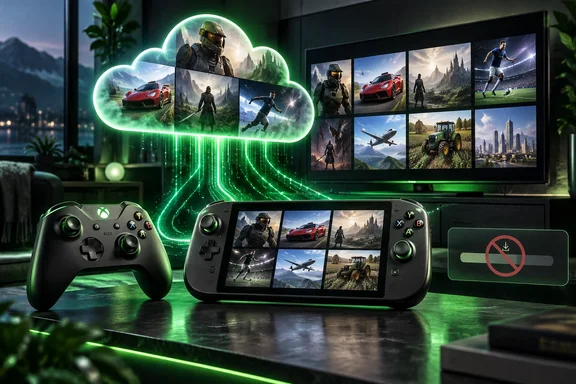
The additions were first compiled by TrueAchievements, which reported the 30-game count on September 18. Microsoft has not issued a matching September blog post announcing this particular batch, but the Xbox Store independently confirms the underlying capability for at least some of its highest-profile entries. Onimusha: Way of the Sword, for example, is marked cloud-playable with Game Pass Essential, Premium, or Ultimate — with the game purchase still required.
That last clause is the one prospective users should pay attention to. This is not a 30-game Game Pass drop. It is an expansion of the cloud entitlement attached to games players already own, alongside titles they may already access through their Game Pass catalog.
The 30-game figure is a catalog update, not one release-day launch
The September additions cover a mix of new releases, older games, free-to-play titles, and games that are already part of Game Pass. The list reported by TrueAchievements includes Aniimo, Avatar Legends: The Fighting Game, Bendy and the Ink Machine, Bus Simulator 27, Call of Duty: Black Ops Cold War, Deconstruction Simulator, Dice A Million, Ferocious, Honeycomb: The World Beyond, and Hot Wheels Infinite Rush.
The rest of the reported additions are Kernel Hearts, Mewgenics, Moonlighter 2: The Endless Vault, Mortal Shell II, MXGP 2021 – The Official Motocross Videogame, NBA 2K27, No More Room in Hell 2, Onimusha: Way of the Sword, Railbreak DX, Romeo is a Dead Man, RuneScape: Dragonwilds, Shape of Dreams, Shelldiver, Sniper Dan, SpeedRunners 2: King of Speed, Super Woden Rally Edge, The Blood of Dawnwalker, The Royal Writ, Train Sim World 7, and Virtua Fighter 5 R.E.V.O. World Stage.
Cloud gaming publication Cloud Dosage reported a smaller, 19-game subset earlier in the week, including Mewgenics, Mortal Shell II, NBA 2K27, No More Room in Hell 2, and Onimusha. That difference is more useful than it first appears: these catalog changes have been arriving in stages, and third-party trackers are not necessarily observing the same moment or applying the same definition of an addition.
Players should therefore treat the 30-title figure as a September tally, rather than expect every game to have appeared simultaneously on every client and in every supported market. The reliable test is still the cloud-playable label on the individual Xbox Store page or the title’s listing in the Xbox Cloud Gaming library.
Ownership and subscription are two separate requirements
Microsoft’s naming makes this easy to misunderstand. Stream Your Own Game does not mean that any title in a user’s Xbox purchase history can be streamed. It means a subscriber can stream a title they own only when Microsoft has enabled that game for the program.
For paid games such as Onimusha: Way of the Sword, the Xbox Store is explicit: the title requires a purchase, then supports cloud play through Game Pass Essential, Premium, or Ultimate. That is a meaningful change from the earlier version of the feature, which was initially tied to Game Pass Ultimate before Microsoft broadened cloud access across its reorganized membership tiers.
The feature also overlaps with the Game Pass library without replacing it. TrueAchievements notes that Call of Duty: Black Ops Cold War, RuneScape: Dragonwilds, Moonlighter 2, Dice A Million, Kernel Hearts, Shelldiver, Shape of Dreams, Virtua Fighter 5 R.E.V.O. World Stage, The Royal Writ, and SpeedRunners 2 are presently available through Game Pass at qualifying subscription levels. For those titles, a subscriber who has the relevant catalog access does not need to buy a separate copy merely to play through the cloud.
That can change when a game leaves Game Pass. If it remains supported by Stream Your Own Game, buying it means the player can continue streaming it; if it is removed from both the subscription catalog and the supported owned-game list, cloud access disappears. Microsoft’s cloud entitlement is tied to a shifting service catalog, not a permanent promise that every digital purchase will be streamable forever.
Free-to-play Aniimo is a separate edge case. There is no purchase hurdle for the game itself, but the cloud access requirement still applies. The fact that a game costs nothing does not turn Xbox Cloud Gaming into an unrestricted free streaming service.
The useful upgrade is storage relief, especially on Windows handhelds
Microsoft said in its April Xbox Update that the owned-game cloud library had passed 1,000 supported titles. Thirty more games is a modest increase against that base, but the composition of this batch makes it more useful than a catalog refresh dominated by legacy titles.
Several additions are current releases that can place large installation demands on a console, Windows gaming PC, or handheld. For a Windows 11 handheld such as the ROG Xbox Ally, streaming Onimusha, NBA 2K27, or The Blood of Dawnwalker can preserve internal SSD space and eliminate the wait for a full download. On a desktop PC, it also offers a way to sample a supported game before committing storage and bandwidth to a local installation.
The trade-off is familiar to cloud players: storage savings come at the cost of dependence on latency, available network capacity, and Microsoft’s streaming infrastructure. Fast action games are the least forgiving use case. TrueAchievements specifically characterized Onimusha: Way of the Sword as a poor fit for cloud play because its combat leans heavily on timing, an assessment that will resonate with anyone trying to parry or dodge through an unstable Wi-Fi connection.
That does not make the feature irrelevant for demanding games. It makes the device and connection part of the purchasing decision. A player using a TV app, browser, phone, or underpowered PC may value instant access more than perfect response times; a player with a capable gaming PC and a tight-action title may still prefer a local installation.
Microsoft is expanding the catalog while cloud limits loom
The timing is awkward. Xbox is adding newer, more desirable owned-game streaming options even as reports from cloud-focused outlets indicate that Microsoft plans monthly cloud-play limits for Game Pass subscriptions beginning in November. Cloud Dosage reported that Ultimate members would receive 15 cloud hours per month, with lower allowances on less expensive tiers.
Microsoft had not published a September explanation alongside this 30-title catalog expansion addressing how those reported limits would apply to owned games. That omission matters more than the raw title count. Stream Your Own Game has value because it allows a digital purchase to travel across devices; a strict usage allowance would make that portability less attractive for players who use cloud streaming as their primary way to play.
For now, the immediate result is more concrete: owners of the newly supported titles can check their Xbox Cloud Gaming library and stream them without a local install, using Game Pass Essential, Premium, or Ultimate where cloud play is supported. The larger question is whether Microsoft’s November service rules will make that newly expanded catalog feel like a benefit players can use freely, or a library they must ration.
References
- XBOX Cloud Gaming Expands Stream Your Own Game With 30 New Titles Windows Report · 2026-09-19T07:11:03+00:00