

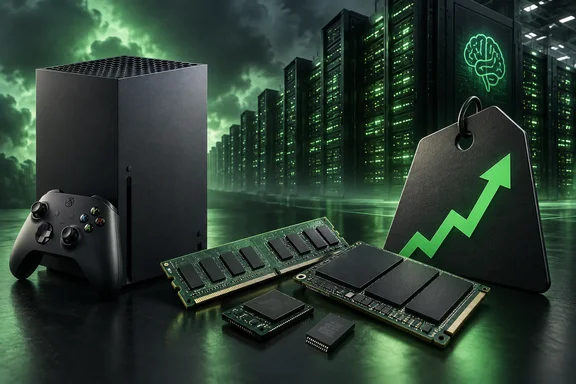
Business Insider's So Expensive series covers this in a new episode. The report connects the rising cost of consumer electronics, consoles included, to AI data centers buying up memory and storage. It highlights Xbox's warning that console memory and storage costs are expected to double again by fall 2027. It also looks at whether this could change how console makers price and sell hardware, perhaps even making consoles something you pay for monthly, like a phone.
Here's what the official record supports, and what is still opinion or speculation.
What Xbox actually announced
The concrete change arrived on June 25, 2026. On Xbox Wire, Microsoft said that effective August 1, 2026, it would update prices worldwide: Xbox consoles would increase by US$100 for 512 GB models and US$150 for 1 TB models, and the 2 TB model would be sunset. Those prices are now in effect.
This was the second increase in about a year. Microsoft said that last October it increased Xbox console prices by $20-$70 in the U.S., hoped another increase would not be necessary, and spent several months working with suppliers on options.
Microsoft blamed components. Per the company, console storage and memory prices have increased by more than 2.5x, it expects another doubling by the fall of 2027, and while the whole consumer electronics industry is struggling with the components crisis, the effects are particularly hard on consoles.
The post also explains why consoles are hit so hard. Unlike phones, PCs and speakers, Xbox says consoles are typically sold for less than they cost to make. When your hardware already loses money, a jump in component costs can't be absorbed through profit margins. That is Microsoft's stated reasoning, not an independent audit of its costs, but it fits how console hardware has long been sold.
Section summary: The August 1 price increase is a fact. The fall 2027 doubling is Microsoft's forecast. A price for the next-generation console has not been announced.
The new price list
According to TechPowerUp, U.S. prices after the increase are: 512 GB Series S: $499.99; 1 TB Series S: $599.99; 512 GB Series X Digital: $749.99; 1 TB Xbox Series X $799.99.
| Model | Price after Aug. 1, 2026 (US) | Nov. 2024 list price (Xbox Wire) |
|---|---|---|
| Series S 512 GB | $499.99 | $299.99 |
| Series S 1 TB | $599.99 | $349.99 |
| Series X Digital | $749.99 | $449.99 (1 TB Digital Edition) |
| Series X 1 TB | $799.99 | $499.99 |
| Series X 2 TB | Discontinued | $599.99 (Galaxy Black) |
The right-hand column comes from Xbox's November 2024 console lineup post. It shows how far prices have moved in under two years. The entry-level Series S has gone from about $300 to about $500. TechPowerUp's list shows the Series X Digital as a 512 GB model, while the 2024 version was 1 TB, so that row isn't an exact like-for-like comparison.
A correction on the Business Insider transcript: it says the 512 GB Series S went from $400 to $500, which matches. It gives the 1 TB model's old price as "4:50," which is a transcription error. Tech-Insider, citing Windows Central, reported that the 1TB model climbed from $449.99 to $599.99, which matches the $150 increase Xbox announced.
Xbox says the increase applies worldwide but states the amounts in U.S. dollars. Prices outside the U.S. won't necessarily have moved by those exact amounts, so check your local Microsoft Store.
The AI data center connection
Business Insider presents AI infrastructure as a major driver here, and other outlets back up the general mechanism. CNBC reported that memory makers such as Micron and SK Hynix have limited capacity and are prioritizing high-bandwidth memory for AI infrastructure such as Nvidia's GPUs, and they are raising prices to reflect higher demand, which widens their profit margins. CNBC also noted that the Xbox announcement came hours after Apple announced price increases for MacBooks and iPads, so consoles are far from the only devices affected.
Keep the causation claim in proportion. Neither Business Insider's episode nor Xbox's announcement puts a number on how much of the increase comes from AI data centers. "AI demand is squeezing memory supply" is well supported as an industry explanation. "AI caused exactly X percent of your console price increase" is not something the evidence shows.
There's also an awkward irony: Microsoft, one of the world's biggest AI infrastructure spenders, is raising console prices partly because of an AI-driven component shortage. TechPowerUp's comment section noticed. At least one reader called it ironic given Microsoft's strong push behind AI. That's a fair point, though a single company's buying doesn't set the global memory market.
Section summary: AI demand pressuring memory supply is a well-supported explanation. How much of the price increase it accounts for is unknown.
The CEO's timeline
A June 10 memo from Xbox CEO Asha Sharma to employees, published on Xbox Wire, gave a more detailed timeline:
- When Sharma joined as CEO in February, Xbox was paying more than twice as much for console storage components as it had the previous fall.
- Those costs then doubled again.
- Planning for the 2027 holiday season, Xbox expects another significant increase, which would put storage prices at more than five times what it paid two years earlier.
- Memory costs followed a broadly similar path.
This timeline measures from a different starting point than the June 25 "2.5x now, double again by fall 2027" figure. Combining the two into one precise forecast would be sloppy math. Both say the same thing, though: costs haven't peaked.
The memo also said Xbox currently can't build as many consoles as players want to buy, and that it needs a new hardware business model and new partnerships while it remains committed to its next-generation hardware, Project Helix. No launch date or price for Helix has been announced. Fall 2027 is when Xbox expects component costs to double, not a confirmed Helix launch window.
Will consoles be sold like phones?
The episode features gaming YouTuber Luke Stevens, who describes the mood among players as dread rather than the excitement that usually comes with a new generation. He points out that the top-tier version of a roughly six-year-old console now costs close to $1,000. He predicts consoles will increasingly be sold on two- or three-year plans, like phones, and says few people can afford a $1,200 to $1,500 console outright.
Those figures are Stevens's opinion and a hypothetical. They are not an Xbox announcement or an analyst forecast. Still, Xbox is already moving toward financing. Its June 25 post announced:
- Buy Now, Pay Later on eligible Xbox hardware through Microsoft Stores, split into short-term, interest-free installments.
- 0% APR financing for up to 12 months on eligible hardware, through partners.
- Trade-in and resale programs with retail partners, offering cash or store credit for old consoles, which are then resold at lower prices.
- Certified Refurbished consoles at Microsoft Stores for up to US$100 off MSRP.
Xbox notes that payment options vary by region, credit comes from third parties, and eligibility rules apply.
Twelve months of financing isn't the same as a 36-month phone-style contract, so Stevens's prediction hasn't come true yet. The move toward monthly payments has clearly started, though.
What buyers should do now
- If you need a console soon: Look at Certified Refurbished units first. Up to $100 off the new MSRP matters more when that MSRP has jumped. Only consider financing if you'd be comfortable paying the full price anyway, since "0% APR" loans can carry penalties if you miss a payment.
- If you're waiting for the next generation: Budget carefully. Microsoft hasn't given a price, but its own cost forecast points up, not down.
- If you have an older console: Watch for the trade-in programs to open with retailers near you. Your old hardware may be worth more than you think.
- If you game on PC: Memory and SSD prices come from the same market Microsoft is complaining about, so upgrading RAM or storage probably won't get cheaper soon either.
The price increase has already happened. Xbox itself is forecasting more cost pressure through 2027. Whether that means a $1,000-plus next-generation Xbox, a monthly payment plan, or a bigger push toward cloud streaming hasn't been decided, and Microsoft hasn't said.
References
- AI data centers' demand for memory and storage is helping drive up costs of consumer electronics, including gaming consoles. Xbox says its console memory and storage costs are expected to double again by fall 2027. For players, that could mean the next g - LinkedIn LinkedIn · Mon, 28 Sep 2026 17:00:58 GMT
- Microsoft lifts price of Xbox consoles due to soaring component costs cnbc.com
- Xbox Console Prices Skyrocket in August | TechPowerUp techpowerup.com