

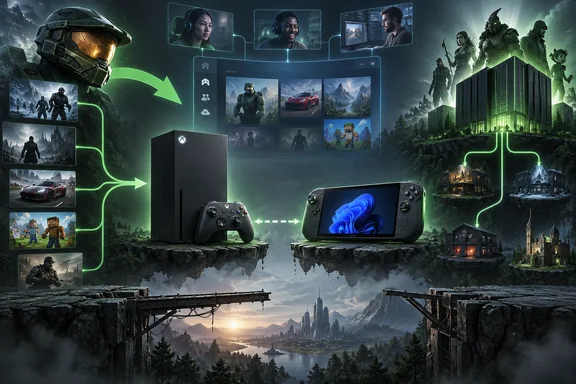
Microsoft's September 22 Xbox Reset Moves Halo to Activision
Chief content officer Matt Booty's memo to Xbox staff contained three announcements. First came the job cuts: another 268 jobs across Halo Studios, other first-party developers, and Xbox Game Studios management. Microsoft said "The actions completed since July, inclusive of the studio divestitures, bring us roughly three-quarters of the way through previously announced restructuring". That figure is Microsoft's own estimate of progress. It is not a final count of jobs or studios. TechSpot puts it in context: job losses from July 2026 to July 2027 will total around 3,200, which matches the roughly 3,200 cuts across fiscal 2027 that Kimmich cites.
Second came the reorganization. Microsoft said the goal is to strengthen its franchises and games by operating fewer business units, aligning groups that already work closely together, and focusing its publishing expertise. The concrete moves:
- Activision adds Rare and World's Edge and will develop the next Halo with a new, purpose-built team that is separate from ongoing development and plans for Call of Duty.
- A small team at Halo Studios will continue supporting the Halo community and games in-market.
- Bethesda adds Obsidian, which will continue its current projects, including Grounded, as well as the new Fallout project made in collaboration with Bethesda Game Studios.
- King, which makes Candy Crush, takes Microsoft Casual Games.
- Playground and Turn 10 merge into a single studio for Forza and Fable.
Third was an update on the studios being spun off, and each has a different outcome. Compulsion Games and Double Fine returned to their own management in August with their IP, back catalogs and runway funding. Undead Labs has left on similar terms and, with a new publisher, will release State of Decay 3 day one on Game Pass. Two separate agreements to sell Ninja Theory fell through, so Microsoft is starting employee consultation on a proposed closure while it looks for other options. Consultation at Arkane continues through the end of the year. None of these studios should be lumped together as simply "sold" or "closed."
Industry reaction was split. The Next Web reported that analyst Christopher Dring said putting the series under Activision makes sense, with the caveat that the company should be mindful not to lose what makes Halo unique. Aftermath ran its coverage under the headline "There Is No Plan."
Jon Kimmich Separates Microsoft Gaming From the Xbox Platform
Kimmich is CEO of the games consultancy Software Illuminati and spent 16 years at Microsoft, including the years when the original Xbox was conceived and launched. His essay rests on one distinction. Microsoft Gaming is the whole business and its profit and loss: King, Activision, Blizzard, Bethesda, Mojang, hardware, subscriptions, stores and services. The Xbox platform is Microsoft's relationship with players and developers: the console, Xbox Mode, commerce, identity, ownership, community, tools and third-party support. As he puts it, Microsoft Gaming can grow while the Xbox platform withers.
He uses "XboxOS" throughout as shorthand for the operating-system layer of that platform. He says clearly that Microsoft has announced no such product, and readers should keep that in mind for everything below.
In Kimmich's telling, Xbox's old trouble was structural. Windows chased ubiquity, Azure chased cloud usage, the console business chased store revenue, Game Pass chased subscribers and studios chased hits. Each choice made sense on its own, and together they didn't add up. He reads Xbox CEO Asha Sharma's reset memo as an admission of this. He cites its descriptions of silos, decisions that passed through as many as 14 management layers, and a "platform team" that grew 40% while players and playtime fell. He notes that Sharma says a single executive now holds end-to-end P&L responsibility for content, hardware, platform and services "for the first time."
He sees the logic of the September map: fewer units, with franchises placed under operators that already have proven commercial machinery. His objection is that this is "a publishing answer, not a platform answer." Nothing in the reorganization explains how Activision, Bethesda or King will draw players to Xbox, as opposed to growing their own audiences and P&Ls.
Halo Becomes the Test Case for Xbox Exclusivity
Kimmich treats Halo as the clearest example of that conflict. Its history explains why. Halo launched in 2001 alongside the first Xbox, made by Bungie. Windows Central's Jez Corden told the BBC that Halo was once to Xbox what Mario is to Nintendo, but years of mismanagement have eroded that.
Kimmich accepts that a purpose-built Activision team might make a better Halo. What worries him is how that team will be judged. If it is measured mainly on reach and franchise revenue, the rational choice is to ship Halo everywhere. If Xbox needs Halo to pull players onto its platform, someone with authority over the whole P&L has to put a value on that and pay for it. Same franchise, different objective.
He points to this year's Gamescom as an early sign of a split. Gears of War: E-Day and Fable were shown for Xbox console, PC and Game Pass, with no PS5 version announced. State of Decay 3 is also coming to PS5, and Minecraft Dungeons II stays fully cross-platform. He praises Microsoft's deal to publish Kojima Productions' PHYSINT after PlayStation Studios walked away from it. It gets Xbox a potentially defining game without another studio purchase, though he notes its platforms haven't been announced, so it says nothing yet about exclusivity. What Xbox needs, he argues, is a policy on which games stay platform-defining, and that policy has to last longer than one news cycle.
Console Price Hikes and Project Helix Squeeze the Hardware Anchor
Microsoft's leadership has said the console comes first. Kimmich quotes Sharma's top priority as "CORE: Strengthen our platform, led by console." He cites the numbers behind it: content and services revenue down 10% in the June quarter, and full-year hardware revenue down 29% on lower console volume.
His problem with a console-first plan is timing. Microsoft's latest price increases took effect worldwide on August 1: $100 more for 512GB models and $150 more for 1TB models, with the 2TB model discontinued. Microsoft blamed components. It said storage and memory prices have risen more than 2.5 times, expects another doubling by fall 2027, and noted that consoles are typically sold below what they cost to make. Those figures are Microsoft's explanation and forecast, not independent market data. Kimmich gives the U.S. prices after the increase as $799.99 for the 1TB disc-drive Series X, $499.99 for the 512GB Series S and $599.99 for the 1TB Series S. He also cites a $899.99 Series X25 collector's edition bundled with Halo: Campaign Evolved, and Valve's Steam Machine at $1,049 to $1,349. Those specific prices come from his essay.
Project Helix is Microsoft's next-generation first-party console, announced at GDC in March 2026. Microsoft describes it as a custom AMD system-on-chip designed alongside the next generation of DirectX and FSR, claims an order-of-magnitude leap in ray-tracing performance, and plans to send alpha hardware to developers starting in 2027. There is no retail price or consumer launch date. The most important detail for this story is that Helix is designed to play both Xbox console and PC games.
Kimmich reads Helix as a balancing act between three goals that pull against each other:
- keeping enough Xbox Store revenue to subsidize the hardware;
- opening the platform far enough that cross-platform play means something;
- keeping the price low enough for a mass-market console.
He notes that Sharma told the BBC Helix must balance "efficiency and affordability alongside performance" but didn't confirm a disc drive. His conclusion: Microsoft-built boxes approaching $1,000 are poor tools for winning back players. The economics of the platform can't rest only on Microsoft building every box itself.
Xbox Mode, Play Anywhere and Disc-to-Digital Are the Platform Pieces Already Shipping
A few parts of Kimmich's platform idea already exist, and this is where the essay connects most directly to Windows.
Xbox Mode first appeared in an early version on the ROG Xbox Ally handhelds and started rolling out to Windows 11 in select markets in April 2026. Microsoft describes it as a full-screen, controller-optimized Xbox experience that lets players switch between work and play while keeping Windows open. It runs on top of Windows. It is not a separate operating system. Kimmich cites Ars Technica's testing, which found that buying or downloading from Steam or Epic usually meant dropping back into those companies' desktop apps. Microsoft calls that flexibility. Kimmich says that, controller in hand on the couch, it feels rough and unfinished.
Xbox Play Anywhere is Microsoft's program for buying a supported game once and playing it on both console and Windows with progress carried over. Microsoft says the catalog has passed 1,500 games and that 500 development teams have shipped through it. Kimmich adds that Microsoft says developer onboarding, which could once take months, now takes about 30 minutes. Publishing is still a separate step, but the GDK and its documentation are public.
The newest piece is disc-to-digital, announced August 26, with Xbox Insider testing from August 31. Microsoft's instructions are to insert a supported disc into an Xbox One or Xbox Series X console and launch the game. That claims a digital entitlement, which unlocks Play Anywhere and Xbox Cloud Gaming where the game supports them, and the disc keeps working as before. Microsoft says most Xbox One and Series X disc games are supported, starting with "thousands" of titles, but not every title will be available at launch. Microsoft hasn't published rules on resale, transfers or which publishers are taking part. Kimmich calls it the first concrete test of treating ownership as a platform asset: a supported disc becomes a way into the entitlement system rather than a dead end tied to one drive. He argues this matters more because, in his account, Sony plans to go discless for new PlayStation releases in 2028.
The weak point in his XboxOS vision is hardware partners. Valve lets other companies build SteamOS devices, with Lenovo shipping the first licensed third-party SteamOS handheld in May 2025. Kimmich notes that Sharma called Helix a "great family of devices" at Gamescom. He also says plainly that no OEM or licensing terms have been announced, so the phrase is a signal, not a plan. For Lenovo or Asus to choose a Microsoft gaming OS over plain Windows or SteamOS, he lists what Microsoft would need to offer:
- a seamless controller-first interface;
- the Xbox console and PC catalogs;
- Play Anywhere cross-buy and cross-save;
- Game Pass;
- simpler certification;
- co-marketing;
- licensing terms that leave the OEM room to make money.
Where the Savings Go Decides Whether Xbox Stays a Platform
The second half of the essay asks who pays for an open Xbox. Mobile is making money. Kimmich cites AppMagic estimates of more than $1.7 billion in 2025 in-app spending, $1.3 billion of it from King. But the Xbox mobile store once promised for July 2024 never appeared. He argues that King should keep its own brand and contribute cash and expertise, not wear Xbox green. Minecraft, with Microsoft accounts and its Marketplace creator program, is the more interesting case. The open question is whether its creator tools make Xbox more valuable, or only Minecraft.
He is blunt about what Microsoft has to own and what it can charge for. Owning the platform means controlling identity, commerce, entitlements, discovery and transaction data. That makes Microsoft the price-maker. A pure publisher is a price-taker, paying Apple, Google, Sony and Valve a toll at every gate. His prescription:
- Microsoft should own identity, entitlements, commerce and community.
- It should charge through Store transactions, first-party sales, Game Pass and OEM licensing.
- It should subsidize the plumbing, including PlayFab, Azure, DirectX and dev tools, so developers can get in easily.
- The Xbox Store on PC has to be credible first on catalog, reliability, refunds, reviews, ownership and developer economics. Only then can cross-buy and simpler publishing set it apart.
He wouldn't keep Steam off Xbox hardware. He would try to make Xbox the best place for Steam, Epic, GOG, Battle.net, Game Pass and direct developer relationships to live side by side. He also warns that an Xbox good only for launching Steam amounts to "subsidizing Valve's cash register." He sees Gamescom's Battle.net promotion with Diablo IV and The Witcher 3 Remastered arriving through Play Anywhere as two separate experiments against Steam. Unless Battle.net and the Xbox Store share identity, entitlements or economics, they don't add up to one platform.
He treats the idea of spinning off Xbox, raised by former Activision COO Thomas Tippl, as a thought experiment until someone spells out which franchises, entitlements and liabilities would leave Microsoft. The practical test comes sooner. If the savings go back into Helix, Xbox Mode, the Store, developer tools and signature games, Microsoft is still building a platform. If the cash goes up to the parent company while more assets are sold, he calls that a managed retreat, whatever the memo says. His worst case is a company that promises a platform while running a harvest portfolio.
What this means for Xbox owners and Windows PC gamers
For most readers, the decision is about where to build your library over the next two years. Nothing announced on September 22 changes games you already own or how Xbox Mode on Windows 11 works today. The signals worth watching are the ones Kimmich lists for the next 12 to 24 months: third-party devices running an Xbox OS layer, rising Play Anywhere and PC Store use, disc-to-digital carrying over to Helix, faster publishing for developers, a decision on how Battle.net relates to the Xbox Store, and an exclusivity policy that holds for more than one reporting period.
- If you own Xbox One or Series X discs, enroll in the Xbox Insider Program to test disc-to-digital. Expect only supported titles, and don't assume the resulting digital license can be resold or transferred.
- Before relying on cross-device ownership, check whether a game carries Xbox Play Anywhere support. The catalog has passed 1,500 games but does not cover every Xbox title.
- If you're buying hardware now, remember the August 1 price increases and that Helix has no price or launch date. Developer alpha kits arrive in 2027.
- If you use Xbox Mode on Windows 11, expect Steam and Epic purchases and downloads to still drop you back into those launchers' desktop apps.
- If you're a developer, the Xbox GDK and documentation are public, and Play Anywhere reaches both console players and Windows users.
- If you follow Halo, watch whether Microsoft explains what the next game is meant to do for the Xbox platform, not just who is making it.
Kimmich comes down firmly on the side of Xbox as a platform: keep the console as the reference device, turn Xbox Mode into a coherent layer on Windows and partner hardware, and make ownership and developer reach the reason to pick Xbox. The September 22 map makes Microsoft a more disciplined publisher and leaves that bet unmade. The next chance to see which way it goes is October 6, when Booty has scheduled an all-Xbox town hall to review progress and preview upcoming games. TechSpot notes the date falls the day before Microsoft's first Surface event in more than two years.
References
- Quo Vadis, Xbox? | Jon Kimmich guest post - GamesBeat GamesBeat · 2026-09-23T14:44:51+00:00
- Xbox lays off 268 more people as Activision takes over Halo and Bethesda absorbs Obsidian | TechSpot techspot.com
- Continuing Our Reset - XBOX Wire news.xbox.com