

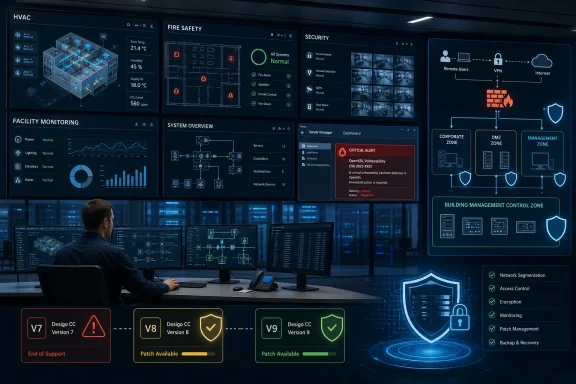
For organizations operating Siemens Desigo CC as part of a building-management, fire-safety, security, or broader critical-infrastructure environment, this is not simply another software-library update. The flaw resides in a cryptographic dependency, but the operational implications extend to the Windows systems, network zones, remote-access paths, service integrations, and change-control processes that surround the Desigo CC deployment.
The immediate priority is clear: identify the deployed Desigo CC version, apply the vendor-provided update where one exists, and place compensating controls around systems that cannot yet be brought to a fixed release.
Overview: What the Siemens Desigo CC Advisory Says
The Siemens ProductCERT advisory, republished by CISA on July 28, identifies Desigo CC family V7, V8, and certain V9 releases as affected by CVE-2025-15467. The remediation position differs substantially by major version, making an accurate asset inventory essential before scheduling maintenance work. CISA’s advisory lists the following product status:
| Desigo CC release family | Advisory status | Vendor remediation |
|---|---|---|
| V7 | Affected | No fix currently available |
| V8 | Affected | Update to patch V8.0 QU2.0021 |
| V9 before V9.0 QU1 | Affected | Update to V9.0 QU1 or later |
The advisory’s machine-readable product range also describes affected V9 releases as versions below 9.0.1, while its remediation language uses the Siemens package designation V9.0 QU1. Administrators should therefore validate the installed product build against the exact update package and documentation made available through Siemens support, rather than relying only on a shortened version string in a local inventory report. CISA’s published remediation details identify V9.0 QU1 or later as the corrective path for V9 and V8.0 QU2.0021 as the corrective patch for V8.
This is an important distinction for Windows administrators. A workstation or server may report a Windows version, a Desigo CC major release, a maintenance-update label, and several underlying component versions. None of those labels should be treated as interchangeable. The relevant question is whether the installed Desigo CC package incorporates Siemens’ OpenSSL remediation.
Siemens’ own Desigo CC material describes the platform as a building-management solution that is expected to receive ongoing cybersecurity updates, an expectation that matters greatly when the platform connects operational technology, facilities services, and enterprise workflows. Siemens’ Desigo CC product information states that the platform receives regular updates intended to address new cybersecurity threats.
Why CVE-2025-15467 Is So Serious
CVE-2025-15467 is an out-of-bounds write vulnerability, classified under CWE-787. The affected OpenSSL code processes CMS AuthEnvelopedData or EnvelopedData content using AEAD ciphers, including AES-GCM. An attacker can craft message parameters containing an oversized initialization vector, or IV, that is copied into a fixed-size stack buffer without sufficient length validation. OpenSSL’s vulnerability record describes the defect as a stack buffer overflow in CMS (Auth)EnvelopedData parsing.
The key security detail is timing. The malformed data reaches the vulnerable copy operation before authentication or tag verification has completed. In practical terms, the parser can be exposed to the malformed structure without the attacker first possessing a valid cryptographic key or creating a correctly authenticated encrypted message. OpenSSL’s advisory summary notes that no valid key material is required to trigger the overflow because it occurs before authentication.
That does not mean every affected Desigo CC system is automatically remotely exploitable. A vulnerable library must be reachable through an application workflow that parses untrusted CMS or PKCS#7 content using the affected AEAD path. The exact exposure will depend on the roles enabled on a system, the protocols and integrations in use, trust relationships with clients and servers, firewall rules, email or message-processing workflows, and whether an attacker can deliver crafted content to the relevant parser.
However, organizations should not downgrade the seriousness of the issue simply because exploitability can vary. A stack-based out-of-bounds write is among the more consequential memory-safety failures because it can cause:
- Denial of service, including a crashed application or unavailable management service.
- Potential remote code execution, depending on the surrounding application, platform hardening, compiler protections, and exploit conditions.
- Integrity risk, if an attacker can gain execution in the context of a vulnerable service.
- Confidentiality risk, if a successful compromise enables access to sensitive operational, facilities, or credential-related data.
- Operational disruption, particularly when the affected system is relied upon for monitoring, alarms, supervisory control, or incident response.
OpenSSL characterizes the issue as a potential crash or remote-code-execution condition, while emphasizing that practical remote-code-execution feasibility depends on the operating environment and available mitigations. OpenSSL’s CVE entry provides that qualification directly. The 9.8 CVSS score in the Siemens/CISA advisory should therefore be read as a measure of the vulnerability’s worst-case security characteristics, not as proof that every unpatched deployment can be compromised through the same path. CISA’s Siemens advisory provides the vector CVSS:3.1/AV:N/AC:L/PR:N/UI:N/S:U/C:H/I:H/A:H.
The OpenSSL Versions Behind the Exposure
The upstream OpenSSL issue affects multiple supported OpenSSL 3.x release branches. OpenSSL lists the vulnerable ranges as:
- OpenSSL 3.6.0 before 3.6.1
- OpenSSL 3.5.0 before 3.5.5
- OpenSSL 3.4.0 before 3.4.4
- OpenSSL 3.3.0 before 3.3.6
- OpenSSL 3.0.0 before 3.0.19 OpenSSL’s vulnerability index
The affected condition is notable because it is not a legacy OpenSSL 1.0.2 or 1.1.1 issue. OpenSSL states that those older branches are not affected by CVE-2025-15467, while the vulnerable code exists in the identified 3.x branches. OpenSSL’s published vulnerability details also note that the FIPS modules associated with the affected OpenSSL versions are not impacted because the CMS implementation sits outside the FIPS module boundary.
That FIPS distinction deserves careful handling. It does not mean that a Desigo CC system should be considered safe merely because it uses a FIPS-related deployment or operating model. The upstream statement concerns the boundaries of the OpenSSL FIPS module itself; it does not erase the vulnerability in the wider OpenSSL CMS implementation used by a product. The NVD record for CVE-2025-15467 similarly reflects that the CMS implementation is outside the affected FIPS module boundary.
For IT teams accustomed to applying Microsoft Patch Tuesday updates, this illustrates a familiar but critical reality: Windows patching and application patching are separate responsibilities. A fully updated Windows Server host can still contain a vulnerable third-party application component if the vendor’s product update has not been installed. Conversely, replacing or updating a standalone OpenSSL binary on a server should not be assumed to fix an application that ships, embeds, or otherwise manages its own dependency set.
The supported remediation route is Siemens’ product update, not an improvised attempt to replace cryptographic libraries inside a packaged building-management application.
Why Desigo CC Environments Need a Different Response
Desigo CC belongs to a category of software where availability and trust are inseparable. A typical business application can often tolerate a short restart, deferred maintenance, or a temporary service outage. A building-management platform may instead support visibility into building systems, alarms, security-related functions, environmental control, and operator workflows that cannot simply be paused without a documented operational plan.
That makes this both a vulnerability-management issue and an operational-resilience issue.
Patch urgency must be balanced with safe deployment
Siemens strongly recommends validating security updates before installation and ensuring that trained personnel supervise the update process in the target environment. CISA’s republication of the Siemens guidance specifically advises prior validation and supervised deployment. This is sound advice for any enterprise product, but it carries extra weight in operational environments where a failed update, incompatible extension, certificate problem, or unexpected service restart can affect a facility’s day-to-day operations.
A high-quality Desigo CC patch plan should include:
- Version confirmation
Record the Desigo CC family, exact update level, server roles, installed clients, extensions, and related management components. - Dependency and integration review
Identify links to identity services, databases, management networks, remote-access platforms, alarm receivers, field networks, and third-party systems. - Backup and recovery validation
Confirm that both configuration and operational data are backed up according to the organization’s established procedures, and verify that restoration responsibilities are understood. - Maintenance-window coordination
Coordinate with facilities, security, IT operations, service partners, and any stakeholders responsible for monitoring or responding to critical events. - Staged validation
Where the architecture permits, validate the Siemens update in a representative non-production or controlled environment before broad deployment. - Post-update monitoring
Verify core Desigo CC functions, Windows event logs, service health, client connectivity, certificate-dependent workflows, and relevant alarm or monitoring interfaces after installation.
This approach can feel slower than an emergency patch pushed across conventional endpoints. Yet in a building-management environment, speed without verification can create a second availability incident. The strongest response is urgent and disciplined.
The V7 challenge is more than a versioning problem
The most difficult group is the Desigo CC V7 population. Siemens’ advisory identifies V7 as affected and lists no fix currently available. CISA’s advisory makes that status explicit.
For those installations, the response cannot stop at “watch for an update.” It should shift immediately toward exposure reduction, compensating controls, and upgrade planning. A lack of an immediate vendor patch is not a reason to accept unnecessary network exposure; it is a reason to scrutinize every path by which untrusted data, untrusted systems, or untrusted users could reach the Desigo CC environment.
Practical Mitigations for Unpatched and High-Risk Systems
CISA recommends that organizations minimize network exposure for control-system assets, keep such systems inaccessible from the internet, isolate control networks from business networks, and use more secure methods such as VPNs when remote access is necessary. CISA’s recommended practices also caution that VPN security depends on maintaining both the VPN and the devices connected through it.
Those recommendations should be translated into concrete Desigo CC architecture decisions rather than treated as general security slogans.
Segment the environment
A Desigo CC server should not be casually reachable from corporate user networks, guest Wi-Fi, unmanaged endpoints, or external networks. Siemens’ industrial cybersecurity guidance emphasizes secure architectures, segmentation, controlled data flows, hardening, patch management, and secured backups for operational technology environments. Siemens’ industrial cybersecurity services overview frames those controls as core OT security practices.
Practical segmentation actions include:
- Place Desigo CC servers and engineering systems in a dedicated, controlled network zone.
- Allow only documented communication flows between clients, servers, field gateways, identity services, and approved support systems.
- Restrict administrative protocols to hardened jump hosts or management workstations.
- Block direct inbound internet access.
- Use firewalls to enforce explicit allow rules rather than broad internal-network trust.
- Separate third-party maintenance access from ordinary office connectivity.
- Review legacy rules that were created for commissioning and never removed.
Segmentation does not patch CVE-2025-15467. What it does is reduce the number of systems and identities capable of reaching the vulnerable service path. That can materially lower attack opportunity while an update is tested, scheduled, or awaited.
Treat remote access as a privileged service
Remote access is often essential for distributed facilities, system integrators, and support personnel. It should also be considered one of the highest-value control points around an unpatched Desigo CC installation.
A secure remote-access design should require:
- Multi-factor authentication for remote administrative access.
- Named accounts, not shared credentials.
- Least privilege, with roles scoped to the task and environment.
- Time-bounded access for contractors and vendors.
- Session logging and, where appropriate, session recording.
- Hardened jump hosts rather than direct remote desktop exposure to servers.
- Rapid access revocation when a maintenance task, contract, or incident response period ends.
This is particularly important because the CVSS vector for the Siemens advisory includes no privileges required in its most severe model. CISA’s CVSS assessment does not mean every reachable Desigo CC interface is vulnerable, but it does underscore why unnecessary access paths should be removed rather than merely monitored.
Reduce untrusted-content pathways
The upstream flaw is tied to parsing crafted CMS or PKCS#7 structures. OpenSSL’s vulnerability documentation specifically identifies applications and services that process untrusted CMS or PKCS#7 content using AEAD ciphers as the vulnerable use case.
Security teams should therefore examine, without disrupting supported product functionality:
- Integration points that accept signed, encrypted, or PKCS#7/CMS-formatted content.
- Message-handling workflows and certificate-related exchanges.
- File-import or document-processing processes associated with external parties.
- Remote support or client pathways that cross security zones.
- Systems that can relay content into the Desigo CC server environment.
The objective is not to disable cryptography or make unsupported configuration changes. It is to understand where untrusted structured content may enter the environment and to constrain that traffic using approved product and network controls.
A Windows Administrator’s Patch-Verification Checklist
Windows administrators should resist the temptation to define remediation solely as “install the update and close the ticket.” A Desigo CC security update should be verified at several levels.
Confirm the product update, not just the operating system
Start by confirming whether the relevant Desigo CC server or client is V7, V8, or V9. Then map that result to the Siemens guidance:
- V9: Move to V9.0 QU1 or later.
- V8: Install V8.0 QU2.0021.
- V7: Apply compensating controls and pursue Siemens-supported lifecycle or upgrade options because the advisory lists no currently available fix. CISA’s remediation table provides these product-specific actions.
Next, obtain the installer or patch only through authorized Siemens support channels and established procurement or service arrangements. Siemens has separately advised customers to verify the validity of digital signatures on Desigo CC software supplied by Siemens, a relevant safeguard whenever software updates are distributed into sensitive operational environments. Siemens ProductCERT guidance on Desigo CC software signatures recommends validation of supplied digital signatures to help prevent supply-chain attacks.
Verify the outcome after maintenance
A successful installer exit code is not sufficient evidence of remediation. After deployment, teams should verify:
- The displayed Desigo CC version and update level.
- Successful startup of required Desigo CC services.
- Expected client connection behavior.
- Operational dashboards, alerts, and configured workflows.
- Health of supporting Windows services and scheduled tasks.
- Relevant application and system event logs.
- Connectivity from approved client zones only.
- Continued enforcement of firewall and remote-access policies.
The goal is to establish both security remediation and functional continuity. This is especially important in a platform where operational staff may depend on the system’s visibility or alarm-handling capabilities.
Strengths in the Siemens and CISA Response
The advisory has several notable strengths.
First, it provides clear product-family remediation paths for V8 and V9 instead of merely naming a vulnerable third-party component. That matters because product operators need a supported update destination, not just a list of vulnerable OpenSSL versions. CISA’s Siemens advisory identifies the relevant Desigo CC update levels.
Second, the advisory does not overstate certainty around remote code execution. It identifies both denial of service and possible code execution while preserving the important qualification that exploitability depends on platform and toolchain mitigations. OpenSSL’s vulnerability record makes the same distinction.
Third, Siemens and CISA emphasize validated updates, trained supervision, segmentation, firewalls, VPN-based remote access where required, and risk analysis before changes are deployed. CISA’s defensive guidance recognizes that industrial and building-management environments require a more careful operational process than ordinary desktop patching.
Finally, the advisory’s scope helps organizations avoid a common security mistake: assuming that a cryptographic-library vulnerability is relevant only to a “crypto server.” In reality, vulnerable parsing behavior can exist inside application workflows that are not obviously branded as encryption services.
Risks That Remain After the Advisory
The most visible remaining risk is the absence of a fix for Desigo CC V7. Organizations with V7 estates may face difficult choices involving network isolation, tighter operational controls, longer-term migration work, and potentially significant coordination with building operators or service partners.
Another risk is asset ambiguity. Large environments may have multiple sites, different regional service arrangements, installed clients, redundant servers, disaster-recovery instances, test systems, or forgotten engineering workstations. A single unpatched node can undermine an otherwise strong remediation campaign if it remains reachable from a broader management network.
There is also the risk of misapplied remediation. Updating Windows, updating a standalone OpenSSL package, or applying a generic library patch does not necessarily update the OpenSSL component embedded or managed within Desigo CC. Siemens’ product-specific update guidance should take precedence over assumptions about the host operating system.
Finally, security teams should avoid using the FIPS-module statement as a blanket exception. The relevant distinction is narrow: OpenSSL says the vulnerable CMS implementation is outside the FIPS module boundary. OpenSSL’s CVE information does not describe the entire affected OpenSSL deployment as safe in FIPS-oriented environments.
The Bottom Line for Desigo CC Operators
CVE-2025-15467 is a critical OpenSSL stack buffer overflow with direct relevance to Siemens Desigo CC V7, V8, and earlier V9 deployments. Its technical trigger is specialized, involving malformed CMS or PKCS#7 encrypted-message content, but its potential consequences—service disruption or possible remote code execution—justify immediate attention in environments that manage building or operational infrastructure. OpenSSL’s advisory and CISA’s Siemens advisory both characterize the flaw as a severe pre-authentication memory-safety issue.
For Desigo CC V9, the supported action is to update to V9.0 QU1 or later. For V8, administrators should deploy V8.0 QU2.0021. For V7, where no fix is listed, organizations should immediately reduce exposure through strict network segmentation, firewall enforcement, controlled remote access, least privilege, monitoring, and a formal plan for a supported upgrade path. CISA’s product remediation guidance provides the version-specific direction.
The strongest response is not a rushed reboot or a checkbox-driven patch cycle. It is a verified Siemens Desigo CC update program combined with disciplined Windows administration, careful OT network design, and compensating controls that keep critical building-management systems reachable only by the people and systems that genuinely need them.
References
- Siemens Desigo CC CISA · 2026-07-28T12:00:00+00:00