

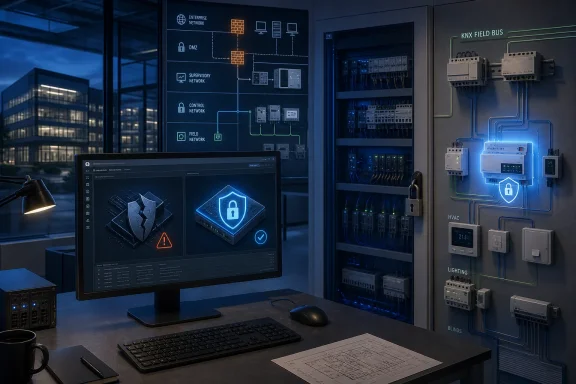
The defining complication is that ABB has no corrective software measure planned. The affected devices use classic KNX technology without the newer KNX Secure capabilities needed to establish the assurance that a firmware image is authentic and unaltered. That makes CVE-2026-12705 a lifecycle and architecture issue: organizations must compensate through physical protection, network segmentation, operational discipline, and ultimately migration decisions rather than wait for a conventional vendor patch.
Overview: What CVE-2026-12705 Means for KNX Deployments
The vulnerability is classified as CWE-353: Missing Support for Integrity Check. Firmware integrity is the process of validating that the code being installed is exactly the code the device manufacturer intended to release. Without a reliable integrity mechanism, an update workflow cannot properly distinguish a legitimate firmware image from a modified substitute.
According to the CVE record, the affected products are:
- KNX Update Tool (ABB) through version
2.0.175 - KNX Update Tool (BJE) through version
2.0.175
ABB describes the update capability as the ETS applications “ABB Firmware Update 2.0” and “BJE Firmware Update 2.0,” used to update firmware on various ABB KNX devices directly across the KNX bus. The workflow can obtain current firmware files from the internet automatically or allow manual import, and it is designed for use with ETS 5 or later. ABB’s advisory, republished by CISA
This distinction matters. The advisory concerns the integrity assurance around firmware updates for classic KNX devices, not a claim that every KNX installation can be remotely compromised through an exposed web service. ABB specifically states that successful exploitation requires physical access to the affected device’s KNX bus. CISA’s publication of ABB’s advisory likewise notes that remote exploitation is not the expected scenario.
That access requirement meaningfully reduces exposure in well-designed environments. It does not eliminate risk. Field-bus access can arise from unlocked plant rooms, poorly controlled ceiling voids, shared technical spaces, exposed cabinets, contractor access, improperly segmented interfaces, or access gained after a separate physical or IT intrusion.
The Security Rating Needs Context
ABB assigned CVSS v3.1 6.4, rated Medium, with the vector:
CVSS:3.1/AV:A/AC:H/PR:L/UI:N/S:U/C:N/I:H/A:H
The CVSS v3.1 vector reflects an adjacent attack vector, high attack complexity, low privileges required, no user interaction, and high impacts on integrity and availability. The newer CVSS v4.0 assessment is 5.9 Medium. NVD’s CVE-2026-12705 record
Those numbers are directionally useful, but security teams should resist treating “Medium” as synonymous with “routine patch-cycle item.” The score captures exploit preconditions, not the business significance of a particular building function. A manipulated lighting actuator in a low-risk zone and a manipulated device involved in access, hospitality room entry, perimeter controls, or operationally sensitive facilities can have radically different consequences.
ABB itself advises against using legacy KNX devices to control sensitive functions, explicitly citing examples such as access control to hotel rooms and other protected areas. The CISA advisory therefore points to the key operational lesson: risk is determined by the role of the device, not just the CVSS score of the update tool.
Why Firmware Integrity Is the Core Issue
Firmware updates are a high-trust operation
Firmware is not an ordinary configuration file. It is the code that determines how a field device behaves at its most fundamental level. A secure update process ordinarily depends on a chain of trust that verifies an image before a device accepts and installs it.
That assurance may involve one or more controls:
- Cryptographic signatures from the vendor
- Certificate-backed authentication
- Hash or checksum validation with authenticated distribution
- Secure boot or trusted boot validation
- Protected provisioning keys
- Anti-rollback protections
- A controlled and auditable update channel
CVE-2026-12705 is concerning because a missing integrity verification control means the update process cannot reliably provide that foundational trust for the legacy product class in question.
ABB’s advisory says an attacker could exploit the issue by tampering with the firmware image or intercepting the data flow between the device and firmware update tool. If an attacker can also reverse-engineer the relevant device firmware, ABB warns that the attacker could change device behavior; otherwise, a malicious or malformed image could cause the product to stop functioning correctly. ABB’s advisory via CISA
Availability can be the first and most realistic impact
The availability implication deserves special attention. Building automation devices are often installed in locations where recovery requires onsite troubleshooting, replacement hardware, physical access, recertification, recommissioning, or schedule disruption. A device made unusable after a corrupted or hostile firmware operation can turn a cyber event into a facilities incident.
For a small installation, that may mean replacing an actuator or interface. For a larger estate, disruption can cascade into failed room controls, unavailable lighting zones, inaccessible operational systems, equipment alarms, or substantial technician time.
The CVE’s high availability impact is therefore not abstract. It reflects the fact that field-device recovery is often more costly and slower than restoring a conventional workstation or server. NVD’s vulnerability entry
Integrity loss raises a more difficult question
Availability failures are visible. Integrity failures can be more difficult to identify because a modified device may still appear to work. It may respond to some commands, retain portions of expected behavior, or fail only in a specific state.
That does not mean every affected legacy KNX device has a practical path to covert compromise. The advisory’s reverse-engineering scenario is conditional, and the CVSS vector classifies attack complexity as high. But the absence of image-integrity assurance means a defender lacks a fundamental control that would normally prevent unauthorized firmware from being accepted in the first place.
Background: Classic KNX Versus KNX Secure
The heart of ABB’s advisory is an architectural divide between classic KNX products and devices that support KNX Secure. ABB says the issue exclusively affects legacy KNX devices that do not support the more recent security standard, and that the required security capabilities cannot be supplied by a software update to those legacy devices. CISA’s ABB advisory
KNX Secure introduced security mechanisms designed for modern building automation threat models. The KNX Association describes two complementary elements:
- KNX IP Secure, which protects KNX communication carried over IP networks.
- KNX Data Secure, which protects communications at the device and group-object level across KNX media. KNX’s security overview
For KNX Data Secure, the association describes security properties including freshness, data integrity, authentication, and encryption. Secured telegrams use a sequential number and authentication information, with AES-128-based cryptographic mechanisms used to provide confidentiality and integrity protection. KNX Data Secure documentation
Security cannot be retrofitted when the device lacks the required trust model
It is tempting to interpret “no patch planned” as a vendor decision not to prioritize remediation. In this case, ABB’s stated reasoning is more fundamental: the classic KNX protocol stack and its security concept lack the technical foundation needed to resolve the flaw through a software update. ABB’s advisory via CISA
That is an important distinction for IT and OT leaders. A vulnerability can exist in a software application while the durable remedy requires changes in the endpoint hardware, device identity model, protocol capabilities, or commissioning model. If those elements were never present in a legacy device, a new version of the management tool cannot magically give the installed device a cryptographic root of trust.
This is also why KNX Secure migration should not be understood as a simple checkbox exercise. The KNX Association explains that secure communication requires compatible secure devices and appropriately secured group addresses; secure and unsecured communication cannot simply be mixed on the same protected group address. KNX’s ETS security guidance
Why This Matters for Windows-Based ETS Workflows
ABB’s Firmware Update applications operate within the ETS ecosystem, which places this advisory squarely in the workflows used by system integrators, facilities teams, and building-automation professionals. The update tool is not merely an isolated utility: it is part of the environment through which authorized operators deliver firmware to field devices.
That creates two important security boundaries:
- The engineering workstation and its firmware files
- The physical KNX path between the update tool and the target device
Protecting only the Windows endpoint is not sufficient if an attacker can physically attach to, observe, or manipulate the field bus. Conversely, physically securing the bus is not enough if the engineering workstation is exposed to malware, unauthorized software, compromised removable media, or unverified firmware imports.
The central takeaway is that firmware updates must be treated as a privileged operational event. They should receive controls at least as stringent as configuration changes to sensitive building systems.
The risks of automatic versus manual firmware acquisition
ABB says firmware can be downloaded automatically from the internet or imported manually. CISA’s publication Neither path should be assumed safe merely because it is convenient.
For automatic retrieval, organizations should validate the trustworthiness of the management endpoint, internet path, DNS configuration, proxy infrastructure, certificates, and local application environment. For manual import, the risks shift toward file provenance, storage controls, removable media, email delivery, file-share access, and the possibility of an operator selecting the wrong artifact.
Because the advisory identifies missing integrity protection for legacy KNX firmware updates, a sensible defensive posture is to establish a separate organizational verification process around firmware files—even where that cannot substitute for device-enforced cryptographic verification.
That process may include:
- Obtaining firmware only from vendor-controlled channels
- Recording source URLs, file names, versions, and acquisition dates
- Maintaining an approved firmware repository with restricted write access
- Using vendor-provided hashes or signatures where available
- Requiring dual review before importing firmware into an update session
- Keeping update workstations isolated from routine web browsing and email
- Documenting every update event, target device, operator, and result
These procedures do not repair the vulnerability. They reduce the chances that a modified image enters the trusted workflow.
Practical Mitigations When a Patch Does Not Exist
1. Treat the KNX bus as sensitive physical infrastructure
ABB’s most important mitigation is also the most direct: limit physical access to authorized personnel. The advisory assumes installations follow accepted security practices, but that assumption must be tested rather than accepted on paper.
Organizations should inventory where KNX cabling, junctions, distribution boards, power supplies, couplers, and field devices are physically accessible. Security reviews should include not only data closets and central panels, but also guest-accessible rooms, ceiling spaces, service corridors, tenant areas, maintenance zones, and construction environments.
Effective controls can include:
- Locked and monitored control cabinets
- Restricted access to technical rooms
- Tamper-evident seals where appropriate
- Contractor escort and visitor controls
- Asset labels that support rapid identification
- Documented authorization for field-bus work
- Post-maintenance inspections of affected panels and branches
2. Segment building-automation networks from enterprise IT
CISA’s standard industrial control system guidance recommends minimizing network exposure, placing control-system networks behind firewalls, and isolating them from business networks. It also recommends secure remote-access methods such as VPNs when remote access is required. CISA’s recommended practices in ICSA-26-209-07
Network segmentation does not directly solve a physical-bus vulnerability, but it reduces the number of paths through which an attacker might reach engineering systems, gateways, remote support tools, or IP-linked KNX infrastructure. It is a compensating control that narrows the opportunity to turn an enterprise compromise into an OT event.
For facilities with remote management requirements, the objective should be controlled access through hardened jump hosts, multi-factor authentication, tightly scoped user permissions, session logging, and an approval process for engineering changes.
3. Restrict firmware updates to controlled maintenance windows
Organizations should avoid treating firmware updates as casual, ad hoc tasks. A better model is a formal maintenance procedure that includes planning, authorization, verification, execution, and recovery.
A robust workflow should include:
- Identify the exact device and its business role.
- Confirm whether the device is a classic KNX product affected by the advisory.
- Assess downstream operational impact before commencing work.
- Validate the firmware source and capture the file’s provenance.
- Ensure physical bus access is controlled throughout the update.
- Use a dedicated, managed engineering workstation where possible.
- Log the update, operator, time, result, and device response.
- Test expected operation after completion.
- Retain rollback and replacement plans appropriate to the device.
The requirement for a recovery plan is especially important. If the impact of an unsuccessful update is device failure, a team should know in advance whether it can restore the previous state, replace the device, reprogram it, or operate safely without it.
4. Prioritize sensitive legacy functions for replacement
ABB’s guidance is unusually specific in discouraging reliance on legacy KNX devices for sensitive functionality such as hotel-room access control or other protected areas. CISA’s copy of the ABB advisory That recommendation should drive risk-based replacement planning.
A practical migration priority order may look like this:
- Access and security-adjacent functions
- Systems with major availability or business-continuity impact
- Devices in publicly accessible or difficult-to-protect areas
- Assets reached through shared or complex network paths
- Low-consequence lighting, comfort, or convenience functions
This does not require an immediate all-or-nothing removal of every legacy KNX endpoint. It does require accepting that some devices have crossed from “long-lived infrastructure” into “security debt that must be actively managed.”
The Strengths and Limits of ABB’s Response
A clear scope is useful
ABB’s advisory provides several valuable pieces of information. It identifies the affected tool versions, describes the technical class of weakness, explains the need for physical bus access, identifies the legacy KNX boundary, and acknowledges that the issue cannot be fully resolved through software changes. ABB’s advisory through CISA
That clarity is helpful because it prevents two damaging misunderstandings: first, that the vulnerability necessarily permits unauthenticated remote attacks over the internet; and second, that an updated workstation application alone can make classic devices cryptographically secure.
The advisory also records that ABB had received no indication of exploitation at the time the original notice was issued. CISA’s advisory This should be treated as a status observation, not a reason to defer mitigation. For systems with long service lives, exposure can persist long after a vulnerability becomes public.
“No corrective measures” is still operationally difficult
The hard part for customers is that no patch changes the decision tree. Asset owners must carry the cost of compensating controls, risk assessments, operational restrictions, and eventual replacement planning.
This can be particularly challenging in installations where the building automation system was designed around durability and long replacement cycles. KNX’s longevity is often a strength, but lifecycle longevity becomes a cybersecurity complication when devices remain in service beyond the era in which their original protocol assumptions were reasonable.
The lesson is broader than ABB or KNX: the security characteristics of field devices must be evaluated as part of their service-life management, not only when they are installed or when a vulnerability is announced.
A Strategic Lesson for Building Automation Security
CVE-2026-12705 is not simply a story about an update tool. It is a case study in how trust breaks down when a system has no means to verify the authenticity and integrity of the code it is asked to install.
Modern KNX Secure capabilities demonstrate the direction the ecosystem has taken. KNX Data Secure provides encryption, authentication, freshness protections, and integrity safeguards for protected communications, while ETS projects using KNX Secure rely on protected project credentials and device certificates to manage key material. KNX’s Data Secure documentation KNX’s ETS security guidance
However, modern secure components do not automatically eliminate the exposure of a legacy endpoint. Mixed environments require careful architecture because secure communication depends on compatible devices and aligned security settings. KNX’s guidance on mixed operation
For organizations running legacy ABB or BJE KNX devices, the immediate priority is straightforward: identify whether the ABB KNX Update Tool is used in the environment, determine whether update workflows touch classic non-KNX-Secure devices, and implement strict controls around physical bus access and firmware handling. The longer-term priority is more demanding but unavoidable: move sensitive functions away from legacy devices that cannot validate the integrity of their own firmware-update path.
The absence of a patch does not mean the absence of action. It means the action must be architectural, operational, and sustained.