

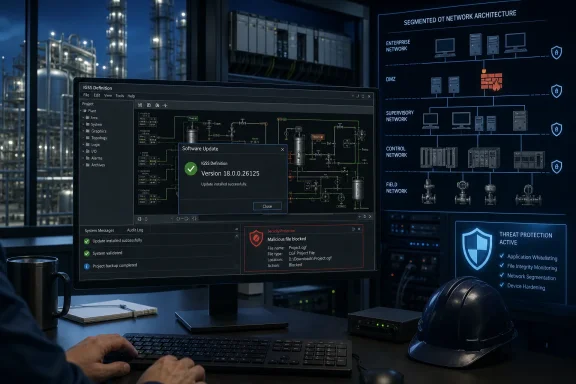
CISA republished Schneider Electric’s SEVD-2026-195-01 advisory on July 30, 2026, following the vendor’s original July 14 release. The issue carries a CVSS 3.1 score of 7.8 and is tracked as CWE-787, an out-of-bounds write weakness.
Update IGSS Definition to 18.0.0.26125
The practical remediation is clear: organizations using IGSS Definition should update the Def.exe module to version 18.0.0.26125 through IGSS Master’s Update IGSS Software mechanism or Schneider Electric’s published update package.
IGSS is used to monitor and control industrial processes, while IGSS Definition is the design-time application used by integrators to create mimic diagrams for operators. That makes the affected component especially important in environments where engineering stations can exchange project files with contractors, system integrators, or removable media.
Schneider Electric says the vulnerable versions include IGSS Definition releases through 18.0.0.26124. Although the advisory’s affected-product data also references 18.0.0.26125, its remediation section explicitly identifies 18.0.0.26125 as the fixed version. Administrators should treat the vendor’s stated fixed build as the upgrade target and verify the installed Def.exe version after deployment.
The Attack Requires a Malicious Project File
The CVSS vector describes the flaw as locally exploitable, requiring user interaction but no privileges. In practice, an attacker would need to persuade an engineer or operator to open or import a crafted CGF file into IGSS Definition.
That does not make the issue routine. Engineering workstations often have elevated access to SCADA configurations, project assets, and operational networks. A compromise of a design-time system can become more consequential than a compromise of a standard office endpoint, particularly if it enables unauthorized changes to graphics, control logic workflows, or trusted engineering files.
Until the update is applied, Schneider Electric advises customers not to execute commands or open and import files from untrusted sources. That guidance should extend to emailed project files, contractor-delivered media, shared folders, and archives transferred through removable storage.
Segmentation Still Matters After Patching
CISA’s republished advisory reiterates the standard industrial-control-system safeguards: keep control networks behind firewalls, isolate them from business networks, minimize Internet exposure, and use appropriately secured remote-access paths when they are unavoidable.
For Windows administrators supporting OT environments, the immediate work is to identify every workstation running IGSS Definition, confirm whether Def.exe is below 18.0.0.26125, and schedule the update under the site’s change-control process. Teams should also review who can introduce CGF files into engineering workflows and ensure removable media is scanned before reaching operational systems.
The patch closes the known defect, but the enduring exposure is the same: untrusted engineering files should never be treated as harmless documentation in a SCADA environment.