

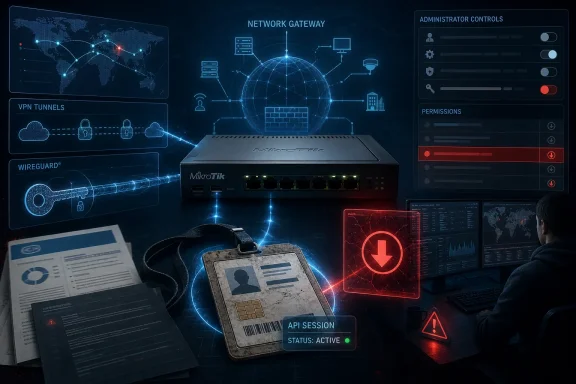
The practical risk is not an unauthenticated router takeover: the advisory rates the issue 4.9 under CVSS v3.1 and requires high privileges to begin with. But it creates a dangerous failure point for organizations that rely on RouterOS user groups to rapidly contain an account, revoke access during an incident, or limit an administrator’s reach after a role change.
According to CISA’s July 30 advisory, RouterOS versions across the product line are affected when the RouterOS API is enabled. An already authenticated API session may retain its old permission set despite a policy change, allowing the user to continue retrieving information that the newly reduced account should no longer access.
Permission Changes Do Not End Existing Sessions
The defect is categorized as CWE-613, Insufficient Session Expiration. In effect, changing the account’s group or reducing its permissions is not enough by itself to immediately enforce the new policy against a live API connection.
That matters most on routers used as VPN gateways, remote-access concentrators, or edge devices managed through automation. A compromised privileged account can be partially contained on paper while its pre-existing API session remains capable of reading sensitive RouterOS data.
CISA’s summary describes the potential exposure in particularly serious terms: an attacker could reportedly extract a WireGuard private key in plaintext using low-privilege API access, which could enable VPN impersonation and decryption of traffic associated with that key. However, the CVE’s detailed description focuses on stale permissions after a user is downgraded, rather than documenting a separate WireGuard-specific bug. Administrators should treat the session-retention condition as the confirmed issue and assess access to WireGuard configuration accordingly.
Logging Out Is the Immediate Mitigation
MikroTik’s stated mitigation, reproduced by CISA, is operational rather than a published fixed RouterOS release: fully log out affected users whenever their permissions are reduced so a new session is created under the updated policy.
For RouterOS administrators, that should mean:
- Terminate active API sessions as part of every permission downgrade, account suspension, and incident-response playbook.
- Review accounts and groups with API access, especially service accounts used by monitoring, backup, and configuration-management platforms.
- Restrict API exposure to trusted management networks and avoid placing RouterOS management services directly on the internet.
- Rotate WireGuard keys and review active peer configurations if an account with former elevated access may have been compromised.
CISA said it had received no reports of public exploitation targeting CVE-2026-14227 as of July 30. The absence of known exploitation should not be confused with a clean bill of health: the weakness specifically undermines the administrative action teams depend on when they are trying to reduce an account’s access quickly.