

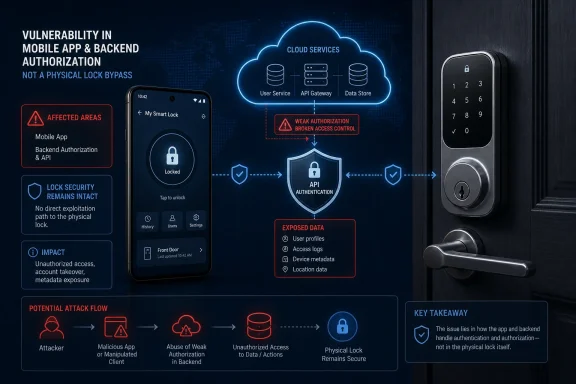
The flaw is rated Medium severity, with a CVSS v3.1 score of 5.3 and a CVSS v4.0 score of 6.9, but those labels must be understood in context. This is not a report of a lock being picked, Bluetooth traffic being replayed, or a door being opened directly from the street. It is an issue involving sensitive information embedded in source code and insufficient backend authorization—a category of failure that can create a path toward data exposure or access to sensitive cloud-side functions.
For igloohome users, property managers, vacation-rental operators, and organizations deploying smart access systems, the immediate priority is straightforward: ensure the Android app and associated service access are updated to the vendor-remediated state. The more important lesson, however, is broader. Modern smart locks are not only physical security products; they are distributed systems spanning a phone application, cloud services, credential workflows, integrations, and sometimes a Wi-Fi bridge. The security of the door increasingly depends on the security discipline applied to every one of those layers.
Overview: What CVE-2026-16581 Means
CISA identifies CVE-2026-16581 as an Inclusion of Sensitive Information in Source Code vulnerability, tracked under CWE-540. The advisory says that vulnerable releases of the Android application could permit an unauthorized actor to access functions or backend services that were not adequately protected by authentication controls. It also states that no user interaction is required for exploitation and that the affected version is igloohome Smart Lock Mobile Application (Android) 3.2.3. CISA’s advisory lists the product status as known affected.
That wording matters. Sensitive information exposed in application code can include implementation details, API endpoints, identifiers, test artifacts, secrets, or other material that assists an attacker in interacting with a backend. The problem becomes significantly more consequential if the discovered information reveals a route to an API or service whose authorization checks are incomplete.
The CWE-540 classification does not mean all source-code disclosures are identical. Instead, it describes a weakness where source code accessible to an attacker contains information that should not be exposed. MITRE notes that exposed code can reveal logic, defects, and potentially credentials or other useful data, helping attackers understand systems they are targeting. CWE-540’s definition also places the weakness within the broader landscape of exposed data and broken access control.
In the igloohome case, the key operational risk is not merely that code may have revealed something sensitive. It is that the disclosed information could have enabled interaction with backend functionality that was not sufficiently safeguarded by authentication. That combination is exactly why mobile applications should be treated as untrusted clients: anything shipped to a user’s device can ultimately be inspected, copied, modified, and studied.
The affected product boundary
The advisory specifically calls out the Android version of the igloohome Smart Lock Mobile Application, version 3.2.3 and prior. It does not describe an identical iOS issue, a hardware firmware defect, a Bluetooth protocol flaw, or a general vulnerability in every igloohome device.
That distinction should prevent two common mistakes:
- Do not assume the advisory is a direct physical bypass of every igloohome lock.
- Do not assume a physical lock is unaffected simply because its local Bluetooth or PIN mechanisms are separate from the cloud service.
A smart-lock ecosystem can offer layered functionality. igloohome’s own product documentation describes app-based access management, visitor PIN sharing, Bluetooth keys, access logs, remote functionality via the Bridge, and integrations with property-management and access platforms. The igloohome app listing says users can distribute PIN codes or Bluetooth keys and review property access logs, while the company’s product pages describe optional remote controls and cloud-connected monitoring capabilities. igloohome’s Bridge documentation confirms that the bridge can provide remote control and monitoring through the mobile application.
A backend authorization defect therefore deserves attention even when it is not equivalent to a physical lock compromise. In a connected-access environment, cloud functions can govern access provisioning, account actions, device relationships, audit-log availability, or integrations. The exact scope of accessible functions is not detailed in the public advisory, so it would be irresponsible to claim that the flaw automatically lets an attacker unlock a door, retrieve every credential, or assume control of a customer account.
Background: Smart Locks Are Software Systems With Physical Consequences
The appeal of an igloohome smart lock is clear. It replaces key handoffs with time-sensitive PINs, Bluetooth credentials, activity logging, and management through a phone. For homeowners, it can simplify daily access. For short-term rentals, maintenance teams, and multi-property operators, it can reduce the logistics of keys while creating a record of who entered and when.
igloohome also emphasizes an offline-oriented access model. Its current platform materials state that credentials can validate locally at the lock rather than waiting for a cloud response, and that access can continue without a Wi-Fi or internet dependency. igloohome’s platform overview describes credentials as validating locally on the lock, while the company’s Retrofit Lock page says time-sensitive PINs can be generated without requiring the lock itself to remain on Wi-Fi. The Retrofit Lock documentation further explains that PIN-code activity logs may be synchronized when the phone and lock are within Bluetooth range.
That architecture can be a genuine resilience advantage. A lock that can continue to accept a properly generated offline credential during an internet outage is often more useful than one that becomes dependent on a live cloud round trip. It can reduce the chance that a Wi-Fi outage causes a legitimate guest, resident, or employee to be locked out.
But offline access does not eliminate the importance of cloud security. It changes the threat model.
Offline credentials reduce some exposure, not all exposure
A locally validated access code may mean a lock can operate during an outage. It does not mean backend authorization is irrelevant. The mobile app can still be involved in provisioning, issuing, revoking, synchronizing, logging, pairing, account management, and third-party integrations.
igloohome’s documentation makes this split visible. The company says its Bridge supports remote monitoring and remote unlocking, while a direct phone-to-lock connection can use Bluetooth at short range. The Bridge product page describes this difference explicitly, including remote access capabilities and a direct Bluetooth connection model without the bridge.
For security teams, that means asset inventories should not stop at “smart lock installed.” They should distinguish between:
- Locks used only with offline PINs or local Bluetooth access.
- Locks paired to individual user accounts through the mobile application.
- Locks attached to an igloohome Bridge for remote monitoring or control.
- Locks linked to rental-management, hospitality, or property-management platforms.
- Environments using APIs, SDKs, webhooks, or automated guest-access workflows.
The more integration and remote administration involved, the more important backend identity controls become. That does not make the system inherently unsafe. It does mean that weaknesses in access control have a wider potential blast radius than they would in a purely local device.
Why access-control failures are particularly sensitive here
A standard consumer application breach may expose user preferences, account details, or activity history. A smart-access application can sit closer to a physical security boundary.
The igloohome app is designed to manage locks and keyboxes, share access through PINs or Bluetooth keys, and display access activity. The app’s listing also describes an Airbnb-oriented workflow in which a booking can trigger creation of a time-limited PIN for a guest. In other words, access software can influence when credentials are issued, who receives them, and how operators reconstruct events later.
That makes authorization bugs especially important. The security objective is not only protecting a user’s password or personal data; it is ensuring that every sensitive backend request is authenticated, authorized for the right account or organization, limited to the intended object, and logged for investigation.
Technical Analysis: Sensitive Source Data Meets Insufficient Authorization
At its core, CVE-2026-16581 describes two related security concerns:
- Sensitive information was present in source code.
- The information could be used to access backend functionality not sufficiently protected by authentication controls.
Neither condition should exist in a production mobile application.
Mobile applications are not a safe place for secrets
Android applications are distributed to devices that users fully control. Even if an APK is obfuscated, determined researchers and attackers can inspect code, resources, network definitions, strings, configuration files, and embedded metadata. Obfuscation may slow reverse engineering, but it does not transform a client application into a trustworthy secret store.
This is why critical API credentials, privileged endpoints, administrative tokens, and assumptions about trusted clients should never depend on the secrecy of a mobile binary. The client must be presumed observable.
MITRE’s guidance for CWE-540 makes the central risk plain: source code or related material exposed to users can reveal useful intelligence, including sensitive information and implementation logic. MITRE’s CWE-540 entry recommends removing sensitive code or data from externally accessible locations and recognizes that static analysis can help detect instances of the weakness.
In a mobile context, an appropriate engineering response includes:
- Eliminating hard-coded production secrets from application packages.
- Restricting API keys to narrow functions, origins, and environments where possible.
- Using backend-issued, short-lived tokens rather than persistent client-side credentials.
- Maintaining separate development, staging, and production environments.
- Preventing debug endpoints and test services from remaining externally reachable.
- Treating all client-provided identifiers and flags as untrusted input.
Authentication is not authorization
The advisory’s wording also points to a common and damaging design error: authentication controls alone are not enough.
Authentication answers: Who is making this request?
Authorization answers: Is that identity allowed to perform this action on this specific resource under these conditions?
A backend endpoint can be vulnerable even if it checks for the existence of a token. If it does not verify that the token belongs to the correct user, property, lock, organization, role, or tenant, an attacker may be able to manipulate identifiers and reach data or actions belonging to another entity.
For a connected-access platform, effective authorization should be enforced server-side on every sensitive request. The backend should verify, at minimum:
- The request has a valid authenticated identity.
- The identity belongs to the relevant account or organization.
- The identity has the correct role and permissions.
- The requested lock, keybox, credential, property, or log belongs to that identity’s authorized scope.
- The action is valid for the current state of the account and device.
- Rate limits, anomaly detection, and audit logging are in place for sensitive operations.
A mobile app should never be the system’s final authority on whether an action is permitted. It can present a user interface and request an action, but the backend must independently make the decision.
Understanding the CVSS Scores
CISA assigns CVE-2026-16581 a CVSS v3.1 base score of 5.3 and a CVSS v4.0 base score of 6.9, both classified as Medium. The CISA advisory provides vectors for both scoring versions.
The CVSS v3.1 vector is:
CVSS:3.1/AV:N/AC:L/PR:N/UI:N/S:U/C:L/I:N/A:N
This translates to a vulnerability that is:
- Reachable over the network.
- Of low attack complexity.
- Exploitable with no privileges required.
- Exploitable with no user interaction required.
- Associated with low confidentiality impact.
- Not assigned integrity or availability impact in the base score.
The v4.0 vector similarly indicates network reachability, no prior privileges, no user interaction, and a limited direct confidentiality effect:
CVSS:4.0/AV:N/AC:L/AT:N/PR:N/UI:N/VC:L/VI:N/VA:N/SC:N/SI:N/SA:N
CVSS is useful because it offers a common language for discussing intrinsic vulnerability characteristics. But it is not a complete measure of operational risk. The official CVSS v4.0 specification explains that base metrics capture qualities that are constant across environments, while threat and environmental metrics can further adjust prioritization based on real-world context. FIRST’s CVSS v4.0 specification is clear that organizations should refine base scores with threat intelligence and environmental considerations.
For a single homeowner with no bridge, no third-party integrations, and a small number of locally administered locks, the practical exposure may differ substantially from a property manager operating hundreds of units with remote workflows and staff roles. The CVSS base score is the beginning of the triage process—not the conclusion.
Why 5.3 and 6.9 can both be valid
The difference between CVSS v3.1 and v4.0 scores should not be read as a contradiction. CVSS v4.0 uses an updated scoring model and different metric structure. It can express attack conditions and impacts differently from the earlier version.
What remains consistent is the advisory’s core risk statement: the issue is network reachable, does not require prior privileges or user interaction, and can expose a limited amount of confidential information. Those factors justify quick remediation even though the advisory does not describe an availability outage, destructive capability, or confirmed broad integrity compromise.
Vendor Remediation and What Organizations Should Do
CISA states that igloohome has enhanced backend access-control mechanisms so that only properly authenticated and authorized requests can interact with sensitive functionality. The advisory does not provide a detailed public technical description of the backend changes, and it does not publish a full exploitation sequence. That restraint is appropriate for a vulnerability involving access-control weaknesses.
The key point is that remediation is not framed as a hardware replacement program. It is a correction to the access controls protecting backend services. Because the vulnerable Android application version identified is 3.2.3 and prior, users should ensure they are not relying on that affected release.
Immediate priorities for igloohome users
For individual users and small operators, a practical response should include the following steps:
- Update the Android app from the official store channel.
Verify that the installed igloohome Smart Lock Mobile Application is not version 3.2.3 or an earlier affected release. Avoid sideloaded APKs, device backups that restore obsolete versions, and unofficial app repositories. - Review account security.
Use a unique, strong password for the igloohome account. If account reuse is possible, change the password and remove it from any unrelated service. Enable available account protections such as biometric app access where appropriate. - Review shared access.
Audit active PINs, Bluetooth keys, guest permissions, and user accounts. Remove credentials that are expired, unnecessary, or associated with former residents, guests, contractors, or staff. - Review bridges and integrations.
If using an igloohome Bridge, check the device’s placement, Wi-Fi configuration, and association with the correct account. If using booking, property-management, or access-platform integrations, review API connections and revoke integrations that are no longer required. - Check activity logs.
Examine access history for unfamiliar entries, unexpected administrative changes, or credentials issued outside normal workflows. Logs are not perfect evidence of every event, but they are important for identifying anomalies and establishing timelines. - Contact the vendor for environment-specific questions.
CISA directs users to igloohome for additional information. Organizations with complex deployments should seek confirmation of remediation status, supported app versions, and any recommended credential-review process.
Additional actions for property managers and enterprise deployments
Large deployments should treat this as an access-control review rather than a simple app-update ticket.
Property and facilities teams should inventory:
- All Android devices used to manage igloohome locks.
- App versions across managed phones and tablets.
- Shared admin accounts and service accounts.
- Bridges connected to business Wi-Fi networks.
- Automated guest-code workflows.
- API integrations, webhooks, and partner platforms.
- Former employee, contractor, and vendor access.
- Policies for emergency access, lock ownership transfer, and incident response.
The goal is not to create panic or assume compromise. It is to make sure the organization knows who can provision access, what systems can request access changes, and how that authority is monitored.
No Reported Public Exploitation, But Timely Action Still Matters
CISA says it has received no reports of public exploitation specifically targeting CVE-2026-16581 at the time of the advisory’s publication. The CISA notice provides useful situational context, but it should not be mistaken for a reason to defer updates.
The absence of known public exploitation is not proof that nobody has attempted abuse. More importantly, vulnerabilities involving exposed application information and backend authorization can become easier to investigate once an advisory identifies the product, affected version range, and weakness category.
The most constructive response is neither alarmism nor complacency. It is ordinary security hygiene applied with urgency:
- Update affected software.
- Remove unnecessary access.
- Validate administrative boundaries.
- Monitor for anomalies.
- Reduce exposure to cloud-connected management features where they are not needed.
CISA’s general defensive guidance also recommends minimizing network exposure, isolating operational technology and remote devices where feasible, using secure remote-access practices, and conducting an impact analysis before applying changes in operational environments. The advisory appropriately frames these as defensive measures rather than one-size-fits-all instructions.
The Broader Lesson for Windows and Android Users
Although the vulnerable product is an Android application, Windows users should not dismiss the advisory as someone else’s problem. Smart-lock administration often intersects with Windows PCs through property-management dashboards, business email accounts, shared documentation, booking platforms, and browser-based portals. A compromised Windows endpoint or reused password can undermine access systems even when the original weakness was found in a mobile app.
The same principle applies to all connected physical-security platforms: the secure lock is only one part of the security boundary. The phone, cloud account, Wi-Fi bridge, guest-management system, administrator role, and support workflow are all part of the system that ultimately controls access.
igloohome’s product strategy illustrates both the advantages and the responsibilities of this model. Its local credential validation and offline-capable access workflows can offer resilience when connectivity is poor. igloohome’s platform overview emphasizes that its credentials validate locally and do not always wait for a cloud response. Yet the company also supports app-based management, bridges, remote operation, activity logs, and integrations—features that make authorization engineering central to the product’s security posture. igloohome’s Bridge page and app documentation show how those digital layers extend the practical capabilities of the lock.
CVE-2026-16581 should therefore be read as a focused warning about the igloohome Smart Lock Mobile Application for Android, not an indictment of all smart-lock technology. The reported remediation—strengthening backend authentication and authorization—targets the right security boundary. The remaining responsibility for users and operators is equally clear: update the affected application, reassess who has access, and treat the management layer of a smart lock with the same seriousness traditionally reserved for the lock itself.