

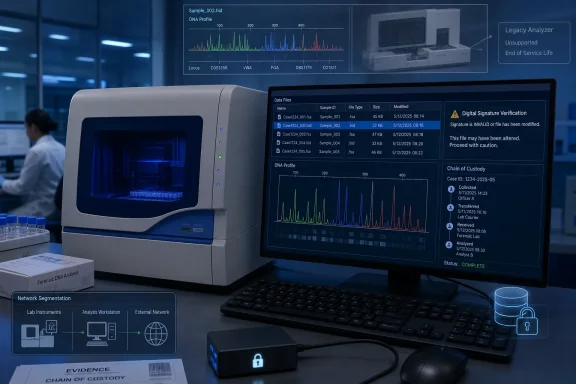
.fsa and .hid DNA-data files they produce could be modified before analysis with little apparent indication of tampering. For laboratories using the affected genetic analyzers, CVE-2026-17583 is an evidence-integrity problem, not a conventional remote-code-execution incident: a changed file can lead to inaccurate DNA test outcomes while the instrument itself continues operating normally.Thermo Fisher’s security bulletin, published July 31, 2026, says the updates add digital signatures so customers can verify that output files have not been modified. CISA’s medical advisory, published August 4, confirms the flaw affects eight Applied Biosystems product families and assigns a CVSS 3.1 score of 8.4 and CVSS 4.0 score of 8.2, both rated High. CISA also says it has no report of public exploitation and that the vulnerability is not remotely exploitable.
The important operational detail is in Thermo Fisher’s wording: the signatures will help customers verify file integrity moving forward. That means a lab cannot assume its existing archive of .fsa and .hid files has acquired an integrity record merely by installing a patch. The vendor’s bulletin does not describe a retrospective signing process, a utility to validate historical files, or a way to establish whether prior output had been modified before the update.
For Windows administrators supporting forensic, paternity, research, or human-identification workflows, the immediate work is therefore twofold: patch supported acquisition and analysis systems, then determine whether historical files need a separately documented chain-of-custody review.
The affected software spans collection and analysis
The weakness is present in software that controls capillary-electrophoresis instruments and in GeneMapper ID-X, the analysis package that consumes the output. Thermo Fisher’s older documentation describes the relevant workflow plainly: data-collection systems generate .fsa or .hid sample files, which are then passed into downstream analysis. The vulnerable interval is after output generation and before analysis software loads the file.
The supported products with available fixes are:
- Applied Biosystems 3500/3500xL Series Data Collection Software, updated from version 4.0.2 or earlier to version 4.0.3.
- Applied Biosystems 3730/3730xL Series Data Collection Software, updated from version 5.0.2 or earlier to version 5.0.3.
- Applied Biosystems SeqStudio Genetic Analyzer Data Collection Software, updated from version 1.2.5 or earlier to version 1.2.6.
- Applied Biosystems SeqStudio Flex Series Instrument Software, updated from version 1.2.0 or earlier to version 1.2.1.
- Applied Biosystems GeneMapper ID-X Software, updated from version 1.7.3 or earlier to version 1.7.4.
The patched scope matters because signing at collection addresses only part of the workflow. A signature can establish that a file has changed since it was signed, but the defense works only if the downstream workflow preserves the signed object and checks the signature before relying on the data. Thermo Fisher says its updates add that protection layer, but its two-page bulletin does not specify the signature algorithm, key-management model, validation behavior in third-party analysis platforms, or what users will see when a verification failure occurs.
That omission is especially relevant to labs with mixed estates. Thermo Fisher explicitly says customers using another third-party analysis platform may need to rely on its recommended procedural controls. In practical terms, the patch should not be treated as proof that every legacy or external pipeline will reject a modified file automatically.
Three older analyzer families will receive no fix
The sharpest risk falls on three end-of-life product lines for which Thermo Fisher will not issue an update:
- Applied Biosystems 3130 Series Data Collection Software version 4.1 and earlier.
- ABI PRISM 3100/3100-Avant Data Collection Software version 2.0 and earlier.
- ABI PRISM 310 Data Collection Software version 3.1 and earlier.
This is not a temporary patch-delay problem. Thermo Fisher identifies all three as unsupported, meaning the vendor’s technical answer is compensating controls rather than a cryptographic integrity upgrade.
Those systems deserve a separate inventory rather than a generic “patch what you can” ticket. In many labs, an analyzer-control PC is retained because it remains tied to validated hardware, a documented workflow, old methods, or irreplaceable peripherals. That operational reality does not remove the vulnerability; it leaves the organization responsible for proving that output cannot be changed unnoticed between collection and interpretation.
CISA’s advisory recommends limiting network exposure, avoiding internet accessibility, and using secure remote access methods where remote access is unavoidable. Thermo Fisher adds controls that are more specific to the handling problem: secure chain of custody, encrypted password-protected storage, access restrictions, least-privilege permissions, and firewall or network-access-control rules that allow only trusted connectivity.
For an unsupported analyzer workstation, those recommendations should translate into a concrete control boundary: no casual shared-folder export, no broadly writable USB media, no general-purpose user accounts on the collection PC, and no assumption that a Windows login alone establishes forensic provenance. If a file must move to another system, the transfer and custody record need to carry as much evidentiary weight as the instrument run itself.
Digital signatures change future trust, not past evidence
Thermo Fisher characterizes the risk as “nearly undetectable” modification of output files when laboratory controls are circumvented. CISA similarly says an attacker could alter DNA data and produce inaccurate test results. Neither description says the instrument has to be compromised, and neither describes a network-delivered exploit chain.
That distinction narrows the initial access scenario but raises the stakes for insider-risk and workflow-security controls. A person, malware process, remote-support session, or unauthorized account that can alter a file in the period between export and analysis can attack the result without necessarily disrupting the analyzer. The security event could present as a routine file-handling action rather than a failure of the instrument.
The CVSS scoring shows why organizations should read the advisory rather than triage it only by the number. CISA’s CVSS 3.1 vector assigns high impacts to confidentiality, integrity, and availability, producing an 8.4 score; its CVSS 4.0 vector describes no confidentiality or availability impact and high integrity impact, producing 8.2. Thermo Fisher publishes the 8.2 CVSS 4.0 figure. The vendor and CISA agree on the severity classification, but the underlying practical impact described in both advisories is the integrity of DNA-result files.
For laboratory leadership, that is the real risk model: not that the analyzer becomes unavailable, but that an apparently usable result could be based on altered source data. A lab’s response should be judged by whether it can detect and investigate that condition, not merely by whether its endpoint-management console reports the new version installed.
Windows teams need to map the data path before deploying
The fixes include conventional executable patches for the 3500/3500xL, 3730/3730xL, and GeneMapper ID-X products, alongside package updates for SeqStudio and SeqStudio Flex systems. Thermo Fisher adds one deployment dependency for SeqStudio Flex installations using Security, Auditing, and E-signature features: administrators must install the latest SAE profile on the SAE Admin Console before applying the 1.2.1 instrument update.
That prerequisite is easy to miss in a rushed remediation cycle. A failed or incomplete change on a controlled instrument can create downtime, while skipping the stated profile update risks leaving the intended security configuration incomplete. Labs should therefore follow their normal validation and change-control process, but should not let validation become an indefinite reason to leave collection and analysis endpoints unaddressed.
A useful remediation sequence is:
- Identify every machine or instrument running one of the eight named software families, including isolated systems that may not report into normal endpoint-management tooling.
- Record the exact installed version and distinguish supported platforms eligible for an update from the three end-of-life families that require compensating controls.
- Map where
.fsaand.hidfiles are first written, copied, archived, analyzed, and backed up, including removable media and shared storage. - Apply the applicable Thermo Fisher update, including the SeqStudio Flex SAE profile prerequisite where relevant, and document post-update signature-verification behavior in the laboratory’s actual analysis path.
- Review historical casework and retained output separately, because the bulletin provides no indication that pre-update files can be retroactively signed or automatically authenticated.
The final item is the one many patch programs will miss. Installing version 4.0.3, 5.0.3, 1.2.6, 1.2.1, or 1.7.4 protects the handling of newly generated files under the updated workflow; it does not by itself establish the integrity of files already stored on a file share, removable drive, analysis workstation, or case archive.
CISA credits Nathaniel Adams, Laura Gaydosh-Combs, and Kevin Dyer with reporting the flaw, and says no public exploitation is known as of August 4. That is welcome, but it does not reduce the remediation priority for labs that rely on these files as the basis for human-identification conclusions. The supported systems now have an update path; the older 3130, 3100/3100-Avant, and 310 installations have a permanent governance and access-control problem until they are retired or isolated behind controls strong enough to compensate for the missing integrity check.