
CISA has added CVE-2026-18577, an actively exploited authentication-bypass flaw in N-able N-central, to its Known Exploited Vulnerabilities catalog. For managed service providers and enterprise IT teams that run N-central, the immediate practical requirement is to ensure the central server is on N-central 2026.3 Hotfix 1, build 2026.3.1.7, then investigate whether the platform was used to reach managed devices before the update was applied.
CISA’s August 3 alert identifies the issue as an “Authentication Bypass Using an Alternate Path or Channel” vulnerability and says it has evidence of active exploitation. That designation changes the priority: this is no longer a vulnerability-management queue item to be folded into the next routine maintenance window. N-central is a remote monitoring and management platform with privileged reach into customer and corporate endpoints; an unauthorized administrator session on the server can become a channel for remote-control sessions, script execution, software deployment, credential collection, and persistence across many downstream systems.
N-able released Hotfix 1 on August 2 after warning that all N-central versions before the hotfix were affected. The important detail is that upgrading to the base 2026.3 release was not sufficient. Community reports tracking the incident show that N-able initially directed customers toward 2026.3, then updated its incident messaging after identifying additional security concerns affecting all versions, including the then-current 2026.3 build. The corrective build is 2026.3.1.7.
That sequence is the most consequential part of this incident. Organizations that treated “latest major release” as equivalent to “remediated” may have remained exposed until Hotfix 1 landed.
CISA’s KEV catalog is deliberately narrower than a general CVE database. A vulnerability lands there when CISA has evidence that it has been exploited in real attacks. The agency’s new Binding Operational Directive 26-04 directs federal civilian agencies to prioritize remediation based on risk, with special urgency for publicly exposed vulnerabilities that can give an attacker total control of an asset after compromise.
CVE-2026-18577 is exactly the kind of problem that risk model is intended to catch. Authentication bypass means the attacker does not need to win a phishing campaign, reuse a password, or brute-force a user account before reaching a privileged application path. If the affected N-central management interface is reachable from the internet, the RMM server itself can become the initial foothold.
CISA’s directive technically binds Federal Civilian Executive Branch agencies, not commercial MSPs or private enterprises. But the operational logic applies even more sharply to N-central operators. A compromise of a single RMM administration plane can expose dozens, hundreds, or thousands of managed systems, often across separate customers and Windows domains. The blast radius is determined by what the N-central instance can administer, not by the number of servers directly hosting the product.
N-central’s own documentation describes remote-control capabilities that can bridge technicians to managed systems over encrypted connections. That is valuable during normal operations; in an incident, it explains why a successful N-central takeover should be treated as a potential downstream endpoint compromise rather than as a contained web-server event.
N-able’s first public guidance reportedly identified active exploitation of environments earlier than N-central 2026.2 and advised customers to move to 2026.3. By August 2, the company said its continuing investigation had found additional concerns affecting all N-central versions and issued Hotfix 1 for the 2026.3 branch. N-able’s current corrective version is 2026.3.1.7.
The vendor’s revision does not mean the first upgrade was pointless. It means the initial mitigation did not fully address the attack surface now tracked as CVE-2026-18577. Administrators that completed an upgrade to 2026.3 but did not apply Hotfix 1 should regard themselves as unpatched.
This is particularly important for organizations that use change-management evidence to close tickets. A completed record showing “upgraded to N-central 2026.3” should not be marked remediated unless it also confirms the final server version is 2026.3.1.7 or a later N-able release that explicitly includes the hotfix. Version verification on the actual server matters more than an update job’s success status.
Hosted N-central customers should also obtain clear confirmation from N-able that their particular instance received the vendor’s mitigation or upgrade. Reports from N-central users indicate that hosted environments were subject to protective measures while the hotfix rollout proceeded, but a temporary hosted-service control is not a substitute for confirming the instance’s current build and reviewing it for compromise.
Reports from N-central administrators and incident-tracking discussions have highlighted suspicious post-compromise activity involving Cloudflare Tunnel tooling, including a
The response should begin with the central server because it holds the administrative record:
An organization with no EDR coverage on the N-central appliance should not assume it has no evidence. Its network logs, web-access logs, identity logs, N-central application records, and logs from managed Windows devices can still reconstruct whether unauthorized administration occurred. The absence of a detection alert is especially weak assurance where the management server is operated like an appliance and receives less endpoint telemetry than ordinary Windows infrastructure.
For on-premises N-central installations, restrict administrative-interface access to a VPN, zero-trust access proxy, or narrowly allowlisted management addresses while patching and investigation take place. Enforce multifactor authentication for every administrative account, but do not represent MFA as a fix for an authentication-bypass vulnerability; if an exploit sidesteps the normal authentication flow, the second factor may never be requested.
Operators should also check whether reverse proxies, web application firewalls, port-forwarding rules, DNS records, and emergency access paths leave alternate routes to the console. The flaw’s classification — authentication bypass through an alternate path or channel — makes it particularly unwise to validate protection only by testing the ordinary login page.
CISA’s August 3 notice does not disclose a CVSS score, an exploit chain, victim count, threat-actor attribution, or a detailed technical description. As of August 3, CVE-2026-18577 also does not appear in the public NVD search results, leaving administrators without the usual NVD enrichment while the incident is active. Those omissions do not lower the priority; they mean defenders should avoid building their response around assumptions that have not been publicly confirmed.
The concrete endpoint is straightforward: if an N-central server is below 2026.3.1.7, it needs emergency remediation. If it was internet-accessible before the hotfix, the patch should be followed by an investigation spanning the N-central server and the Windows devices it manages.
N-able released Hotfix 1 on August 2 after warning that all N-central versions before the hotfix were affected. The important detail is that upgrading to the base 2026.3 release was not sufficient. Community reports tracking the incident show that N-able initially directed customers toward 2026.3, then updated its incident messaging after identifying additional security concerns affecting all versions, including the then-current 2026.3 build. The corrective build is 2026.3.1.7.
That sequence is the most consequential part of this incident. Organizations that treated “latest major release” as equivalent to “remediated” may have remained exposed until Hotfix 1 landed.
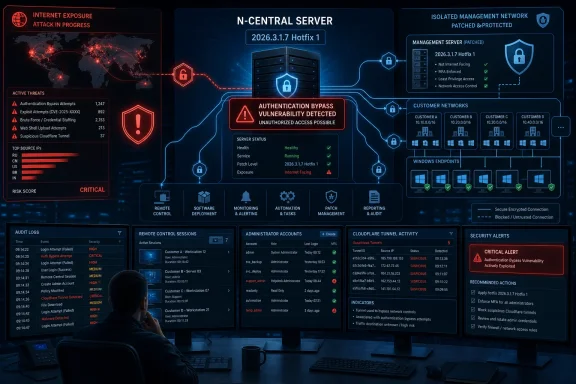 The KEV listing confirms exploitation, not merely severity
CISA’s KEV catalog is deliberately narrower than a general CVE database. A vulnerability lands there when CISA has evidence that it has been exploited in real attacks. The agency’s new Binding Operational Directive 26-04 directs federal civilian agencies to prioritize remediation based on risk, with special urgency for publicly exposed vulnerabilities that can give an attacker total control of an asset after compromise.CVE-2026-18577 is exactly the kind of problem that risk model is intended to catch. Authentication bypass means the attacker does not need to win a phishing campaign, reuse a password, or brute-force a user account before reaching a privileged application path. If the affected N-central management interface is reachable from the internet, the RMM server itself can become the initial foothold.
CISA’s directive technically binds Federal Civilian Executive Branch agencies, not commercial MSPs or private enterprises. But the operational logic applies even more sharply to N-central operators. A compromise of a single RMM administration plane can expose dozens, hundreds, or thousands of managed systems, often across separate customers and Windows domains. The blast radius is determined by what the N-central instance can administer, not by the number of servers directly hosting the product.
N-central’s own documentation describes remote-control capabilities that can bridge technicians to managed systems over encrypted connections. That is valuable during normal operations; in an incident, it explains why a successful N-central takeover should be treated as a potential downstream endpoint compromise rather than as a contained web-server event.
N-able’s initial upgrade advice did not end the exposure
The incident timeline matters because it undercuts a common emergency-patching assumption: that installing the newest generally available release automatically closes the issue.N-able’s first public guidance reportedly identified active exploitation of environments earlier than N-central 2026.2 and advised customers to move to 2026.3. By August 2, the company said its continuing investigation had found additional concerns affecting all N-central versions and issued Hotfix 1 for the 2026.3 branch. N-able’s current corrective version is 2026.3.1.7.
The vendor’s revision does not mean the first upgrade was pointless. It means the initial mitigation did not fully address the attack surface now tracked as CVE-2026-18577. Administrators that completed an upgrade to 2026.3 but did not apply Hotfix 1 should regard themselves as unpatched.
This is particularly important for organizations that use change-management evidence to close tickets. A completed record showing “upgraded to N-central 2026.3” should not be marked remediated unless it also confirms the final server version is 2026.3.1.7 or a later N-able release that explicitly includes the hotfix. Version verification on the actual server matters more than an update job’s success status.
Hosted N-central customers should also obtain clear confirmation from N-able that their particular instance received the vendor’s mitigation or upgrade. Reports from N-central users indicate that hosted environments were subject to protective measures while the hotfix rollout proceeded, but a temporary hosted-service control is not a substitute for confirming the instance’s current build and reviewing it for compromise.
Patch the N-central server, then hunt beyond it
Applying Hotfix 1 stops the known vulnerable path. It does not remove an attacker who already used that path to create accounts, alter automation, open remote-control sessions, deploy tools, or establish access on managed Windows endpoints.Reports from N-central administrators and incident-tracking discussions have highlighted suspicious post-compromise activity involving Cloudflare Tunnel tooling, including a
cloudflared service and an executable masquerading as svchost.exe in user Documents locations. Those reports are useful hunting leads, but they should not be mistaken for a complete detection rule or a confirmed signature of every intrusion. Attackers can change filenames, service names, IP addresses, and persistence mechanisms quickly.The response should begin with the central server because it holds the administrative record:
- Confirm the N-central server is running 2026.3.1.7 or a later explicitly remediated version, and remove public access until that verification is complete.
- Review administrator accounts, recently created users, privilege changes, API credentials, SSO configuration, and MFA settings for changes that do not have a documented operational owner.
- Examine N-central audit logs for anomalous logins, remote-control launches, bulk jobs, script deployments, software-install tasks, and configuration changes beginning before the August 2 hotfix release.
- Review managed Windows endpoints for unexpected remote-access software, new services, scheduled tasks, unusual outbound connections, and activity originating from N-central automation accounts.
- Preserve relevant N-central logs, endpoint telemetry, proxy records, firewall logs, and identity-provider events before retention windows overwrite them.
An organization with no EDR coverage on the N-central appliance should not assume it has no evidence. Its network logs, web-access logs, identity logs, N-central application records, and logs from managed Windows devices can still reconstruct whether unauthorized administration occurred. The absence of a detection alert is especially weak assurance where the management server is operated like an appliance and receives less endpoint telemetry than ordinary Windows infrastructure.
Public exposure is the first containment decision
CISA’s alert specifically frames KEV remediation around high-risk, publicly exposed assets. That emphasis is appropriate here. An N-central server that is reachable from the internet presents a far more urgent problem than one accessible only through a tightly controlled management network, though neither deployment should remain unpatched.For on-premises N-central installations, restrict administrative-interface access to a VPN, zero-trust access proxy, or narrowly allowlisted management addresses while patching and investigation take place. Enforce multifactor authentication for every administrative account, but do not represent MFA as a fix for an authentication-bypass vulnerability; if an exploit sidesteps the normal authentication flow, the second factor may never be requested.
Operators should also check whether reverse proxies, web application firewalls, port-forwarding rules, DNS records, and emergency access paths leave alternate routes to the console. The flaw’s classification — authentication bypass through an alternate path or channel — makes it particularly unwise to validate protection only by testing the ordinary login page.
CISA’s August 3 notice does not disclose a CVSS score, an exploit chain, victim count, threat-actor attribution, or a detailed technical description. As of August 3, CVE-2026-18577 also does not appear in the public NVD search results, leaving administrators without the usual NVD enrichment while the incident is active. Those omissions do not lower the priority; they mean defenders should avoid building their response around assumptions that have not been publicly confirmed.
The concrete endpoint is straightforward: if an N-central server is below 2026.3.1.7, it needs emergency remediation. If it was internet-accessible before the hotfix, the patch should be followed by an investigation spanning the N-central server and the Windows devices it manages.
References
- Primary source: CISA
Published: 2026-08-03T12:00:00+00:00
Loading…
www.cisa.gov - Related coverage: nvd.nist.gov
Loading…
nvd.nist.gov - Related coverage: nvd.nist.gov
Loading…
nvd.nist.gov - Related coverage: cve.org
Loading…
www.cve.org - Related coverage: advisories.ncsc.nl
Loading…
advisories.ncsc.nl - Related coverage: advisories.ncsc.nl
Loading…
advisories.ncsc.nl - Related coverage: thevulnerabilitynews.com
Loading…
thevulnerabilitynews.com - Related coverage: service.securitm.ru
Loading…
service.securitm.ru - Related coverage: vulnerabilities.ncsc.nl
Loading…
vulnerabilities.ncsc.nl - Related coverage: vulnerabilities.ncsc.nl
Loading…
vulnerabilities.ncsc.nl - Related coverage: cisa.gov
Loading…
www.cisa.gov