
Johnson Controls customers running TL280 Internet alarm communicators below firmware 5.63 should schedule an update and treat the device as a network-security priority, but the August 6 advisory leaves administrators with an unusually important uncertainty: its description says the flaw involves hardcoded credentials, while its assigned weakness category describes unsafe cryptography instead. Those are different failure modes, different investigation paths, and potentially different exposure boundaries.
CISA republished Johnson Controls’ Product Security Advisory JCI-PSA-2026-08 on August 6 for CVE-2026-27871. The advisory names every Johnson Controls TL280 version earlier than 5.63 as affected and directs operators to apply firmware 5.63. CISA says no public exploitation specifically targeting this issue has been reported.
The practical urgency is not driven by the advisory’s 4.1 CVSS 3.1 base score alone. The TL280 is an Ethernet-connected alarm communicator used with compatible PowerSeries Neo panels to carry alarm events, supervision heartbeats, remote uploading and downloading, and—in supported deployments—remote firmware updates. A compromise of the communicator would be a foothold in an alarm-reporting path, not a routine flaw in an isolated building peripheral.
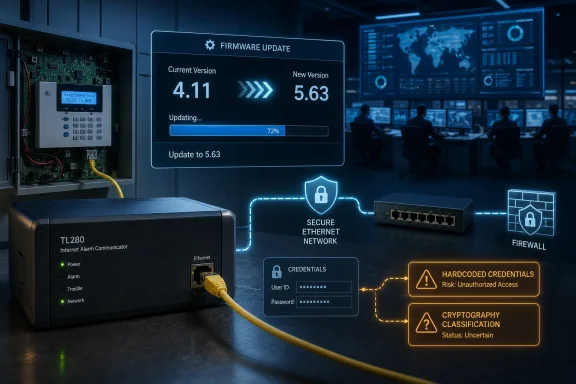
Johnson Controls’ stated remediation is simple: update affected TL280 units to firmware 5.63. The advisory does not provide a workaround that removes the underlying condition, nor does it identify a safe earlier firmware release, affected serial ranges, or a public technical explanation of what changed in 5.63.
That absence matters for facilities with regulated fire or burglary monitoring. Johnson Controls’ own TL280 documentation says the module can act as a primary or backup communications channel, depending on configuration, and that its Ethernet link supports alarm reporting to Sur-Gard central-station receivers. The same documentation describes remote firmware-upgrade capability, but it also says some UL and ULC listed installations permit only local firmware updates.
Administrators should therefore avoid treating this as a generic overnight remote-patching task. Before touching firmware, determine whether each appliance is in a listed configuration, whether it is a primary alarm path, which monitoring receiver it reports to, and whether a maintenance window could create a supervised-communication trouble condition. A firmware update that restarts the module can be operationally safe, but only if the alarm company, central station, and site staff know it is happening and can validate restored reporting afterward.
Johnson Controls has not said whether 5.63 changes the upgrade workflow, invalidates existing configuration, requires panel-side changes, or affects related variants such as the TL280R or later E models. The CISA record names TL280 specifically, so organizations should not assume that a related model is affected—or fixed—without checking its installed firmware and the vendor’s applicable advisory.
This is more than a clerical nit. If the real problem is a shared or embedded credential, the immediate concern is whether a party with access to a firmware image, an administrative interface, or a related management channel could reuse a known secret across devices. That would justify credential rotation, a hunt for configuration reuse, and scrutiny of any downstream systems that trusted the communicator.
If the actual issue is weak cryptography, the work is different: identify which traffic is protected, whether encryption is enabled, whether a protocol can be intercepted or altered, and whether monitoring infrastructure uses the risky configuration. The TL280’s manuals describe AES-128 encryption for Ethernet communications, with encryption enabled from the central-station receiver. They also warn that packets begin encrypted only after a subsequent event or a restart once encryption has been enabled.
CISA’s mitigation text itself points toward the credential interpretation. It recommends rotating shared or downstream credentials “derived from or associated with the hard-coded values,” watching device logs for anomalous authentication activity, restricting access to trusted management VLANs, and conducting firmware-integrity checks. Those actions make sense for embedded credentials. They do not explain the assignment of CWE-327.
There is a second sign that the advisory was assembled from a template without sufficient product-specific review: one mitigation tells customers to restrict access to affected “cameras.” The TL280 is not a camera. Johnson Controls’ product documentation identifies it as an Internet alarm communicator with a 10/100 Ethernet interface, designed to connect compatible intrusion and fire alarm panels to central-station receivers.
The safe conclusion is that customers should act on the firmware fix and credential-rotation guidance, but should not assume the published weakness classification accurately describes the technical flaw. Johnson Controls and CISA need to clarify whether CVE-2026-27871 is a hardcoded credential exposure, a cryptographic design issue, or a combined problem involving embedded cryptographic material.
The scores should not be read as evidence that unpatched TL280 units are harmless. They indicate that the advisory’s stated model does not describe a simple unauthenticated, internet-wide takeover. An attacker would need network reachability, significant pre-existing access or privileges, and a favorable condition that CISA has not publicly detailed.
That makes network segmentation especially consequential. A TL280 reachable only from its alarm-panel LAN and intended central-station infrastructure presents a markedly different opportunity than one sitting on a flat corporate subnet, a shared building-management VLAN, or a segment with unrestricted remote-administration access. Johnson Controls’ installation literature has long advised restricting unauthorized network access and locating the communicator in a secured area; the current advisory reinforces that the device should not be exposed directly to the internet.
The advisory does not identify a web-management port, a protocol, a default account name, an exploit chain, or indicators of compromise. Administrators should resist the urge to scan aggressively against production alarm networks based on an incomplete CVE description. Start with asset inventory, firmware version collection, firewall review, and maintenance coordination rather than unvalidated probing of life-safety-adjacent equipment.
That makes the conflicting classification the central unresolved issue, not a reason to delay patching. Firmware 5.63 is the vendor’s fix; installations below that release should be treated as affected. But security teams should record the advisory’s ambiguity in their change and risk documentation, especially if they are being asked to justify why credentials were rotated or why encrypted transport was reviewed.
Until Johnson Controls publishes a corrected technical description, the defensible operating assumption is that firmware below 5.63 may contain embedded security material with consequences beyond the individual communicator. Patch the TL280, isolate its network path, rotate related secrets, and verify that alarm reporting remains intact after the change.
The practical urgency is not driven by the advisory’s 4.1 CVSS 3.1 base score alone. The TL280 is an Ethernet-connected alarm communicator used with compatible PowerSeries Neo panels to carry alarm events, supervision heartbeats, remote uploading and downloading, and—in supported deployments—remote firmware updates. A compromise of the communicator would be a foothold in an alarm-reporting path, not a routine flaw in an isolated building peripheral.
 Firmware 5.63 is the only stated fix
Johnson Controls’ stated remediation is simple: update affected TL280 units to firmware 5.63. The advisory does not provide a workaround that removes the underlying condition, nor does it identify a safe earlier firmware release, affected serial ranges, or a public technical explanation of what changed in 5.63.That absence matters for facilities with regulated fire or burglary monitoring. Johnson Controls’ own TL280 documentation says the module can act as a primary or backup communications channel, depending on configuration, and that its Ethernet link supports alarm reporting to Sur-Gard central-station receivers. The same documentation describes remote firmware-upgrade capability, but it also says some UL and ULC listed installations permit only local firmware updates.
Administrators should therefore avoid treating this as a generic overnight remote-patching task. Before touching firmware, determine whether each appliance is in a listed configuration, whether it is a primary alarm path, which monitoring receiver it reports to, and whether a maintenance window could create a supervised-communication trouble condition. A firmware update that restarts the module can be operationally safe, but only if the alarm company, central station, and site staff know it is happening and can validate restored reporting afterward.
Johnson Controls has not said whether 5.63 changes the upgrade workflow, invalidates existing configuration, requires panel-side changes, or affects related variants such as the TL280R or later E models. The CISA record names TL280 specifically, so organizations should not assume that a related model is affected—or fixed—without checking its installed firmware and the vendor’s applicable advisory.
The advisory’s classification does not match its description
CISA’s vulnerability description says CVE-2026-27871 concerns “hardcoded credentials,” meaning authentication material embedded in firmware. Yet the advisory identifies CWE-327, Use of a Broken or Risky Cryptographic Algorithm. MITRE’s CWE taxonomy treats hardcoded credentials as CWE-798, while CWE-327 concerns the selection or use of weak cryptographic algorithms or protocols.This is more than a clerical nit. If the real problem is a shared or embedded credential, the immediate concern is whether a party with access to a firmware image, an administrative interface, or a related management channel could reuse a known secret across devices. That would justify credential rotation, a hunt for configuration reuse, and scrutiny of any downstream systems that trusted the communicator.
If the actual issue is weak cryptography, the work is different: identify which traffic is protected, whether encryption is enabled, whether a protocol can be intercepted or altered, and whether monitoring infrastructure uses the risky configuration. The TL280’s manuals describe AES-128 encryption for Ethernet communications, with encryption enabled from the central-station receiver. They also warn that packets begin encrypted only after a subsequent event or a restart once encryption has been enabled.
CISA’s mitigation text itself points toward the credential interpretation. It recommends rotating shared or downstream credentials “derived from or associated with the hard-coded values,” watching device logs for anomalous authentication activity, restricting access to trusted management VLANs, and conducting firmware-integrity checks. Those actions make sense for embedded credentials. They do not explain the assignment of CWE-327.
There is a second sign that the advisory was assembled from a template without sufficient product-specific review: one mitigation tells customers to restrict access to affected “cameras.” The TL280 is not a camera. Johnson Controls’ product documentation identifies it as an Internet alarm communicator with a 10/100 Ethernet interface, designed to connect compatible intrusion and fire alarm panels to central-station receivers.
The safe conclusion is that customers should act on the firmware fix and credential-rotation guidance, but should not assume the published weakness classification accurately describes the technical flaw. Johnson Controls and CISA need to clarify whether CVE-2026-27871 is a hardcoded credential exposure, a cryptographic design issue, or a combined problem involving embedded cryptographic material.
The CVSS vectors constrain the likely attack path
CISA assigns CVSS 3.1 score 4.1, rated Medium, with a network attack vector but high attack complexity and high privileges required. The vector also limits the stated confidentiality, integrity, and availability impact to Low. CISA’s CVSS 4.0 score is lower, 2.1, rated Low, and adds the requirement that another attack condition be present.The scores should not be read as evidence that unpatched TL280 units are harmless. They indicate that the advisory’s stated model does not describe a simple unauthenticated, internet-wide takeover. An attacker would need network reachability, significant pre-existing access or privileges, and a favorable condition that CISA has not publicly detailed.
That makes network segmentation especially consequential. A TL280 reachable only from its alarm-panel LAN and intended central-station infrastructure presents a markedly different opportunity than one sitting on a flat corporate subnet, a shared building-management VLAN, or a segment with unrestricted remote-administration access. Johnson Controls’ installation literature has long advised restricting unauthorized network access and locating the communicator in a secured area; the current advisory reinforces that the device should not be exposed directly to the internet.
The advisory does not identify a web-management port, a protocol, a default account name, an exploit chain, or indicators of compromise. Administrators should resist the urge to scan aggressively against production alarm networks based on an incomplete CVE description. Start with asset inventory, firmware version collection, firewall review, and maintenance coordination rather than unvalidated probing of life-safety-adjacent equipment.
What TL280 operators should do now
The immediate program is straightforward, even though the technical advisory is not. Identify all TL280 installations—particularly legacy units managed by alarm contractors rather than internal IT—then determine which units run firmware below 5.63. Do not rely on product family names alone: the TL280, TL280R, cellular-capable variants, and later E versions are documented as separate models and may follow different update paths.- Apply firmware 5.63 to every confirmed affected TL280 after coordinating with the monitoring provider and verifying the applicable listed-installation procedure.
- Place the communicator on a dedicated, restricted network segment and permit only the management and receiver communications required for the deployment.
- Confirm that no direct inbound internet exposure, broad port forwarding, or unmanaged remote-access path exists for the alarm-panel network.
- Review central-station and remote-management arrangements for shared credentials, then rotate any credentials that could have been derived from, associated with, or trusted because of the affected device.
- Check alarm-panel and central-station logs around the maintenance window for failed authentication, unexpected programming changes, communication-path faults, missing heartbeats, or unexplained receiver changes.
- Test alarm reporting, supervision, and any redundant communications path after the update rather than relying only on a successful firmware-installation indication.
The missing technical details need a vendor correction
CISA credits VulnCheck researcher Z with reporting the issue, and says it is not aware of public exploitation. No independent reporting located at publication time adds technical detail beyond the CISA republication and Johnson Controls’ remediation direction.That makes the conflicting classification the central unresolved issue, not a reason to delay patching. Firmware 5.63 is the vendor’s fix; installations below that release should be treated as affected. But security teams should record the advisory’s ambiguity in their change and risk documentation, especially if they are being asked to justify why credentials were rotated or why encrypted transport was reviewed.
Until Johnson Controls publishes a corrected technical description, the defensible operating assumption is that firmware below 5.63 may contain embedded security material with consequences beyond the individual communicator. Patch the TL280, isolate its network path, rotate related secrets, and verify that alarm reporting remains intact after the change.
References
- Primary source: CISA
Published: 2026-08-06T12:00:00+00:00

Johnson Controls Inc. TL280 | CISA
www.cisa.gov
- Related coverage: docs.johnsoncontrols.com
DSC Knowledge Exchange
docs.johnsoncontrols.com
- Related coverage: dsc.com
Internet Alarm Communicator | DSC Security Systems Security Products | DSC
This Internet alarm communicator offers security systems supervision heartbeat via Internet, as well as full event reporting and programmable using DLS 5www.dsc.com
- Related coverage: manualzz.com
- Related coverage: manualzz.com
- Related coverage: manualslib.com
DSC TL280 Installation Manual (Page 18 of 28) | ManualsLib
View and Download DSC TL280 installation manual online. Internet Alarm Communicator - International. TL280 cell phone pdf manual download. [226] Network Trouble Delay Default (0F) This option is used to program the delay, in minutes, for reporting/displaying a network trouble. Valid... www.manualslib.com
- Related coverage: docs.johnsoncontrols.com
OpenBlue, Building Automation and Controls Knowledge Exchange
docs.johnsoncontrols.com
- Related coverage: usermanuals.au
User manual DSC TL280 (English - 36 pages)
Manual DSC TL280. Access the DSC TL280 manual for free, or ask your questions to fellow DSC TL280 owners.www.usermanuals.au
- Related coverage: manualslib.es
Digital security controls TL280 Manuales | ManualsLib
Digital security controls TL280 Manuales de usuario en PDF. Ver online o descargar Digital security controls TL280 Manual De Instalación www.manualslib.es