
iscsid and iscsiadm handle discovery, login, and session management. Administrators with Linux iSCSI initiators should treat untrusted or insufficiently isolated discovery targets as the exposure point until upstream or distribution-specific remediation arrives.Microsoft’s Security Update Guide hosts an entry for the CVE, but the record available on August 8 does not identify an affected Windows version, a Windows build, a KB article, a CVSS score, a fixed Open-iSCSI version, a workaround, or an affected-product matrix. That absence is material. A CVE landing on an MSRC page does not establish that Windows itself is vulnerable, nor does it mean Windows Update has delivered a fix.
No Open-iSCSI upstream advisory, Linux distribution bulletin, NVD analysis record, public patch, or independent technical write-up for CVE-2026-44943 was discoverable at publication time. The CVE description is therefore enough to justify defensive action around exposed discovery services, but not enough to support claims about arbitrary file overwrite, remote code execution, exploit availability, or a particular distribution’s exposure.
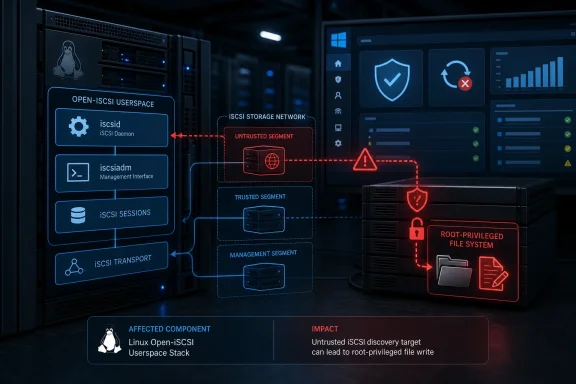 Discovery is a privileged control-plane operation
Open-iSCSI is split between Linux kernel-side data-path components and a userspace control plane. The project identifies the
iscsiddaemon and
iscsiadmmanagement utility as the userspace components responsible for configuration management, discovery, login and logout processing, connection error handling, and related functions.
That distinction explains why the phrase “as root via discovery” deserves attention. Discovery is not ordinary block I/O after a storage session has been established; it is the stage in which an initiator contacts an iSCSI target and processes information about available targets and portals. Open-iSCSI deployments commonly run this work through a privileged service because creating sessions, maintaining node records, and coordinating with the kernel require elevated permissions.
A remote party controlling, impersonating, or able to interfere with a discovery endpoint may therefore be able to influence input processed by a privileged local daemon. The submitted CVE description calls the resulting capability limited file-write, not arbitrary file-write. That wording should be preserved. It says the attacker can cause some form of filesystem modification under root privileges; it does not establish control over the destination path, the written contents, file permissions, overwrite behavior, or whether the result can be chained into code execution.
Those missing details determine severity in practice. A root-owned write restricted to a temporary state file could be serious but containable. A write that can alter discovery records, service configuration, systemd drop-ins, SSH trust material, or another executable control file could become a route to persistent compromise. The public record currently does not say which case CVE-2026-44943 represents.
The exposure is narrower than “every Linux host,” but broad enough to audit now
A machine is not exposed merely because it runs Linux. The relevant question is whether it has Open-iSCSI installed and whether discovery can be initiated against a network-reachable endpoint that is not fully trusted. That includes servers connecting to SANs, virtualization hosts consuming iSCSI datastores, clustered systems, lab environments, recovery tooling, and automation that runs
iscsiadmdiscovery as part of provisioning.
The most consequential environments are likely to be those where discovery is automated, network segmentation is loose, or a storage network spans more systems than the team operating it realizes. iSCSI is often placed on a dedicated VLAN or physically separate fabric precisely because it carries storage traffic and management functions with high trust. Where that separation has eroded—through routed networks, shared switches, temporary recovery paths, or cloud-to-site links—the discovery plane can become reachable by systems that should never be able to influence it.
Windows administrators should also avoid dismissing the advisory entirely if their estate is mixed. Windows Server hosts may connect to iSCSI targets through Microsoft’s own initiator rather than Open-iSCSI, but Hyper-V, VMware, backup appliances, Linux storage gateways, Kubernetes workers, WSL environments, and management jump boxes can all place Open-iSCSI on the same operational path. The vulnerability is not evidence of a flaw in the Microsoft iSCSI Initiator; it is a reason to identify the Linux systems around a Windows storage deployment that actually run
iscsid.
Earlier Open-iSCSI advisories show why package provenance matters. Ubuntu’s 2023 Open-iSCSI bulletin addressed older networking-related issues through distribution-specific package updates, including fixes delivered in versioned packages for Ubuntu 20.04 LTS, 18.04 LTS, and 16.04 LTS extended support. That is the normal remediation model for this software: affected Linux vendors backport a fix into their maintained package streams, often without matching an upstream release number exactly. Administrators should not wait for a generic “latest Open-iSCSI” version claim before checking their vendor’s advisory channel.
The missing fix information is the central problem
The MSRC entry’s lack of a KB number is expected if no Microsoft product is affected. What is less useful is that the currently available public material also does not state the vulnerable Open-iSCSI versions, a commit that introduced or fixes the issue, a reporter, an assigning CNA, or a mitigation.
This leaves security teams with an awkward but familiar choice: make a narrow exposure reduction now, then update as vendor fixes become available. There is no evidence at this stage that disabling all iSCSI connectivity is necessary across every environment. There is also no basis for treating the item as a routine patch-management ticket and moving on, because the alleged action occurs as root and begins with remotely supplied discovery data.
The practical response is to inventory first and alter only the systems that match the threat path:
- Identify hosts with the
open-iscsipackage installed, theiscsidservice enabled or running, or automation that invokesiscsiadm -m discovery. - Record the installed package version and the operating system vendor’s package release, rather than relying solely on the upstream Open-iSCSI version string.
- Identify every discovery target and portal reachable from those hosts, including temporary disaster-recovery targets, test arrays, and scripts that use static discovery addresses.
- Restrict TCP port 3260 and related iSCSI access to dedicated, authenticated storage networks; do not permit arbitrary workstation or server networks to reach discovery-capable initiators or targets.
- Disable or remove Open-iSCSI from systems where it is installed but no longer required, after confirming that no boot, multipath, backup, or clustered-storage dependency remains.
- Monitor the service logs and storage-network telemetry for unexpected discovery activity, new portals, unexplained node-record changes, or sessions established to unfamiliar targets.
Network filtering is a mitigation of reachability, not a correction of the bug. If an attacker already has a position on the storage network, can operate a malicious target in an approved segment, or can redirect traffic through a compromised network device, port-level access control alone may not protect the initiator.
Do not convert “limited write” into a root-RCE headline
The language around CVE-2026-44943 needs discipline. Root context makes any write primitive worth investigating, but the CVE title does not say the attacker receives an interactive root shell, runs commands, overwrites arbitrary files, or bypasses iSCSI authentication. Those are separate technical claims that require evidence from a patch, proof of concept, upstream advisory, or vendor analysis.
Similarly, “remote” should not be read as “internet-exposed.” iSCSI discovery is commonly available only on internal storage networks, and many deployments use target-side access controls. The real risk is governed by who can reach or impersonate a discovery endpoint from the affected initiator—not by whether a host has a public IP address.
This is also why a CVSS score, when one is eventually published, will need reading rather than automatic triage. A high score could be justified if the vulnerability needs no credentials and has a meaningful write destination. A lower score could still represent an urgent issue for a virtualization host or storage gateway that trusts a broad set of discovery endpoints. Conversely, a constrained write may have limited impact on a tightly segmented host with static, authenticated targets and no discovery automation.
Watch the Linux vendor record, not Windows Update
Microsoft says its Security Update Guide can expose remediation, mitigations, workarounds, known issues, affected products, and revisions through its CVRF data. For CVE-2026-44943, those are precisely the fields administrators need, and they are not yet available in usable form from the public entry.
Until the record fills in, the priority is to establish whether discovery is enabled and reachable on each Open-iSCSI host, preserve logs before making broad configuration changes, and monitor the Open-iSCSI project plus the security advisories for Red Hat, SUSE, Ubuntu, Debian, and the distribution actually supplying the package. Once a fixed package version or commit appears, distribution packages—not a Windows KB—will be the remediation to deploy.
References
- Primary source: MSRC
Published: August 8, 2026 at 8:41 AM UTC
Security Update Guide - Microsoft Security Response Center
 msrc.microsoft.com
- Related coverage: msrc.microsoft.com
Security Update Guide - Microsoft Security Response Center
msrc.microsoft.com
- Related coverage: open-iscsi.com
- Related coverage: nvd.nist.gov
Vulnerability APIs
 nvd.nist.gov
- Related coverage: docs.oracle.com
- Related coverage: support.microsoft.com
Description of the security update for Microsoft Exchange Server Subscription Edition RTM: June 09, 2026 (KB5094139) | Microsoft Support
Description of the security update for Microsoft Exchange Server Subscription Edition RTM: June 09, 2026 (KB5094139)support.microsoft.com - Related coverage: nist.gov
National Vulnerability Database
NIST maintains the National Vulnerability Database (NVD), a repository of information on software and hardware flaws that can compromise computer security. This is a key piece of the nation’s cybersecurity infrastructure.www.nist.gov - Related coverage: advisories.ncsc.nl
- Related coverage: nvlpubs.nist.gov
Technical Specification for the Security Content Automation Protocol (SCAP): SCAP Version 1.4
The Security Content Automation Protocol (SCAP) is a suite of specifications that standardize the format and nomenclature by which software flaw and security configuration information is communicated, both to machines and humans. This publication, along with its annex (NIST Special Publication...nvlpubs.nist.gov
- Related coverage: cve.mitre.org
- Related coverage: access.redhat.com
- Related coverage: access.redhat.com
