
Microsoft has published CVE-2026-56161 for an Azure Logic Apps Information Disclosure Vulnerability, but the public record currently provides too little technical detail for administrators to identify a vulnerable workflow, determine the exposure path, or apply a customer-side patch. The advisory was published on August 6, 2026, at 7:00 a.m. Pacific time, and Microsoft’s Security Update Guide is the only authoritative disclosure located for the CVE at publication.
For Azure teams, the immediate conclusion is narrower than the title may suggest: this is a confirmed Microsoft service-side security advisory, not yet a documented configuration flaw in a specific Logic Apps connector, runtime, deployment model, or workflow action. Microsoft has not publicly identified an affected Logic Apps tier, a region, a trigger type, a connector, a CVSS base score, an exploit path, or an update package.
That absence matters. Azure Logic Apps is frequently used to move data and credentials between Microsoft 365, Azure Key Vault, line-of-business APIs, SaaS platforms, and on-premises systems. An information-disclosure flaw in that role could have consequences beyond the Logic App resource itself if it exposed workflow inputs, action outputs, callback URLs, connector material, or data supplied by a downstream service. But none of those scenarios has been confirmed for CVE-2026-56161, and administrators should resist treating plausible attack paths as published facts.
Microsoft’s August 6 Security Update Guide entry assigns CVE-2026-56161 to Azure Logic Apps and classifies the issue as information disclosure. That establishes the vulnerability’s existence and the product family involved. It does not establish whether the affected service is Logic Apps Consumption, Logic Apps Standard, both, or a particular internal Azure component shared by them.
The record also does not say whether exploitation requires an authenticated Azure tenant user, a workflow author, an external caller to a request trigger, access to a callback URL, or no prior authorization at all. Those distinctions determine whether this belongs in an application-team review queue, an Azure RBAC review, a public-endpoint investigation, or an emergency cloud-service incident response.
Microsoft has likewise not identified whether it has already remediated the issue in the hosted service. That omission is important for a cloud vulnerability: customers cannot assume either that an Azure-side fix has been deployed everywhere or that there is a tenant-controlled update to install. The available advisory does not provide a remediation statement, deployment status, mitigation, workaround, or a link to a customer action.
A search of the public National Vulnerability Database and CVE Program listings after the advisory’s publication did not surface a matching public record. That is not evidence that the CVE is invalid; Microsoft is a CVE Numbering Authority and its Security Update Guide can publish first. It does mean that defenders cannot currently use NVD enrichment to fill in the missing CVSS vector, weakness classification, affected configuration data, or references.
This is an easy place for security dashboards to overstate the risk. A vulnerability title containing “Information Disclosure” says that confidentiality can be affected; it does not, on its own, reveal what information could be disclosed, at what scale, or under what permissions. There is no published basis yet to claim exposure of secrets, customer data, workflow definitions, tokens, service principals, or cross-tenant information.
Nor is there a basis to call the flaw remotely exploitable, unauthenticated, actively exploited, or critical. Microsoft has not made any of those assertions in the available record. No independent reporting, proof-of-concept publication, CISA alert, or Azure service-health notice was located for the CVE as of August 6.
The more useful operational stance is to treat this as a confirmed but under-documented cloud-service vulnerability. It warrants inventory and access review, especially for workflows handling sensitive material, but not assumptions about a particular connector or a rushed configuration change that could interrupt business automation.
Microsoft documents controls to restrict access to workflow history and to obscure sensitive inputs and outputs. For individual triggers and actions, administrators can configure Secure Inputs, Secure Outputs, or both. Azure Logic Apps then hides those values in run history, and Microsoft says secured outputs are not returned by the workflow-history API.
Those settings are not automatic protection for all downstream processing. Microsoft’s documentation specifically notes that data-handling behavior can differ when secured values are passed into later actions, including Compose, Parse JSON, and Response actions. A team that enabled secure outputs on a Key Vault retrieval years ago may still need to review later actions that transform, compose, return, or log that value.
This does not mean CVE-2026-56161 bypasses Secure Inputs or Secure Outputs. Microsoft has not said that. It means the controls are worth validating now because they limit routine administrative and diagnostic exposure regardless of the eventual technical explanation for this CVE.
Start with workflows that process credentials, authentication headers, personally identifiable information, financial records, health data, HR records, or high-value integration payloads. Review not only the workflow designer, but also the run history visible to operators, Azure RBAC assignments, and any diagnostics destinations receiving workflow runtime data.
A Logic App whose portal run history is tightly restricted can still leak useful metadata or workflow details into a Log Analytics workspace if the workspace has broader reader access, cross-team queries, long retention, exports, or downstream analytics integrations. Microsoft also notes that Azure Monitor resource logs are not transactionally guaranteed, so they should support investigation rather than serve as the only source of truth for whether a workflow did or did not execute.
Administrators should review where Logic Apps diagnostics are routed and who can query each destination. Security teams should include Azure Monitor, Storage, Event Hubs, SIEM forwarding rules, and data-export pipelines in that review; focusing only on the Logic App’s Contributor and Reader assignments can miss the places where workflow evidence actually travels.
The same applies to workflow callback URLs. Microsoft’s documentation says request-trigger URLs use shared access signatures generated from a secret logic-app key, trigger name, and operation. Microsoft advises against direct browser use for production and higher-security systems because the key appears in the URL. That guidance is not a mitigation for CVE-2026-56161, but it is a sensible opportunity to rotate or replace exposed callback URLs, limit inbound IP ranges where appropriate, and move high-value endpoints behind stronger identity controls or API Management.
Until then, the concrete risk is not a known exploit chain; it is that organizations running sensitive Logic Apps may not know where their workflow payloads, credentials, and diagnostic records can already be viewed.
That absence matters. Azure Logic Apps is frequently used to move data and credentials between Microsoft 365, Azure Key Vault, line-of-business APIs, SaaS platforms, and on-premises systems. An information-disclosure flaw in that role could have consequences beyond the Logic App resource itself if it exposed workflow inputs, action outputs, callback URLs, connector material, or data supplied by a downstream service. But none of those scenarios has been confirmed for CVE-2026-56161, and administrators should resist treating plausible attack paths as published facts.
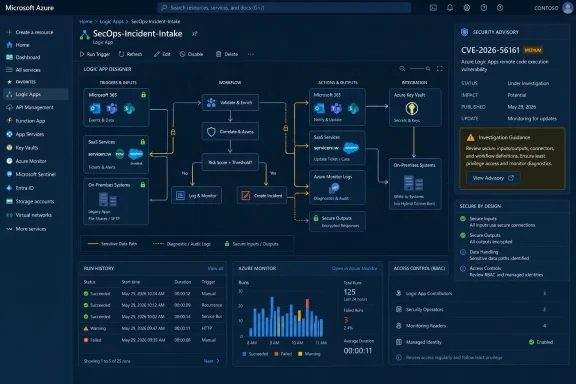 Microsoft Has Confirmed the CVE, but Not the Attack Surface
Microsoft’s August 6 Security Update Guide entry assigns CVE-2026-56161 to Azure Logic Apps and classifies the issue as information disclosure. That establishes the vulnerability’s existence and the product family involved. It does not establish whether the affected service is Logic Apps Consumption, Logic Apps Standard, both, or a particular internal Azure component shared by them.The record also does not say whether exploitation requires an authenticated Azure tenant user, a workflow author, an external caller to a request trigger, access to a callback URL, or no prior authorization at all. Those distinctions determine whether this belongs in an application-team review queue, an Azure RBAC review, a public-endpoint investigation, or an emergency cloud-service incident response.
Microsoft has likewise not identified whether it has already remediated the issue in the hosted service. That omission is important for a cloud vulnerability: customers cannot assume either that an Azure-side fix has been deployed everywhere or that there is a tenant-controlled update to install. The available advisory does not provide a remediation statement, deployment status, mitigation, workaround, or a link to a customer action.
A search of the public National Vulnerability Database and CVE Program listings after the advisory’s publication did not surface a matching public record. That is not evidence that the CVE is invalid; Microsoft is a CVE Numbering Authority and its Security Update Guide can publish first. It does mean that defenders cannot currently use NVD enrichment to fill in the missing CVSS vector, weakness classification, affected configuration data, or references.
The Published Detail Does Not Describe a Root Cause
The explanatory text accompanying the submission describes a confidence-oriented vulnerability metric: how certain the vulnerability’s existence is and how much technical knowledge may be available to attackers. It does not describe CVE-2026-56161’s root cause, proof of concept, exploitability, or technical impact.This is an easy place for security dashboards to overstate the risk. A vulnerability title containing “Information Disclosure” says that confidentiality can be affected; it does not, on its own, reveal what information could be disclosed, at what scale, or under what permissions. There is no published basis yet to claim exposure of secrets, customer data, workflow definitions, tokens, service principals, or cross-tenant information.
Nor is there a basis to call the flaw remotely exploitable, unauthenticated, actively exploited, or critical. Microsoft has not made any of those assertions in the available record. No independent reporting, proof-of-concept publication, CISA alert, or Azure service-health notice was located for the CVE as of August 6.
The more useful operational stance is to treat this as a confirmed but under-documented cloud-service vulnerability. It warrants inventory and access review, especially for workflows handling sensitive material, but not assumptions about a particular connector or a rushed configuration change that could interrupt business automation.
Run History Is the First Exposure Point Worth Reviewing
Microsoft’s own Azure Logic Apps documentation explains why information-disclosure advisories deserve attention even before root-cause details arrive. Workflow run history can contain triggers, action inputs, action outputs, request and response data, error details, and timing information. That diagnostic depth is valuable during troubleshooting, but it can also put sensitive business data within reach of users whose roles were granted for operational convenience rather than data access.Microsoft documents controls to restrict access to workflow history and to obscure sensitive inputs and outputs. For individual triggers and actions, administrators can configure Secure Inputs, Secure Outputs, or both. Azure Logic Apps then hides those values in run history, and Microsoft says secured outputs are not returned by the workflow-history API.
Those settings are not automatic protection for all downstream processing. Microsoft’s documentation specifically notes that data-handling behavior can differ when secured values are passed into later actions, including Compose, Parse JSON, and Response actions. A team that enabled secure outputs on a Key Vault retrieval years ago may still need to review later actions that transform, compose, return, or log that value.
This does not mean CVE-2026-56161 bypasses Secure Inputs or Secure Outputs. Microsoft has not said that. It means the controls are worth validating now because they limit routine administrative and diagnostic exposure regardless of the eventual technical explanation for this CVE.
Start with workflows that process credentials, authentication headers, personally identifiable information, financial records, health data, HR records, or high-value integration payloads. Review not only the workflow designer, but also the run history visible to operators, Azure RBAC assignments, and any diagnostics destinations receiving workflow runtime data.
Diagnostic Logging Can Create a Second Copy of Sensitive Data
Azure Logic Apps can send trigger, run, and action events to Azure Monitor Logs, Storage accounts, Event Hubs, and partner destinations. Microsoft promotes this telemetry for troubleshooting and operational monitoring, but it creates a separate data-access boundary from the Logic App resource itself.A Logic App whose portal run history is tightly restricted can still leak useful metadata or workflow details into a Log Analytics workspace if the workspace has broader reader access, cross-team queries, long retention, exports, or downstream analytics integrations. Microsoft also notes that Azure Monitor resource logs are not transactionally guaranteed, so they should support investigation rather than serve as the only source of truth for whether a workflow did or did not execute.
Administrators should review where Logic Apps diagnostics are routed and who can query each destination. Security teams should include Azure Monitor, Storage, Event Hubs, SIEM forwarding rules, and data-export pipelines in that review; focusing only on the Logic App’s Contributor and Reader assignments can miss the places where workflow evidence actually travels.
The same applies to workflow callback URLs. Microsoft’s documentation says request-trigger URLs use shared access signatures generated from a secret logic-app key, trigger name, and operation. Microsoft advises against direct browser use for production and higher-security systems because the key appears in the URL. That guidance is not a mitigation for CVE-2026-56161, but it is a sensible opportunity to rotate or replace exposed callback URLs, limit inbound IP ranges where appropriate, and move high-value endpoints behind stronger identity controls or API Management.
What Azure Administrators Can Do Before Microsoft Adds Detail
There is no Microsoft-issued patch or workaround to deploy from the public advisory, so the practical response is verification rather than speculative remediation.- Review every production Logic App with sensitive workflow payloads and confirm that Secure Inputs and Secure Outputs are enabled where secrets or regulated data enter, leave, or are transformed by a workflow.
- Audit Azure RBAC on Logic Apps, resource groups, subscriptions, Log Analytics workspaces, Storage accounts, and Event Hubs that receive Logic Apps diagnostic data. Read access to workflow history can be materially more sensitive than the role name suggests.
- Identify public request-trigger workflows and inventory the owners, callback URL distribution, source-IP restrictions, authentication design, and use of Azure API Management or Microsoft Entra ID controls.
- Check whether secrets retrieved from Azure Key Vault are subsequently placed into Compose, Parse JSON, Response, custom connector, logging, or error-handling actions where they may remain visible outside the originally secured action.
- Preserve current diagnostic settings and relevant workflow histories before making broad logging changes. Turning off telemetry may reduce visible data, but it can also remove evidence needed if Microsoft later provides indicators, timestamps, or a defined exposure condition.
- Watch Microsoft’s Security Update Guide entry for a revision rather than waiting for the next conventional Patch Tuesday. The advisory was published on a Thursday, August 6, 2026, and there is no indication in the current record that it is tied to a Windows cumulative update cycle.
Until then, the concrete risk is not a known exploit chain; it is that organizations running sensitive Logic Apps may not know where their workflow payloads, credentials, and diagnostic records can already be viewed.
References
- Primary source: MSRC
Published: 2026-08-06T07:00:00-07:00
Loading…
msrc.microsoft.com - Related coverage: msrc.microsoft.com
Security Update Guide - Microsoft Security Response Center
 msrc.microsoft.com
- Related coverage: cisa.gov
- Related coverage: cisa.gov
Joint Cybersecurity Advisory (JCSA) - AA22-117A: 2021 Top Routinely Exploited Vulnerabilities
PDF documentwww.cisa.gov
- Related coverage: learn.microsoft.com
List vulnerabilities by software - Microsoft Defender for Endpoint | Microsoft Learn
Retrieve a list of vulnerabilities in the installed software.learn.microsoft.com - Related coverage: nvd.nist.gov
Vulnerability APIs
 nvd.nist.gov
- Related coverage: learn.microsoft.com
Loading…
learn.microsoft.com - Related coverage: vulnerabilities.ncsc.nl
- Related coverage: advisories.ncsc.nl
- Related coverage: nzpowerlunchfiles.blob.core.windows.net
Loading…
nzpowerlunchfiles.blob.core.windows.net - Related coverage: microsoft.com
Loading…
www.microsoft.com