
Microsoft’s Security Update Guide published the advisory on August 11, 2026. Microsoft’s own entry describes an unauthenticated network attack in which deserialization of untrusted data in HPC Pack can allow code execution. The CVSS 3.1 vector is the maximum-severity profile short of a 10.0: network reachable, low attack complexity, no privileges required, no user interaction, and high impact to confidentiality, integrity, and availability.
That is the part administrators should take seriously now. The surrounding metadata is the part that demands caution.
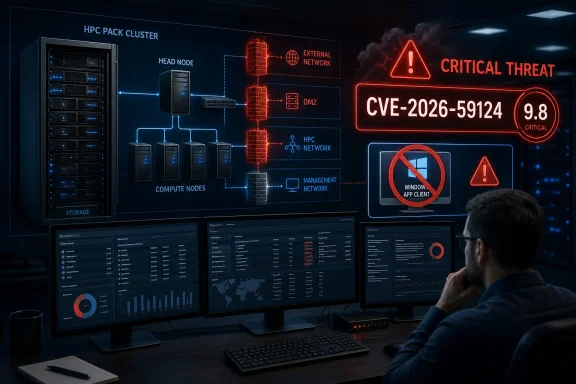 The official CVE record points to the wrong product
The CVE Program’s official JSON record, authored by Microsoft as the CVE Numbering Authority, calls CVE-2026-59124 “Microsoft High Performance Computing (HPC) Pack Remote Code Execution Vulnerability” and gives the same deserialization description as the Microsoft advisory. Yet its affected-product section names Windows App Client for Windows Desktop, with versions from 1.00 through anything below 2.0.1314.0.
Those are not alternate names for the same product. Windows App Client is Microsoft’s remote desktop and virtual-desktop connection application. HPC Pack is a Windows Server-oriented cluster-management suite comprising head nodes, compute nodes, schedulers, brokers, management tools, client utilities, and optional cloud-bursting components. A Windows App version boundary cannot tell an administrator which HPC Pack servers or clients require remediation.
The mismatch reaches the machine-readable CPE identifier used by vulnerability-management tools. Instead of identifying an HPC Pack CPE, Microsoft’s submitted record specifies a CPE for Windows App Client. That means scanners, CMDB correlation platforms, and ticketing automation that ingest CVE data directly could flag the wrong endpoint population while missing the systems administrators actually need to investigate: HPC head nodes, broker nodes, compute nodes, and systems with HPC Pack client utilities.
This is not a semantic nit. The disclosed vulnerability is described as unauthenticated, network-based code execution. A bad version map is precisely how a critical server-side vulnerability turns into a false sense of completion: endpoint teams see a Windows App finding, patch it or suppress it, and the HPC cluster remains untouched.
Microsoft’s published record was marked public at 7:00 a.m. Pacific time on August 11. The CVE Program record was then published at 10:03 a.m. Pacific and modified at 12:16 p.m. Pacific. As of that update, the product mismatch remained in place.
The technical impact is clear; the deployment target is not
Microsoft classifies the weakness as CWE-502, deserialization of untrusted data. In broad terms, this is a class of flaw in which software reconstructs attacker-controlled serialized input into application objects without safely constraining what may be created or executed. The result, according to Microsoft, is code execution over the network without an attacker needing credentials or user interaction.
The CVSS temporal data also matters. Microsoft marks the report confidence as confirmed and lists an official fix, while recording exploit code maturity as unproven. In Microsoft’s usual Security Update Guide terminology, that indicates the company has confirmed the flaw and made remediation available, but it is not claiming that public exploit code exists or that exploitation has been observed.
Microsoft has not publicly supplied the details operations teams need to turn that assurance into a controlled maintenance change. The published CVE record contains no valid HPC Pack version range, no HPC Pack build number, no KB number, no named Quick Fix Engineering package, no download package identifier, and no workaround. It also does not state whether every supported HPC Pack 2019 deployment is affected, whether HPC Pack 2016 remains in scope, or which component exposes the vulnerable deserialization path.
That omission is especially consequential in HPC environments, where updating a head node can cascade into maintenance work across high-availability nodes, compute pools, broker services, client utilities, and cloud-hosted nodes. “Apply the security update” is not enough operational guidance when the advisory does not say which installer or build contains it.
HPC Pack has already made patching non-trivial
Microsoft’s older HPC Pack documentation provides a warning against assuming that the normal update path always closes a security issue. The company’s guidance for the earlier critical CVE-2025-21198 instructed customers using HPC Pack 2016 and HPC Pack 2019 Update 2 or earlier to set a Linux authentication key. When Microsoft released HPC Pack 2019 Update 3, it explicitly said that applying the Update 3 patcher alone did not fix that earlier vulnerability on existing clusters; administrators had to set the key on head nodes and Linux compute nodes before or alongside the upgrade.
That prior issue is distinct from CVE-2026-59124 and should not be mistaken for a workaround for it. But it establishes an important operational fact: HPC Pack security remediation can include configuration work that is separate from installing a newer package. Administrators should not assume that updating a Windows Server cumulative update, applying an old HPC Pack Update 3 package, or changing the Linux authentication key protects against today’s new deserialization flaw.
Microsoft’s latest publicly documented HPC Pack 2019 Update 3 materials describe build 6.3.8328 for the client components and an Update 3 package built around that release. The older HPC Pack remote-code-execution advisory CVE-2025-55232 used a different remediation threshold, identifying HPC Pack 2019 releases below 6.3.8352 Quick Fix QFE as vulnerable. Those records show why exact build numbers are essential—and why the absence of a valid new one for CVE-2026-59124 is a material reporting gap rather than a documentation inconvenience.
What HPC administrators should do before Microsoft corrects the record
Treat CVE-2026-59124 as a high-priority exposure investigation, with a change plan held until the package identity is confirmed. Start by inventorying actual HPC Pack installations rather than relying on vulnerability-scanner matches for Windows App Client.
Cluster owners should identify:
- HPC Pack head nodes, including high-availability and Service Fabric-backed deployments.
- Windows compute nodes, broker nodes, workstation nodes, unmanaged server nodes, and any machines with HPC Pack client utilities.
- Linux compute nodes and the network paths used by the head-node and cluster-management services.
- Internet-facing, partner-connected, cross-segment, or broadly routable interfaces that can reach HPC control-plane services.
At the same time, review firewall policy around head nodes and management endpoints. The CVSS vector says an attacker needs network reachability, not an account. Segmentation cannot replace Microsoft’s fix, but limiting access to known cluster-management networks reduces the number of systems able to attempt an attack while the remediation instructions are incomplete.
Administrators should also preserve evidence before making broad changes. Record installed HPC Pack component versions, node roles, exposed ports, and firewall rules. This will make it possible to verify Microsoft’s eventual fixed-build guidance rather than guessing from a package date, an Update 3 label, or a Windows App Client alert that plainly does not belong to the product named in the vulnerability description.
The correction is now part of the security response
Microsoft has established the existence and severity of CVE-2026-59124: an unauthenticated network RCE in HPC Pack with a 9.8 CVSS score warrants prompt action. But Microsoft’s machine-readable affected-product data currently directs automated defenders to Windows App Client for Windows Desktop, not HPC Pack. No independent outlet had published technical analysis, affected HPC builds, or a verified remediation package at the time of disclosure.
Until Microsoft publishes a corrected affected-product list and a specific HPC Pack update or Quick Fix identifier, the responsible position is straightforward: prioritize network containment and precise HPC inventory, and do not close the vulnerability based on a Windows App Client version check.