
Microsoft published the advisory at 7:00 a.m. Pacific time as part of its August Patch Tuesday release. The MSRC record identifies the issue as a local elevation-of-privilege vulnerability and supplies an official fix through the month’s Windows security updates. SANS Internet Storm Center’s August advisory index independently lists CVE-2026-62688 as Important, with a 7.8 base score and a 6.8 temporal score; it also records Microsoft’s assessments that the flaw was neither publicly disclosed nor known to be exploited when the update shipped.
The immediate action for administrators is straightforward: deploy the August 11 cumulative update applicable to each supported Windows 11 release in the environment, then verify installation rather than relying on update approval alone. This is especially relevant for endpoints where users run developer tools, audio-production software, unsigned utilities, browser-downloaded installers, or any workload that gives an attacker a plausible route to execute code as the current user.
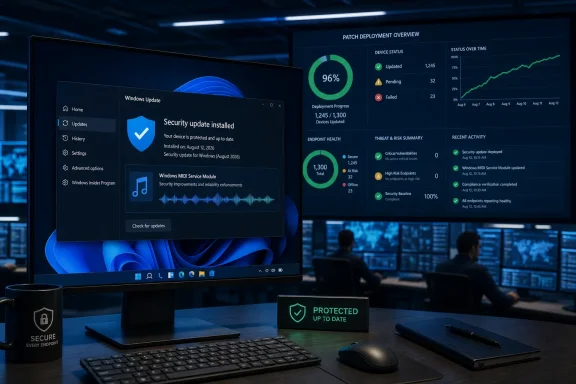 A Local Flaw That Changes the Stakes After Initial Access
CVE-2026-62688 is not described as a remote-code-execution bug. An attacker needs local access and low-level privileges on the target machine, which means this CVE does not by itself let someone scan the internet for vulnerable Windows PCs and take them over.
That limitation is real, but it should not be confused with a minor impact. Local privilege-escalation bugs are routinely useful after phishing, malicious downloads, stolen standard-user credentials, browser compromise, or an attacker’s foothold through another application. The first-stage compromise gets code onto the endpoint; the elevation flaw can remove the restrictions that make that initial access easier to contain.
Microsoft’s CVSS assessment indicates high potential impact on confidentiality, integrity, and availability. In operational terms, that is the profile security teams associate with an attacker crossing from a constrained user context into one capable of reading protected data, tampering with security controls, installing persistence, or disrupting the device. The exact end state and exploitation sequence have not been publicly documented, so administrators should not assume a particular proof-of-concept exists—or that one is required for this to be valuable to an attacker.
The most important point is that the vulnerability is associated with a Windows service component, not merely a single MIDI application. Organizations should therefore avoid trying to scope the issue by asking which employees use synthesizers, MIDI controllers, or music-production software. The relevant question is whether the affected Windows build is installed and whether Microsoft’s August security update has been applied.
Microsoft Says Exploitation Is Less Likely—Not Impossible
Microsoft’s advisory marks CVE-2026-62688 as “Exploitation Less Likely,” with no public disclosure and no evidence of active exploitation at publication. Those fields are useful for prioritization, but they are a snapshot of conditions on August 11, not a compensating control.
“Less likely” generally means Microsoft sees barriers in the attack path: a prerequisite configuration, a narrow race condition, a dependency on existing local execution, or other technical conditions that reduce reliable exploitation. It does not mean the weakness cannot be exploited, nor does it prevent attackers from combining it with a different vulnerability or a social-engineering campaign.
The record’s temporal score of 6.8 also deserves proper reading. It is lower than the 7.8 base score because an official vendor fix is available, not because the underlying flaw became less capable. A vulnerable endpoint that has not installed the update still carries the original risk characteristics.
Microsoft’s report confidence is “Confirmed.” That is stronger than a preliminary or unverified report: Microsoft has acknowledged the bug and issued a security update for it. The supplied advisory language explains why this metric matters: confirmation increases confidence both that the vulnerability exists and that sufficiently credible technical information supported remediation. It does not mean Microsoft has released root-cause details that defenders can independently test.
That missing technical disclosure is material. Microsoft has not publicly described the vulnerable function, the affected file, a specific attack primitive, or a workaround that administrators can apply while deferring the update. No other outlet had published substantive technical reproduction details for CVE-2026-62688 at the time of this report. The absence of a public proof-of-concept reduces immediate commodity exploitation risk, but it also means there is no sound basis for substituting a service disablement, registry change, or application blocklist for patching.
The MIDI Name Is a Poor Basis for Risk Scoping
The Windows MIDI Service Module name can encourage the wrong kind of triage. IT teams understandably map “MIDI” to audio workstations, media teams, USB instruments, and specialist hardware. But vulnerability management needs to follow the affected Windows component and build—not the visible use of MIDI by the person sitting at the PC.
That distinction matters most in organizations where endpoint exceptions are common. A standard user on a shared workstation, a developer on a test device, or a help-desk technician with a limited account may all be low-privilege users. Those accounts are deliberately restricted because they are not supposed to administer the machine. A local elevation-of-privilege exploit exists to defeat exactly that boundary.
For security teams, this CVE belongs in the same response lane as other Windows local privilege-escalation updates:
- Deploy the August 11 Windows security update through Windows Update for Business, WSUS, Configuration Manager, Intune, or the organization’s approved patch platform.
- Confirm the resulting OS build on representative devices and investigate systems that reported an update installation failure or remain on the prior monthly build.
- Prioritize shared endpoints, admin workstations, developer devices, virtual desktop pools, kiosk systems with locally available applications, and machines that process untrusted downloads.
- Do not treat the lack of public exploitation as a reason to postpone deployment through the next monthly cycle.
The concern is amplified on devices where a local attacker can already run code but cannot initially install drivers, access other users’ data, disable controls, or make system-wide changes. Those restrictions are what an elevation-of-privilege vulnerability attempts to bypass.
Patch Verification Matters More Than Approval Status
For this vulnerability, the remediation is the cumulative update, and cumulative-update patching has a familiar weakness in enterprise environments: an update can be approved, targeted, downloaded, or even reported as pending without the endpoint actually reaching a protected build.
Administrators should confirm that the August 2026 quality update completed successfully across the Windows 11 versions in use, including devices managed through different servicing rings. Devices that were powered off during deployment, held by safeguard policies, blocked by disk-space constraints, or left in reboot-pending state should be treated as unremediated until their installed build is verified.
The security impact also argues against separating “user-facing” quality updates from “security-only” work. The Windows MIDI Service Module flaw has no visible feature fix an end user will recognize. Its value to an attacker lies precisely in the background component that most users will never notice.
Microsoft has supplied the fix, confirmed the vulnerability, and reported no active exploitation as of August 11. The remaining exposure is therefore operational: every Windows 11 device that remains on a pre-August security build retains a locally exploitable path that could make a modest endpoint intrusion substantially more damaging.