
The more important finding from the available record is what has not been published. Microsoft’s Security Update Guide identifies the component and impact, but the information currently available for CVE-2026-62812 does not establish the vulnerability’s technical trigger, the privileges an attacker must already hold, the affected Windows Server versions and builds, or a workaround. Searches of the NVD, the CVE Program record, CISA advisories, and independent Patch Tuesday coverage did not surface a separate technical description or a report of exploitation as of August 12.
That makes this a patch-and-verify issue, rather than a case for inventing network controls around an unconfirmed attack path.
 The server role, not every Windows device, is the exposure point
“Windows DHCP Server” is a specific Windows Server role. A workstation, member server, domain controller, or Windows client with the ordinary DHCP Client service enabled is not exposed to this issue merely because it obtains an IP address automatically.
The systems to review are the ones answering DHCP requests: standalone Windows DHCP servers, clustered or failover-paired DHCP servers, and domain controllers that have also been assigned the DHCP Server role. Organizations with distributed branch-office DHCP deployments should not assume the central DHCP pair is the whole scope; an old local Windows Server instance can remain authoritative for a subnet long after it has disappeared from ordinary server inventories.
That distinction is operationally useful. A vulnerability assigned to the DHCP server does not call for an indiscriminate emergency deployment across Windows endpoints. It does call for a targeted search of server roles, DHCP management consoles, IP address management tooling, and configuration-management inventories. In PowerShell, the installed role can be checked with Get-WindowsFeature DHCP; on Server Core or remotely managed systems, that is generally faster and more reliable than using a list of machines named “DHCP.”
The security consequence depends on the missing details. An elevation-of-privilege flaw ordinarily means an attacker needs some existing level of execution or access before gaining rights they should not have. That is materially different from the DHCP Server remote-code-execution vulnerabilities patched in recent months, where the server’s network-facing behavior was itself the entry point. Microsoft has not publicly said whether CVE-2026-62812 is local-only, reachable through DHCP administration interfaces, dependent on domain privileges, or tied to a particular service configuration.
Administrators should therefore avoid treating “elevation of privilege” as proof that untrusted devices on a DHCP-enabled subnet can immediately take over the server. The published classification does not support that conclusion.
Microsoft has confirmed the advisory, but not the attack chain
Microsoft’s August 11 advisory is the authoritative source for the vulnerability’s existence and its identification as an elevation-of-privilege issue. The advisory’s publication also means a Microsoft-serviced update path exists for supported affected products, even though the visible information supplied with the record is thin.
What remains absent is nearly everything incident responders and vulnerability managers normally use to set urgency beyond the vendor’s severity label:
- Microsoft has not publicly described the vulnerable code path or named a weakness category for CVE-2026-62812 in the information currently available.
- Microsoft has not publicly stated that the vulnerability was publicly disclosed before the patch release or exploited in the wild.
- No public proof of concept, researcher write-up, or technical advisory independently explaining exploitation was found.
- The NVD and CVE Program records did not provide a corroborating description at publication time.
This is not an unusual condition on release day. Microsoft often publishes the remediation before enough information exists for defenders—or attackers—to reproduce the flaw. It is also why an “elevation of privilege” label alone should not be translated into a presumed SYSTEM compromise, domain compromise, or remote attack. Those outcomes may be possible in some Windows privilege-escalation cases, but neither Microsoft’s available record nor independent reporting establishes them for CVE-2026-62812.
The absence of technical detail changes the defensive priority in a practical way. Patch the DHCP servers promptly, but put equal effort into verifying that the right machines were identified and that the update did not create a service interruption. DHCP is a foundational network service; an unsuccessful maintenance event can strand clients just as effectively as a security incident.
Treat DHCP failover as part of the patch plan
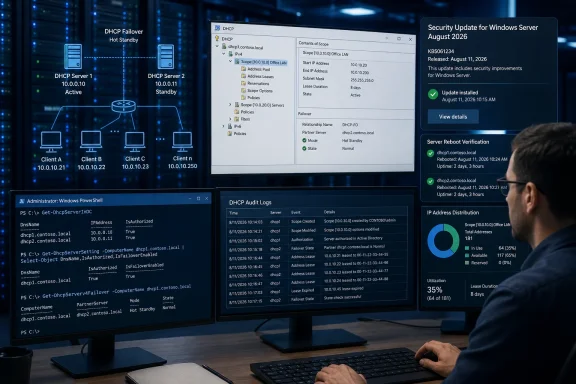
Windows DHCP deployments frequently use DHCP failover relationships, split scopes, or paired servers to keep address assignment available during maintenance. That redundancy gives IT teams a safer route to install the August update, but only if the failover partner is healthy and its leases are replicating before work begins.
A sensible sequence is to patch the passive or secondary DHCP server first, confirm that its scopes, reservations, DNS dynamic-update settings, and failover state remain intact, then move service responsibility as required by the organization’s change process. Patch the remaining partner after the first server has demonstrated stable operation. Sites without DHCP failover should schedule a maintenance window with a tested rollback plan rather than restarting a sole DHCP server in the middle of business hours.
Post-install validation should cover more than whether the server boots. Confirm that the DHCP Server service is running, scopes are active, and fresh clients can obtain an address, gateway, DNS server, and any vendor-specific options used by phones, wireless access points, PXE boot, or imaging systems. Check DHCP audit logs and the DHCP Server event logs for database-loading errors, authorization failures, replication problems, or DNS update failures.
This matters particularly where DHCP is integrated with Active Directory DNS. A server can continue handing out leases while failing to register or update client records correctly, creating what looks like an intermittent name-resolution problem rather than an obvious DHCP outage. Microsoft’s own DHCP troubleshooting guidance points administrators to the DHCP audit files under C:\Windows\System32\DHCP when validating DNS-registration behavior.
Unsupported DHCP servers are the unresolved risk
The CVE is a reminder to distinguish installed servers from supported servers. A Windows DHCP service left behind on an out-of-support release will not gain protection simply because administrators update newer Windows Server hosts elsewhere in the environment. Windows Server 2012 R2, for example, is past normal support and depends on Extended Security Updates through October 13, 2026 for continued security fixes.
Microsoft has not yet provided enough public CVE-2026-62812 detail to state whether any ESU-only operating systems are affected. That gap should be resolved from the Security Update Guide’s product-and-KB mappings before an organization marks the vulnerability remediated. Do not infer coverage from a generic “Windows Server” patch title, and do not rely on an endpoint scanner that detects the CVE without checking whether it recognizes the DHCP Server role and the installed cumulative update.
The right remediation record should capture the server name, operating system version and build, installed August 2026 KB, DHCP role status, failover partner if any, restart status, and lease-validation result. That turns a broad Patch Tuesday alert into evidence that the service actually received the fix.
For now, CVE-2026-62812 warrants prompt remediation on supported Windows DHCP servers, but the public evidence does not support calling it an internet-wormable DHCP bug, an active zero-day, or a confirmed route to domain takeover. Microsoft’s next revision—especially any addition of affected builds, exploitability assessment, or attack prerequisites—will determine whether this remains a focused server-maintenance task or becomes a higher-priority incident-hunting concern.
