
Microsoft’s own FAQ explains that “Remote” in the title refers to the attacker’s location and calls the outcome a form of arbitrary code execution, or ACE. That is a serviceable short answer, but it leaves out the distinction administrators need when deciding how urgently to patch and how to model exposure: AV:L describes the vulnerable execution path, while remote code execution describes the result an attacker can obtain on the victim’s device.
An attacker can be somewhere else entirely, deliver malicious content through an ordinary remote channel, and still face a CVSS Local vulnerability if Office must process that content locally before the flaw triggers. In other words, a remote attacker can induce local execution. Those statements are compatible.
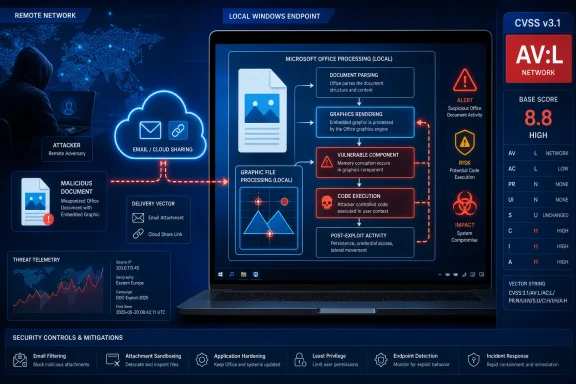 CVSS Uses “Local” More Narrowly Than Many Administrators Do
The Common Vulnerability Scoring System’s Attack Vector metric is not a label for whether an attacker sits at the same keyboard as the victim. It measures the context in which the vulnerable component is exploited.
FIRST, the organization that maintains CVSS, explicitly addresses document-parsing bugs in its CVSS v3.1 guidance. A flaw in an application that processes a malicious document is typically scored AV:L when the vulnerable parser runs locally, even if the attacker sent the document through email, placed it on a website, or otherwise delivered it remotely. The delivery method does not transform the Office component into a network-facing service.
That is the central fact behind CVE-2026-63519. The Microsoft Office Graphics Component does not need to be listening on a TCP or UDP port for an attacker to use it. The vulnerable operation happens after Office, or a related Office component, processes attacker-controlled graphics data on the endpoint.
A network-rated bug, AV:N, is different. The target component itself must accept attacker-controlled network traffic as part of the exploit path: a server service, web service, exposed daemon, or network protocol handler are the familiar examples. The attacker sends packets or requests to that component and triggers the vulnerability there.
For CVE-2026-63519, the available Microsoft language indicates that the vulnerable action is local parsing or handling, not inbound network protocol processing. That is why AV:L is the correct classification even though an attacker may begin the attack from another machine.
The term local here should not be mistaken for “the attacker already has an interactive Windows session” or “the attacker must have a valid domain account.” CVSS AV:L is broader than that. It can cover vulnerabilities reached when a local application opens, renders, imports, previews, or otherwise consumes malicious data that originated elsewhere.
“Remote Code Execution” Names the Impact, Not the Delivery Channel
Security reporting has used “remote code execution” for years as an impact category: an attacker causes code chosen or controlled by them to run on another person’s computer. It is an outcome of exploitation, not a guarantee that the vulnerable code accepts traffic directly from the internet.
That terminology can become imprecise when the phrase is compressed into a CVE title. Microsoft’s title identifies CVE-2026-63519 as a code-execution flaw in the Office Graphics Component. The title does not say “unauthenticated network remote code execution,” “zero-click exploit,” or “server-side remote code execution.” Those are materially different threat models.
Microsoft’s FAQ is correct to point users toward arbitrary code execution as a related term. ACE more directly describes the security consequence: maliciously controlled code may run within the vulnerable application’s local context. In Office cases, that context can be the signed-in user’s account and privileges. Whether that becomes full device compromise depends on what the code can do, what endpoint protections intercept, and whether the attacker can chain another flaw or abuse already available user access.
The practical risk can still be significant. A file-based Office vulnerability often fits into phishing, targeted document delivery, shared storage, collaboration attachments, downloaded content, or removable-media scenarios. None of those require the attacker to have physical access to the endpoint. But they normally require a victim-side event: Office must process the malicious content.
Microsoft’s published FAQ for CVE-2026-63519 says an attacker or victim needs to execute code from the local machine to exploit the issue. That wording should be read as a warning about the required execution context, not as reassurance that the bug is safe from remote attackers. The endpoint is where the vulnerable code runs; the attacker’s infrastructure and delivery channel may be remote.
What the AV:L Score Does — and Does Not — Tell Defenders
AV:L lowers the number of possible attack paths compared with an exposed network service, which is why it generally lowers the CVSS score. It does not prove that user interaction is required, that the Preview Pane is safe, that macros are involved, or that Microsoft Defender or SmartScreen will block the attack.
Those details come from separate CVSS metrics, from Microsoft’s exploitability assessment, and from the advisory’s technical FAQ or mitigation guidance. Microsoft’s published explanation for CVE-2026-63519 resolves the AV:L terminology but does not, in the information currently available, establish a detailed public attack chain, a specific delivery format, Preview Pane behavior, a workaround, or evidence of in-the-wild exploitation.
That absence matters. Administrators should not fill in those gaps with assumptions borrowed from older Office flaws.
An Office graphics issue can involve embedded images, document rendering, conversion, clipboard content, or a component shared by more than one Office workflow. The CVE title alone does not establish which of those is involved. Nor does “Graphics Component” establish that Windows’ separate graphics stack is affected. Treat the product identity in the advisory as authoritative and avoid expanding the incident scope to Windows graphics vulnerabilities unless Microsoft names them.
The distinction is especially important for security operations teams building detection and response logic. Searching for a network service exploit pattern, scanning for a newly exposed port, or treating this as a perimeter-only risk misses the likely control point. The relevant questions are whether affected Office installations received Microsoft’s update, how files enter the organization, which users handle untrusted documents, and whether endpoint monitoring can spot suspicious child processes or unusual Office-driven execution.
The Correct Priority Is “Patch the Endpoint,” Not “Close a Port”
The direct operational response is to identify every supported Microsoft Office deployment covered by Microsoft’s Security Update Guide entry for CVE-2026-63519 and verify that the corresponding security update has installed. Organizations using Microsoft 365 Apps should confirm their servicing channel has received the security build rather than assuming that a recent Windows cumulative update patched Office. Perpetual Office releases, Click-to-Run installations, and managed Microsoft 365 Apps deployments do not necessarily share the same update mechanism or timing.
For managed environments, the immediate checklist is short:
- Confirm that the Office products and architectures listed in Microsoft’s CVE-2026-63519 advisory are present in the software inventory.
- Validate installed Office build numbers against the released security update, including systems that update through Click-to-Run rather than Windows Update.
- Prioritize users who routinely receive documents or graphic-rich files from outside the organization, including finance, legal, HR, sales, executive support, and help desk teams.
- Keep document-origin controls, attachment scanning, Protected View policies, and endpoint detection rules in place while patch deployment is underway.
The important correction is that these are endpoint controls, not merely email-gateway controls. Email filtering may reduce exposure if email is a delivery route, but Microsoft has not publicly identified the precise malicious-content path for this CVE in the material released so far. Content can arrive through more channels than a mailbox.
Microsoft’s Title Is Accurate but Easy to Misread
The advisory title and AV:L metric describe different dimensions of the same vulnerability. “Microsoft Office Graphics Component Remote Code Execution Vulnerability” tells defenders that exploitation can lead to attacker-controlled code running on the affected system. “AV:L” tells them that the vulnerable Office graphics code must be reached through a local execution path rather than attacked as a network service.
Microsoft could have made the distinction clearer by stating plainly that this is a remotely deliverable, locally triggered code-execution vulnerability—if that is the supported attack scenario—or by documenting the precise content-processing condition. Instead, its FAQ relies on the phrase “the location of the attacker,” which risks confusing readers into thinking the CVSS metric measures geographical proximity or session locality. It does not.
For CVE-2026-63519, do not downgrade the issue because the vector says Local, and do not overstate it as a wormable Office service flaw because the title says Remote Code Execution. Patch the affected Office software, verify the update state at the endpoint, and wait for Microsoft to publish any additional detail on the triggering content, exploitation likelihood, and mitigations.
