
sdma_v7_1 driver could deliberately take down the entire kernel after detecting an unexpected fence-memory alignment condition. The patch replaces two fatal BUG_ON() assertions with WARN_ON() calls in drivers/gpu/drm/amd/amdgpu/sdma_v7_1.c, preserving a diagnostic in the kernel log while preventing that assertion itself from becoming a system-wide crash.The NIST National Vulnerability Database published the record on August 10, identifying Linux kernel versions before 7.1.6 as affected and marking Linux 7.1.6 and later 7.1.x releases as fixed. The upstream change first appeared in AMD’s July 2 DRM fixes pull request for Linux 7.2, where AMDGPU maintainer Alex Deucher grouped it with a broader removal of unnecessary
BUG()and
BUG_ON()calls from AMD GPU driver error paths.
For administrators, the immediate conclusion is straightforward: update any Linux host running AMDGPU SDMA 7.1 support to a kernel carrying the fix. But the CVE’s sparse description leaves out an important distinction: this is a kernel availability hardening change, not evidence that the driver now validates or rejects an invalid GPU operation earlier in the stack.
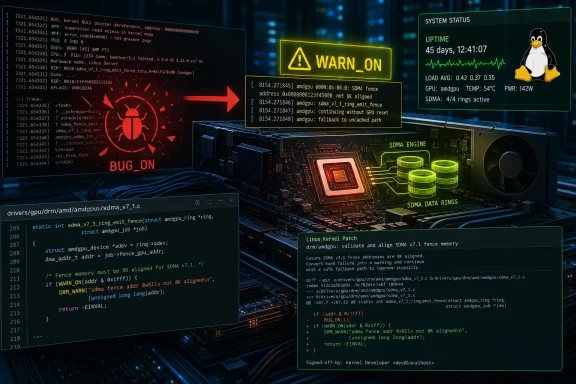 The Two Assertions That Could Panic Linux
The vulnerable code sits in
sdma_v7_1_ring_emit_fence(), which writes GPU fence packets to an SDMA ring. Fences are synchronization markers: the GPU writes a sequence number to memory so the driver and scheduler can determine that submitted work has completed.
Before the fix, the function imposed a fatal condition on the fence address being four-byte aligned. It checked the address before writing the low 32 bits of a fence value and checked it again if the caller requested a 64-bit fence, after advancing the address by four bytes.
A
BUG_ON()is not ordinary defensive programming in Linux. If its condition evaluates true, the kernel treats it as an unrecoverable internal fault. Depending on configuration and runtime policy, that can produce an oops, panic the machine, or leave a host in an unusable state. This is a drastic reaction for an alignment error in a graphics-driver submission path.
The fixed code retains both checks but changes them to
WARN_ON(). A warning records the failed condition and stack information for diagnosis, while execution continues. In this specific function, the driver then proceeds to emit the fence packet.
That difference is the core of CVE-2026-68109. The patch does not add a new alignment check, repair a bad address, or stop a malformed operation before it reaches the ring-emission callback. It changes the kernel’s response from “crash the operating system” to “log the anomalous state.”
This Is a CVE With No Published Severity or Exploit Narrative
NVD currently lists no CVSS v2, v3, or v4 score for CVE-2026-68109, and no CWE classification. The record’s entire technical explanation is that there is “no need to crash the kernel for these cases.” Kernel.org supplied the CVE data, and NVD has not yet enriched it with an impact assessment.
That absence is material. It means there is no published assertion from NVD, AMD, or the upstream Linux commit that an unprivileged local process can definitely trigger this particular SDMA 7.1 path, nor is there a published proof of concept, privilege requirement, affected GPU list, or remote attack scenario.
There is a tempting comparison with CVE-2026-46220, a separate AMDGPU SDMA 4 issue disclosed earlier in 2026. That CVE included a detailed explanation that crafted
DRM_IOCTL_AMDGPU_CSsubmissions could reach fatal alignment assertions and crash a scheduler worker. CVE-2026-68109 does not include comparable language. The two patches share the same broad pattern—replacing fatal assertions in SDMA fence emission—but the public record does not establish that their reachability or exploitation conditions are identical.
Treating CVE-2026-68109 as confirmed local denial of service would therefore go beyond the published evidence. Treating it as a routine cosmetic code cleanup would also be a mistake: the change removes a direct kernel-crash mechanism from a driver path handling GPU synchronization state.
The Patch Was Part of a Larger AMDGPU Cleanup
The July 2 AMDGPU pull request did not present the SDMA 7.1 change as an isolated security fix. It listed 13 related changes from Alex Deucher that removed or downgraded fatal checks across several AMD graphics and DMA implementations, including GFX9, GFX10, GFX11, GFX12, GFX12.1, SDMA 4.4.2, SDMA 5.0, SDMA 5.2, SDMA 6.0, SDMA 7.0, and SDMA 7.1.
That context matters for incident response. The SDMA 7.1 patch is part of an upstream reassessment of where AMDGPU should use kernel-fatal assertions. A
BUG_ON()is appropriate only when the kernel truly cannot continue safely; it is a poor choice for a condition that could emerge from a driver defect, unexpected hardware state, or a command path that should have rejected bad state earlier.
The broad sweep does not make every change a remotely exploitable security vulnerability. It does show that upstream developers found multiple places where AMDGPU’s failure policy was too severe. For operations teams running Linux graphics workstations, GPU compute nodes, virtual-desktop infrastructure, or shared developer machines, avoiding an unnecessary host crash is a real reliability improvement even where exploitability is unproven.
The upstream pull request’s wording is also revealing: it calls the work a removal of unnecessary
BUG()and
BUG_ON()calls from error paths. That is a narrower claim than “fixes GPU command validation.” The work reduces the blast radius after an error is detected; it does not establish that invalid state can no longer reach the error path.
Version Checks Need More Care Than the CVE Summary Suggests
The CVE record gives two forms of version information. It identifies specific stable-tree commits as fixes, and it provides a semantic version range that marks versions before Linux 7.1.6 as affected while marking Linux 7.1.6 through the rest of the 7.1 series as unaffected. It separately identifies Linux 7.2-rc2 as the original upstream version containing the fix.
That creates a practical rule for administrators: do not rely solely on a major-minor version label such as “7.1” or “7.2.” Confirm the exact distribution kernel build and its changelog. Enterprise distributions frequently backport kernel fixes without adopting the upstream version number, while custom kernels can retain vulnerable code despite using a newer-looking version string.
A useful verification sequence is:
- Confirm whether the installed kernel is Linux 7.1.6 or newer within the 7.1 stable series, or includes the Linux 7.2-rc2-era upstream change.
- Check the distribution’s kernel changelog or security tracker for CVE-2026-68109, rather than assuming a generic AMDGPU update includes it.
- If maintaining an internal kernel tree, inspect
drivers/gpu/drm/amd/amdgpu/sdma_v7_1.cforWARN_ON(addr & 0x3)in both fence-writing locations. - Treat a warning from
sdma_v7_1_ring_emit_fence()as a driver or submission-path defect worth investigating, even after patching, because the updated code logs the condition rather than correcting it.
The source file is specific to Linux’s AMDGPU kernel driver. Windows systems using AMD’s normal Windows display driver are not directly affected by this Linux kernel CVE. The relevant WindowsForum audience is therefore users dual-booting Linux, running Linux GPU workloads on bare metal, maintaining Linux hosts, or operating AMD GPU compute and virtualization infrastructure.
The Fix Stops the Panic, Not the Underlying Bad State
The most consequential operational detail is what
WARN_ON()does after it reports the bad alignment. The fence emission continues. That is intentional in the patch, but it means the update is designed to keep the host alive and collect evidence rather than promise normal GPU job completion after the warning.
On an affected, unpatched kernel, an unexpected misaligned fence address can turn into a machine-level failure. On a patched kernel, the likely result is a warning, followed by whatever behavior the GPU and driver exhibit when the fence command is processed. That may be harmless in a state thought unreachable, or it may expose a separate driver bug through a failed workload, reset, hang recovery event, or degraded graphics session.
For that reason, the update belongs in the normal kernel patch cycle, but it should not be silently filed as a CVE that “solves” an AMDGPU correctness issue. It removes an unnecessary kernel-crash outcome. If the warning appears in logs after deployment, the machine has avoided the worst immediate result, but the condition that would previously have invoked
BUG_ON()still deserves investigation.