
drivers/gpu/drm/amd/amdgpu/gfx_v12_0.c could deliberately stop the kernel rather than record a diagnostic and continue.The NVD entry, sourced from kernel.org and published on August 10, identifies the fix as “drm/amdgpu/gfx12: replace BUG_ON() with WARN_ON().” The underlying patch was posted by AMD’s Alex Deucher to the AMD GPU kernel mailing list on June 15 and entered the Linux DRM update flow for Linux 7.2. Its explanation is unusually short: “There’s no need to crash the kernel for these cases.”
That brevity leaves out the operational point: this is a kernel availability fix, not evidence that ordinary AMD Radeon users were exposed to an attacker-triggered crash. The code does remove several fatal assertions, but neither the CVE record nor the patch discussion identifies an unprivileged user-space route to feed the relevant bad addresses into these specific GFX12.0 command-emission functions.
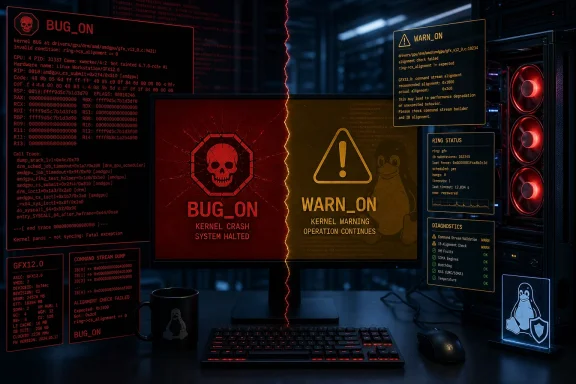 Six Fatal Assertions Were Changed, but Only Five Became Warnings
The CVE title accurately describes most of the patch, though it hides an implementation detail that matters when evaluating the change. Five
BUG_ON()checks became
WARN_ON()checks, while a sixth assertion was removed altogether.
The five warning conversions cover address-alignment assumptions in low-level GPU command construction:
- A wait-for-register-or-memory operation now warns if a memory address is not aligned on a 32-bit boundary.
- Graphics and compute indirect-buffer submission paths now warn if the GPU address is not 32-bit aligned.
- Fence emission now warns when a 64-bit fence address is not eight-byte aligned or when a 32-bit write uses an address that is not four-byte aligned.
Before the change, a failed condition invoked
BUG_ON(), a kernel assertion mechanism Linux documentation explicitly discourages for recoverable runtime conditions. In practical terms, an unexpected address alignment state could turn a graphics-driver failure into a system-wide crash. After the patch, the driver emits a kernel warning and continues writing the command stream.
The sixth change is different. In the Kernel Interface Queue fence-emission path, the patch removes a
BUG_ON()that rejected a 64-bit fence flag because the driver allocates only 32-bit sequence-number writeback addresses. It does not replace that assertion with a warning or an explicit error return.
That is the part obscured by the CVE’s shorthand description. The change does not validate or repair an invalid address before carrying on; it removes the unconditional kernel death penalty. A warning is a better failure mode for system availability, but it is not synonymous with successful recovery. Depending on the condition and the GPU’s response, the result could still be a failed job, a GPU reset, application instability, or a useful kernel log for maintainers instead of a dead host.
The Security Label Is Ahead of the Evidence
Assigning a CVE means the issue has entered vulnerability-tracking channels. It does not, by itself, prove a particular severity, exploitability, or attack scenario. As of August 11, the NVD record has no CVSS v2, v3, or v4 score, no CWE classification, and no NVD technical assessment.
That absence is material. The patch’s rationale says only that the kernel need not crash “for these cases.” It does not say an application can trivially trigger the conditions, that a malformed DRM ioctl reaches these paths, that GPU memory can be corrupted, or that the issue crosses privilege boundaries.
There is a tempting but incorrect comparison with an earlier AMDGPU cleanup, “drm/amdgpu: remove two invalid BUG_ON()s,” which was backported in late 2025. That separate patch removed checks on an indirect-buffer flag reported as trivially triggerable from userspace. CVE-2026-68113 is a different patch affecting different assertions: address alignment and a KIQ fence-flag assumption in the GFX12.0 implementation. Treating every
BUG_ON()removal in AMDGPU as the same denial-of-service bug would overstate the present record.
The evidence supports a more precise conclusion: the prior behavior made an unexpected GFX12.0 driver state capable of taking down the kernel; the fixed behavior favors diagnostics and continued operation. Whether an untrusted local process can reliably create that state remains unproven in the published material.
Fixed Kernel Lines Are Specific, and the Version Numbers Need Attention
The kernel.org data imported into NVD identifies the affected source file as
drivers/gpu/drm/amd/amdgpu/gfx_v12_0.c. This is not a blanket advisory for every AMD GPU, every Radeon driver version, or AMD’s Windows display driver. It concerns Linux systems running the upstream
amdgpukernel module where the driver selects the GFX12.0 code path.
NVD’s affected-version configuration lists these fixed release thresholds:
| Kernel line | Version containing the fix |
|---|---|
| Linux 6.12 | 6.12.101 |
| Linux 6.18 | 6.18.42 |
| Linux 7.1 | 7.1.6 |
| Mainline development | 7.2-rc2 |
The non-linear appearance is normal for a stable backport: a fix can reach maintained stable trees while the next mainline release is still in release-candidate testing. It does mean administrators should not infer safety simply from seeing a “newer-looking” major series name. The actionable check is the complete running kernel release, not the distribution’s marketing version.
The patch also appears in the AMD DRM pull request for Linux 7.2 alongside related removals or warning conversions across GFX8 through GFX12.1 and several SDMA implementations. Those are separate code changes. CVE-2026-68113 tracks the GFX12.0 patch only, so a system administrator should not assume that installing the listed kernel releases resolves every historical fatal assertion in AMDGPU.
WARN_ON Still Can Panic Hardened Systems
Switching from
BUG_ON()to
WARN_ON()changes the default response, but Linux gives administrators a way to make warnings fatal. Systems configured with
panic_on_warncan still panic when a
WARN_ON()condition fires.
Linux kernel documentation makes clear that this is intentional: operators who enable
panic_on_warnhave elected to stop rather than continue after an unexpected kernel condition. That setting is common enough in tightly controlled testing, appliance, and crash-dump environments that the distinction should be part of incident triage.
For ordinary desktop and server installations, the patch should reduce the likelihood that a bad alignment condition becomes an immediate host outage. For hardened fleets with warning panics enabled, it primarily improves observability and source-level correctness; it may not change the visible outcome until the underlying condition is understood and prevented.
Administrators investigating a suspected hit should preserve the kernel log and look for a warning naming
gfx_v12_0.c, rather than assuming that every AMDGPU reset, compositor crash, black screen, or Vulkan failure belongs to this CVE. Those symptoms are broad and commonly arise from firmware, Mesa, display, power-management, or application-level faults outside these six checks.
Windows and WSL Administrators Have a Narrower Exposure
CVE-2026-68113 is not a Windows security update and does not apply to AMD Software: Adrenalin Edition or the Windows kernel display driver. Windows systems become relevant only where they run a Linux kernel that includes the upstream AMDGPU GFX12.0 driver: a conventional Linux dual boot, a Linux virtual machine with hardware passed through, a custom hypervisor deployment, or a custom WSL kernel.
For standard WSL 2 installations, Microsoft ships and services its own Linux kernel. Microsoft’s WSL kernel repository listed version
6.18.26.3as its most recent release on May 28, 2026, which is earlier than the
6.18.42fixed point recorded by NVD. That version comparison alone is not proof of exposure: WSL’s normal GPU acceleration stack uses Microsoft’s virtualized GPU path, including Dxgkrnl support, rather than automatically loading the upstream AMDGPU driver against a directly exposed Radeon device.
Still, WSL administrators using a custom kernel should check both facts rather than relying on the Windows host’s patch level:
wsl --status
uname -r
A custom WSL kernel or a Linux VM with PCIe GPU passthrough deserves the same review as a physical Linux host. Update to the distributor-provided kernel incorporating the relevant stable fix, or to at least Linux 6.12.101, 6.18.42, 7.1.6, or a later corrected build appropriate to that branch.
The immediate consequence is straightforward: patch GFX12.0 Linux systems during normal kernel maintenance, but do not triage CVE-2026-68113 as a confirmed Windows-driver compromise or a demonstrated user-triggerable exploit. The record currently supports an availability-hardening fix with incomplete security characterization, and the missing CVSS assessment should remain missing until someone establishes the trigger path and practical impact.