
gfx_v12_1 code.The immediate problem is less dramatic than a memory-corruption headline, but it is operationally serious: a
BUG_ON()condition in kernel code treats an unexpected state as unrecoverable and deliberately crashes the kernel. The upstream fix changes several of those assertions to
WARN_ON(), which records the bad condition while allowing the kernel to continue. AMDGPU maintainer Alex Deucher summarized the rationale plainly in the June 15 patch submission: there is no need to crash the kernel in these cases.
The CVE appeared in NVD on August 11, but NVD’s record was unavailable at publication time because the site was returning a Cloudflare 502 error. That outage leaves administrators without the usual NVD-derived severity score, CWE classification, affected-product table, or version range. The upstream source record, the AMDGPU mailing-list patch, and the Linux 7.2-rc2 change log nevertheless establish the key point: the vulnerable assertions were present in the GFX12.1 AMDGPU implementation and were removed or downgraded in the upstream fix set.
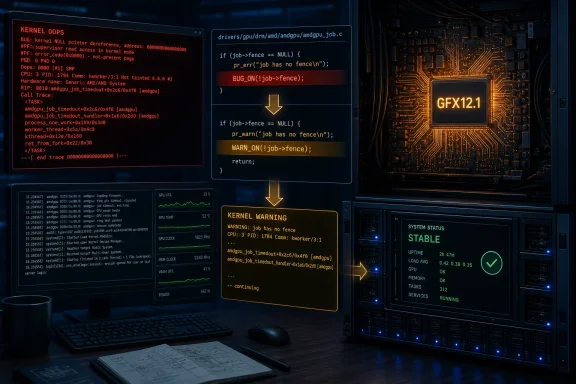 The fix changes five failure paths in GFX12.1 command submission
The patch touches
drivers/gpu/drm/amd/amdgpu/gfx_v12_1.c, the AMDGPU implementation for graphics-core IP version 12.1. Four assertions are changed from
BUG_ON()to
WARN_ON(), while one assertion concerning a 64-bit fence flag on the KIQ path is removed outright.
The affected checks cover alignment requirements in operations that write GPU command packets:
- A memory address supplied to the
WAIT_REG_MEMpacket path must be DWORD-aligned when the driver is using memory-space polling. - An indirect-buffer GPU address emitted for compute work must be DWORD-aligned.
- A fence write address must be DWORD-aligned for a 32-bit write or QWORD-aligned for a 64-bit write.
- The KIQ fence-emission path no longer terminates the kernel if a 64-bit fence flag appears where the driver expects a 32-bit sequence writeback.
These are not cosmetic source cleanups.
BUG_ON()in Linux is intentionally harsh: if its condition evaluates true, the kernel invokes a bug trap. On a production server, workstation, or virtual-machine host, that can mean a panic, a reboot if panic recovery is configured, lost active compute work, and potentially a broad service interruption.
WARN_ON()still captures evidence for developers and administrators through the kernel log, but it avoids treating the host itself as disposable.
The patch does not add a visible new validation or rejection path for malformed work submissions. It specifically changes how the driver responds after reaching these conditions. That distinction is important: avoiding a panic is an availability fix, but a warning means the driver may still be processing an invalid or unexpected state. Administrators should regard the update as preventing the worst host-level outcome, not as a guarantee that bad GPU workloads will complete cleanly.
The CVE arrived after the upstream fix was already merged for testing
The record’s timing is the first important finding. The patch was submitted by Alex Deucher on June 15, 2026. It was then included in the AMDGPU DRM fixes pull request dated July 2, which targeted Linux 7.2. Linux’s 7.2-rc2 shortlog, independently reproduced by LWN.net, lists
drm/amdgpu/gfx12.1: replace BUG_ON() with WARN_ON()among the fixes merged during that release cycle.
That means the remediation entered upstream kernel testing weeks before CVE-2026-68114 became publicly visible in NVD on August 11. This is common in kernel security handling, but it changes the response plan. The CVE identifier is new; the corrected code is not. A system built from a sufficiently recent Linux 7.2 release candidate may already carry the change even if its distribution’s security tracker has not yet mentioned CVE-2026-68114.
The converse is also true. An enterprise distribution can carry an older-looking kernel version while incorporating the relevant patch through a backport. Version-number comparisons alone are unreliable for vendor kernels such as Red Hat Enterprise Linux, SUSE Linux Enterprise, Ubuntu LTS, Debian stable, or appliance kernels. The correct question is whether the distributor’s kernel package includes the upstream
gfx_v12_1.cchange, not whether the package’s top-level version appears newer than Linux 7.2-rc2.
As of August 11, there is no public NVD product-configuration data to map the CVE to named distributions or shipping package revisions. No major distribution advisory surfaced in the available records for CVE-2026-68114 itself. That missing mapping is material: it prevents a responsible claim that a particular commercial Linux release is exposed or already fixed.
Why GFX12.1 sharply narrows the exposure
This is not a blanket AMD Radeon vulnerability. The altered code is confined to AMDGPU’s GFX12.1 implementation, identified in the source as IP version 12.1.0. The broader AMDGPU driver supports generations across GCN, RDNA, and CDNA, but this CVE does not apply merely because a machine has an AMD GPU or loads the
amdgpumodule.
That narrowing matters especially for fleets with a mixed GPU estate. A host running older Radeon hardware on the common GFX9, GFX10, or GFX11 paths does not execute this exact
gfx_v12_1.ccode. Those paths received similarly named
BUG_ON()-to-
WARN_ON()cleanups in the same AMDGPU series, but they are separate code changes and should not be silently folded into CVE-2026-68114.
The available upstream material also does not name a retail Radeon product list for GFX12.1. The code confirms the affected IP block, while the lack of a published hardware mapping means administrators should identify exposure from their own system inventory rather than guessing from marketing families. On Linux, useful checks include the running kernel version, loaded AMDGPU module, PCI GPU inventory, and the kernel log lines that identify AMDGPU IP versions during driver initialization.
For organizations operating AMD GPU compute workloads, the relevant concern is whether the platform has adopted GFX12.1 support and whether untrusted or semi-trusted users can submit GPU work. The source patch itself does not publish a proof of exploitability or a privilege model, so it would be premature to label this a confirmed local privilege-escalation issue. The confirmed impact is a kernel-crash condition in a graphics-driver command-emission path; in practical terms, that places availability at the center of the risk assessment.
What administrators should do while NVD remains incomplete
The action is straightforward for systems that actually use the GFX12.1 AMDGPU path: obtain a kernel package that includes the upstream fix, then reboot into it. This is one of the cases where merely updating a user-space Mesa package, ROCm component, container image, or AMD GPU library is insufficient. The vulnerable logic resides in the running kernel’s AMDGPU DRM driver.
Teams should verify four things before declaring the issue closed:
- Confirm that the affected host uses GFX12.1 rather than assuming exposure from the presence of an AMD GPU.
- Review the vendor kernel changelog or source-package patch list for the GFX12.1
BUG_ON()toWARN_ON()change. - Reboot after installing the corrected kernel, because the old AMDGPU module remains resident until the new kernel is booted.
- Preserve kernel logs if warnings appear after the update, because
WARN_ON()is deliberately diagnostic and may reveal a workload, driver, or integration defect that still needs investigation.
For self-built kernels, the fix is present in the Linux 7.2-rc2 development line and later upstream trees containing the AMDGPU DRM fixes pull. Administrators who must backport should take the complete narrow patch rather than selectively replacing a single assertion: the change set covers separate packet and fence paths, including the removal of the KIQ 64-bit fence-flag assertion.
Windows-only administrators can treat CVE-2026-68114 as an inventory item rather than an emergency patching event. It is a Linux kernel
drm/amdgpuissue, not an AMD Software: Adrenalin Edition or Windows Display Driver Model advisory. The exception is a Windows-managed estate that also runs Linux GPU hosts, Linux virtual machines with direct GPU assignment, or dual-boot engineering machines; those systems need to be assessed on their Linux side.
The practical consequence of the CVE is clear even while NVD’s page is down: organizations using upstream GFX12.1 support should stop waiting for a severity badge and verify their kernel package now. The upstream repair is available, narrowly targeted, and designed to prevent an abnormal GPU-driver condition from taking down the entire Linux host.
