
hci_sync code’s traversal of a UUID list, and it does not affect the Windows 10, Windows 11, or Windows Server Bluetooth stack. The practical action for most WindowsForum readers is therefore none: there is no Microsoft KB, no Windows Update, and no reason to disable Bluetooth on a Windows PC because of this CVE.The issue matters to Linux administrators, embedded-device owners, and Windows users who run a separate Linux environment with direct control of a Bluetooth adapter. The NVD entry appeared on August 11, 2026, but NVD was returning a Cloudflare 502 error when checked, leaving its normal analysis fields—including severity, affected-version ranges, and references—unavailable. That outage exposes the more important operational problem: the CVE identifier is public before the vulnerability record has supplied the information administrators normally use to decide urgency.
Upstream Linux records provide a narrower but more reliable starting point. Bluetooth maintainer Luiz Augusto von Dentz’s tree contains Chengfeng Ye’s fix, titled “Bluetooth: hci_sync: Protect UUID list traversal,” and Linus Torvalds included that patch in Linux 7.2-rc5. The patch was already part of the Bluetooth pull request submitted for the networking fixes stream on July 21.
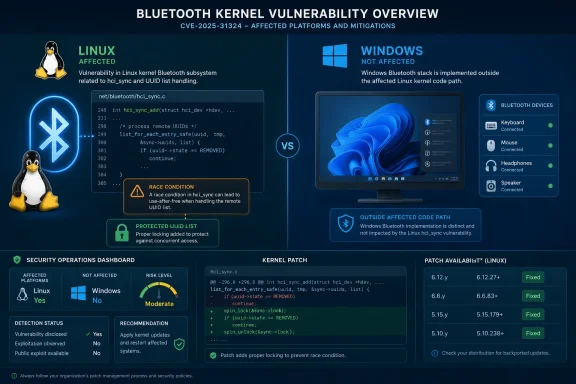 The available record identifies a race, not a finished exploit narrative
The public patch title says exactly what was fixed: a UUID list traversal in the kernel Bluetooth stack lacked the protection needed when that list could change concurrently. In kernel terms, this is a synchronization defect. One execution path can walk objects in a linked list while another potentially removes, changes, or frees an entry; without the appropriate lock or other lifetime protection, the reader can act on stale memory.
That is enough to justify a CVE. It is not enough to responsibly claim remote code execution, local privilege escalation, information disclosure, or even a reliably reachable denial of service. Neither the upstream commit listing nor the Linux 7.2-rc5 announcement publicly describes a proof of concept, a crash trace, an attack precondition, or whether a nearby malicious Bluetooth device can trigger the fault on its own.
This distinction is important because “Bluetooth CVE” is often read as shorthand for an over-the-air attack against every machine with a radio enabled. The available evidence does not support that conclusion here. The affected code is inside Linux’s Host Controller Interface synchronization layer, specifically around the kernel’s handling of UUID state; it is not identified as a malformed-packet parsing bug in a particular USB adapter driver or a defect in the Bluetooth protocol itself.
The Linux Kernel Mailing List’s Linux 7.2-rc5 changelog confirms that the patch landed alongside other Bluetooth fixes, including an RFCOMM use-after-free correction and a
btusbvendor-event validation change. Those are distinct fixes. CVE-2026-68189 should not be inflated by association with them.
Linux 7.2-rc5 has the upstream fix, but that is not a distribution deployment answer
The strongest concrete version fact currently available is that Linux 7.2-rc5 includes the UUID-traversal protection. That is a development release candidate, not a broad statement that every supported distribution kernel has the change. It also does not establish that all earlier Linux versions are vulnerable, because the CVE record has not yet published an affected-version range or identified the commit that introduced the flawed behavior.
That leaves three separate states that administrators should not blur together:
- A self-built Linux 7.2-rc5 kernel includes the upstream fix because the change is in the release candidate’s documented changelog.
- A distribution kernel based on an older version may still contain the fix if its maintainer backported it.
- A kernel reporting a newer-looking base version is not automatically protected if its distributor has not incorporated the relevant patch, although that situation is unlikely once the change reaches stable release channels.
For enterprise Linux estates, appliance fleets, and long-lived embedded products, the version displayed by
uname -ris only the first step. Vendors regularly carry backports without changing the apparent upstream base version, particularly for supported LTS and enterprise kernels. The correct remediation record will be the distribution’s own security advisory or source-package changelog once vendors assess and ship the fix.
As of August 11, no independently published vendor advisory, stable-kernel backport list, severity score, or affected-release matrix was available in the materials reviewed for this report. That is the missing information administrators need most. The responsible position is not that the issue is harmless; it is that the public CVE record is presently too incomplete to rank it beyond “patch when your Linux supplier provides the update.”
Windows hosts are outside the vulnerable code path
CVE-2026-68189 is assigned to the Linux kernel’s
net/bluetoothsubsystem. Windows uses Microsoft’s own Bluetooth kernel drivers, transport drivers, and user-mode services rather than Linux’s
hci_syncimplementation. A Windows machine running Microsoft’s supported Bluetooth stack therefore cannot execute the vulnerable Linux routine described by the CVE.
That remains true if Windows has Bluetooth headphones, mice, keyboards, game controllers, phones, or BLE devices paired with it. These devices do not somehow route Windows Bluetooth operations through Linux kernel HCI code.
WSL deserves a more exact reading. WSL 2 runs a Linux kernel in a lightweight virtual machine, but ordinary Bluetooth use on the Windows host remains handled by Windows. Installing Ubuntu, Debian, Fedora, or another distribution under WSL does not by itself place the Windows Bluetooth adapter under the guest kernel’s control. In the normal configuration, CVE-2026-68189 is not a Windows host exposure merely because WSL is installed.
The exception is a deliberately configured Linux guest—whether WSL, Hyper-V, VMware, VirtualBox, a cloud image, or a physical dual-boot machine—that has direct access to a Bluetooth controller. USB passthrough, device forwarding, a dedicated Bluetooth adapter, and embedded Linux hardware are the configurations worth reviewing. In those cases, the security decision belongs to the Linux guest or appliance vendor, not to Microsoft Update.
The immediate job is inventory, not emergency Windows remediation
Linux administrators should identify systems that actually load and use the Bluetooth subsystem, then follow their platform vendor’s kernel advisory channel. This is especially relevant for desktops, laptops, kiosks, automotive or industrial devices, single-board computers, and appliances where Bluetooth may be enabled by default even if it is not central to the workload.
For systems where Bluetooth is intentionally absent or disabled, the exposed code may not be reachable in practice, but the CVE record does not yet provide the configuration-level analysis needed to make a formal unaffected determination. Organizations that require a documented exposure decision should record the status as awaiting vendor assessment rather than declaring every non-Bluetooth Linux system safe.
There is no evidence in the current record that BlueZ user-space packages need a standalone update for this issue. BlueZ is often the visible Bluetooth component on Linux, but the identified fix is in the Linux kernel, not in the BlueZ daemon or its management utilities. Updating only
bluezwould therefore not be a substitute for a kernel update if a vendor identifies the deployed kernel as affected.
NVD’s outage should not become the vulnerability assessment
The timing creates an awkward but familiar weakness in CVE handling. NVD published the CVE page on August 11, then was unavailable behind a 502 response during this report’s verification. Meanwhile, the upstream fix itself is already visible in the Linux Bluetooth tree and in the Linux 7.2-rc5 changelog. The primary source can confirm that a race was fixed and where it landed; it cannot fill in the severity, exposure conditions, or supported-product status that NVD and downstream Linux vendors typically add later.
Administrators should treat that absence as a documentation gap, not a reason to make up a worst-case impact statement. No public source reviewed here reports exploitation in the wild, a proof-of-concept exploit, a CVSS score, or a required Bluetooth device configuration. Equally, no public source establishes a safe historical kernel boundary.
For Windows users, the concrete consequence is straightforward: do not chase this CVE through Windows Update or alter Windows Bluetooth settings. For Linux systems with Bluetooth hardware, wait for and apply the kernel update issued by the relevant distribution or device vendor, while recognizing that upstream Linux 7.2-rc5 already contains the UUID-list traversal protection.
