

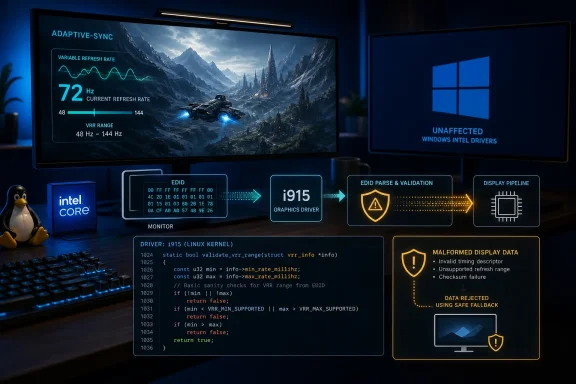
The National Vulnerability Database listed CVE-2026-68254 as published on August 11, 2026, but its record was unavailable at publication time because NVD’s host was returning a 502 Bad Gateway error. The primary upstream record is clearer on the underlying code change: Intel graphics maintainer Joonas Lahtinen included “drm/i915/vrr: require valid min/max vfreq for VRR” in the July 2 drm-intel-fixes pull request, authored by Jani Nikula. Dave Airlie then included that i915 fix in the DRM fixes pull request for Linux 7.2-rc2 on July 3. LWN.net independently recorded the same change in its Linux 7.2-rc2 coverage.
The important finding is what the public record still does not establish. Neither the upstream pull request nor the currently inaccessible NVD page provides a CVSS score, CWE classification, affected-version range, exploitation prerequisites, proof of exploitation, or a list of Linux distributions that have backported the fix. That makes this a patch-now issue for affected Linux systems, but not a basis for claims of remote code execution, privilege escalation, or a confirmed crash condition.
The fix guards the VRR metadata used by i915
Variable Refresh Rate, commonly marketed through display terms such as Adaptive-Sync, FreeSync, or G-Sync Compatible, lets the display refresh at a rate that tracks a game or application’s frame delivery. On Linux systems using Intel’s i915 driver, VRR depends on a negotiated set of display capabilities and mode details, including the monitor’s supported refresh-rate boundaries.
The Linux DRM documentation describes min_vfreq and max_vfreq as the panel refresh-frequency range parsed from the display’s Extended Display Identification Data, or EDID. EDID is the metadata a monitor, laptop panel, dock, adapter, KVM, or display emulator provides to the graphics stack so the operating system can determine valid modes and capabilities.
CVE-2026-68254 addresses a basic trust-boundary problem in that process. Before using VRR, i915 now requires valid minimum and maximum vertical-frequency values. The upstream change is only four added lines in drivers/gpu/drm/i915/display/intel_vrr.c, which strongly suggests a narrowly scoped guard rather than a redesign of Intel’s display pipeline.
That small patch should not be dismissed. Graphics drivers sit at the intersection of firmware descriptions, hot-plug events, mode setting, physical display links, and kernel memory management. A bad value that is harmless in one calculation can become dangerous if subsequent code assumes a nonzero, ordered, and internally consistent VRR range. Input validation prevents the driver from attempting VRR programming based on values that do not describe a usable capability range.
The patch title itself is careful: it says “require valid min/max vfreq,” not “fix memory corruption” or “prevent privilege escalation.” Until the CVE record becomes available and the Linux CNA or a distribution publishes a technical advisory, those more serious descriptions would be speculation.
The likely exposure is narrower than a typical “Intel graphics CVE”
This is an Intel i915 issue, not a blanket vulnerability affecting every Intel GPU, every Linux graphics stack, or Windows display drivers. i915 is the long-standing Linux kernel driver for many Intel integrated graphics platforms. Systems that use Intel’s newer Xe driver, a discrete AMD or NVIDIA GPU as the active display controller, or a virtual display adapter may fall outside the relevant code path.
Even on an i915 system, the vulnerable condition is tied to VRR. A machine needs to reach the driver’s VRR configuration path, which generally means an Intel-controlled display output, a VRR-capable or purportedly VRR-capable sink, and a desktop environment or workload that requests VRR. A fixed-refresh office monitor connected through a configuration that never enables VRR is less likely to exercise this code.
The most plausible input source is display capability data, especially EDID-derived timing information. That observation is grounded in the kernel’s own DRM documentation, which defines the minimum and maximum vertical-frequency fields as EDID-derived values. It does not establish that a malicious monitor, dock, USB-C adapter, HDMI emulator, KVM switch, or remote attacker can reliably exploit the flaw. No public advisory reviewed for this report supplies an exploit path, a proof of concept, or a statement that malformed EDID alone is sufficient.
Administrators should resist the temptation to score this by patch size or by the fact that the source is a monitor. EDID is normally trusted because it arrives from attached hardware, but display chains are increasingly complicated: USB-C docks translate protocols, KVMs impersonate displays, capture equipment can emulate sinks, and lab environments often use programmable adapters. The practical security consequence is strongest in environments where users can attach untrusted display hardware or where display emulators and automated test equipment are common.
Windows PCs are not patched by this Linux kernel change
A Windows 10 or Windows 11 PC using Intel’s Windows graphics driver does not use Linux’s drivers/gpu/drm/i915/display/intel_vrr.c. Windows uses the Windows Display Driver Model, where Microsoft’s DirectX kernel subsystem works with a vendor-supplied user-mode driver and kernel-mode display miniport driver. The affected i915 source file is neither a component of Windows nor part of Intel’s Windows DCH driver package.
That distinction also prevents a common overreaction: installing the newest Intel Windows graphics driver will not change the Linux i915 code in a separate Linux installation. Conversely, upgrading a Linux kernel does not repair a Windows driver. The operating systems need to be evaluated independently.
WSL deserves a more precise answer. WSL 2 can use GPU acceleration, but Microsoft documents that Linux GUI applications use a virtual GPU arrangement and that GPU paravirtualization routes guest-side work across the virtualization boundary to host graphics infrastructure. Microsoft’s GPU-paravirtualization documentation describes a virtual render-device kernel-mode driver in the guest rather than a conventional guest kernel-mode display driver controlling the physical adapter.
There is therefore no evidence that a default WSL 2 installation exposes the physical Intel i915 VRR path implicated by CVE-2026-68254. That is not the same as declaring every imaginable Hyper-V or Linux VM graphics configuration unaffected. A full Linux virtual machine with hardware passthrough, direct device assignment, or another configuration that gives a Linux guest direct control of an Intel display adapter should be assessed as a Linux system, not as ordinary WSL.
Upstream inclusion is not the same as distribution remediation
The upstream timeline has an unusual but important implication. The source-level fix was submitted to the DRM maintainers in early July, while the CVE entry appeared publicly on August 11. In other words, systems can already be protected if their kernel vendor picked up the patch before the CVE was visible in routine vulnerability feeds.
That is common in Linux kernel maintenance, but it complicates asset management. The version string alone may not settle exposure:
- A rolling-release distribution may have included the patch quickly in a newer kernel build.
- An enterprise distribution may have backported the fix to an older long-term-support kernel without adopting a newer upstream version number.
- A custom kernel can contain the July fix even if its package changelog has not yet been updated with CVE-2026-68254.
- A kernel based on an older stable branch may remain exposed until maintainers decide whether the patch applies cleanly and issue a package update.
The upstream pull request establishes that the fix entered the DRM fixes stream for Linux 7.2-rc2. It does not establish a fixed final Linux release, stable-branch backport status, or fixed package versions for Ubuntu, Red Hat Enterprise Linux, Fedora, Debian, SUSE, Arch, ChromeOS, or appliance distributions. None of those details should be invented from the CVE number.
For managed Linux endpoints, the right immediate action is to check the distribution’s kernel security advisory and package changelog for CVE-2026-68254 or the exact upstream subject line, “drm/i915/vrr: require valid min/max vfreq for VRR.” If the advisory is not available yet, administrators should track the kernel package containing the i915 DRM fixes merged in early July and give priority to workstations that use Intel graphics with VRR-capable monitors, docks, or display-lab equipment.
Treat missing vulnerability metadata as a reporting gap, not a low-severity verdict
The NVD outage matters because NVD often becomes the place administrators look for a severity score, CPE mappings, reference links, and change history. At 11:17 UTC on August 11, the public page was unavailable, so those fields could not be independently checked. The submitted NVD capture shows a publication timestamp but no technical description or metrics.
Upstream’s own merge description classed this among “input validation fixes for BIOS data and EDID.” That is useful context, but it is not a severity assessment. It also reveals the broader maintenance lesson: display security bugs do not always arrive with a dramatic crash report. Sometimes the fix is simply the removal of an assumption that externally supplied hardware metadata is sane.
For Windows-only organizations, the operational consequence is limited: document CVE-2026-68254 as a Linux i915 issue and do not divert Windows driver-management work toward it. For organizations with Linux workstations on Intel graphics, especially systems using VRR displays or accepting unknown docks and adapters, the concrete next step is to deploy the distribution kernel update that carries Jani Nikula’s validation check once the vendor identifies it.