
amdgpu kernel driver, not AMD’s Windows Adrenalin driver stack.The issue is unusually narrow, but it is real. The upstream Linux change, authored by WenTao Liang and included in the DRM fixes submitted for Linux 7.2, adds cleanup code to release a retained
prev_sinkobject before the driver exits the timeout path. The Linux 7.2-rc2 changelog also lists the fix, confirming that it reached the mainline release path rather than remaining an unmerged mailing-list patch.
What has not yet materialized is the usual CVE metadata administrators depend on. When checked on August 11, 2026, the National Vulnerability Database entry for CVE-2026-68256 returned a Cloudflare 502 error rather than a vulnerability record. That means there is no NVD-published CVSS score, no NVD-maintained affected-version list, and no NVD analysis to use in patch prioritization at publication time. Treating the identifier as a high-severity remote-code-execution issue would be an overstatement; the source change describes a kernel memory-reference leak in a specific display hotplug error path.
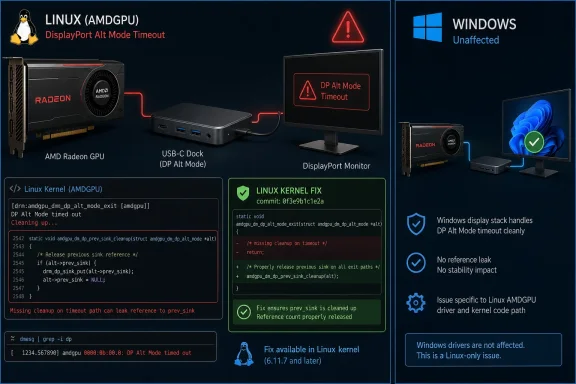 The leak occurs before normal DisplayPort detection finishes
The faulty code is in
detect_link_and_local_sink(), part of AMD’s Display Core code under
drivers/gpu/drm/amd/display. That routine determines whether an output has a locally attached display sink and replaces the driver’s existing representation of that display when connection state changes.
Before probing the new state, the routine stores the existing
link->local_sinkin a
prev_sinkvariable and explicitly retains it. This is deliberate: the driver may need to preserve or compare the previous display object while it disconnects the active sink, probes the connection, reads capabilities, and decides whether the old object can be reused.
For ordinary probe failures, the function already has cleanup paths that call
dc_sink_release(prev_sink). The USB-C-specific DisplayPort Alt Mode timeout return did not. In the affected path, the driver detects a physical DisplayPort endpoint whose encoder advertises USB-C DisplayPort support, waits for Alt Mode to become active, and returns failure if it does not happen in time.
Before the fix, that return happened immediately:
if (!wait_for_entering_dp_alt_mode(link))
    return false;
The corrected code releases the retained object first:
if (!wait_for_entering_dp_alt_mode(link)) {
    if (prev_sink)
        dc_sink_release(prev_sink);
    return false;
}
That is the whole repair. It does not change DisplayPort link training, cable negotiation, USB-C policy-manager behavior, display modes, or AMD GPU firmware. It plugs one missing reference decrement on an error exit.
A timeout can accumulate kernel memory use
A reference count tracks how many active users hold an object. When the count reaches zero, the object can be freed. Here, the old display-sink object is retained as detection begins, but in the Alt Mode timeout case it was not released before the function returned.
One failed event is not likely to destabilize a desktop. The practical risk is repetition: a problematic dock, cable, monitor, USB-C port, or device sequence that repeatedly triggers a DisplayPort Alt Mode timeout could gradually retain display-sink objects that should have been released. In a sufficiently persistent cycle, this produces a kernel-memory leak and potentially contributes to degraded reliability or an eventual denial-of-service condition.
The code itself gives an important limit to the scope. It only takes this path when the connector is handled as DisplayPort and the driver identifies it as a physical USB-C DisplayPort-capable endpoint. Native HDMI, conventional DisplayPort connections that do not rely on USB-C Alt Mode negotiation, and internal eDP laptop panels do not enter this exact timeout branch.
That does not mean every AMD laptop with USB-C video is exposed in the same way. The condition requires the Linux kernel’s AMDGPU Display Core driver to have an existing local sink object, begin a new detection pass, and then fail while waiting for Alt Mode. The public kernel commit does not identify particular Radeon generations, laptop models, docks, or monitor brands, and no independent reporting has established a reproducible hardware matrix.
Linux 7.2 received the change, but downstream status is the real question
AMD DRM maintainer Alex Deucher’s July 2 pull request described this as a “DP alt mode fix” among the fixes intended for Linux 7.2. The Linux 7.2-rc2 changelog separately lists Liang’s patch, while the Linux stable repository log shows the same commit present in its tracked history. Those are strong indicators that upstream kernel users have a fix path.
They are not, however, a distribution advisory. Upstream inclusion does not tell an Ubuntu, Fedora, Debian, SUSE, Arch, Proxmox, Android-derived, appliance, or enterprise-Linux administrator whether their installed kernel has received the backport. Kernel vendors often carry the AMD display driver from a newer upstream release while retaining an older version number, and enterprise distributions may backport a one-line security fix without changing a visible upstream baseline.
Administrators should therefore check the distribution’s kernel changelog or source package rather than relying on a generic “Linux 7.2 or later” rule. The reliable code-level indicator is the presence of the change that releases
prev_sinkwhen
wait_for_entering_dp_alt_mode()fails.
For systems where the risk matters most, the priority order is sensible:
- Update the distribution kernel if it has incorporated the AMDGPU DisplayPort Alt Mode fix.
- Give extra attention to AMD Linux workstations and laptops that regularly connect through USB-C docks, USB-C monitors, or adapters that expose DisplayPort Alt Mode.
- Investigate repeated AMDGPU display-detection failures, connector flapping, or Alt Mode negotiation problems as stability issues even if they do not yet present as a security incident.
- Do not apply an out-of-tree patch to a vendor kernel unless the vendor has not supplied a supported update and the affected system has a demonstrated recurring failure condition.
Windows PCs do not need an AMD driver update for this CVE
For WindowsForum readers, the practical distinction is important. CVE-2026-68256 names a flaw in the Linux kernel’s
drm/amd/displaycode, which is used by the open-source AMDGPU driver. Windows uses a separate AMD display driver architecture and does not load Linux’s
amdgpumodule.
A Windows 11 system with a Radeon GPU, a USB-C monitor, or a DisplayPort Alt Mode dock is therefore not affected merely because it has AMD graphics hardware. Updating AMD Software: Adrenalin Edition for this CVE would not address anything, because the vulnerable code is absent.
The edge cases are Windows-hosted Linux environments. A standard WSL2 installation normally exposes GPU acceleration through Microsoft’s virtualization and graphics integration rather than passing through the physical Radeon GPU to Linux as an AMDGPU-managed display connector. That setup should not be able to exercise the USB-C display-detection path described here. A custom WSL kernel, a Linux virtual machine with direct GPU passthrough, or a dual-boot Linux installation using the physical AMD GPU and USB-C display outputs is different: those are Linux kernel deployments and should be evaluated as such.
The key fact behind CVE-2026-68256 is less dramatic than the presence of a CVE number suggests: it is a specific resource leak in a failure path, not evidence that AMD Windows graphics users face a new compromise risk. But for Linux fleets with AMD USB-C display deployments, especially laptops cycling through docks and conference-room monitors, it is the kind of small cleanup omission that can become a long-uptime reliability problem. The NVD outage currently leaves severity and package coverage unresolved; the upstream patch already makes clear what needs to be fixed.