
The National Vulnerability Database added the record on August 10, 2026, with no CVSS score, CWE classification, or vendor impact assessment yet. Its description tracks the Linux kernel patch submitted by Intel engineer Ashutosh Desai in April and revised in May: two parsers in
drivers/gpu/drm/display/drm_dp_mst_topology.ctrusted a byte-count field from a received MST sideband reply before copying data from the reply buffer.
That sounds narrowly technical because it is. But it is exactly the sort of parser error that belongs in an update queue on Linux workstations connected to USB-C docks, DisplayPort daisy chains, or multi-monitor hubs.
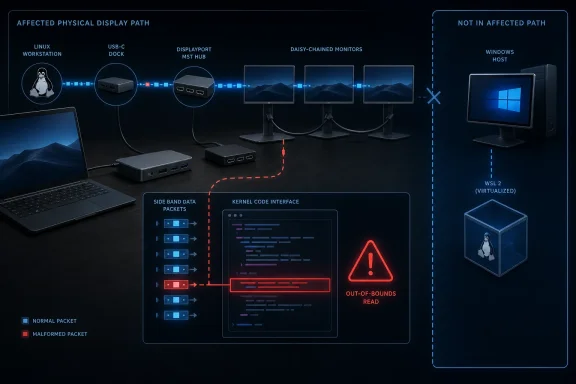 Two sideband replies could overrun their received payload
DisplayPort MST lets one upstream DisplayPort connection carry multiple downstream display paths. A USB-C dock with several video outputs, a monitor with a DisplayPort-out socket, or a dedicated MST hub can sit in that chain. Linux’s DRM display helpers use sideband messages to discover and manage that topology, including remote DPCD register reads and remote I2C transactions used to communicate with devices beyond the first hub.
The vulnerable code handled replies for two operations:
drm_dp_sideband_parse_remote_dpcd_read()drm_dp_sideband_parse_remote_i2c_read_ack()
Both functions pull a
num_bytesfield from an incoming reply and copy that many bytes from the raw sideband-message buffer. Before the fix, the DPCD parser checked whether it had reached the end of the message while reading the header, but did not check whether the following payload was actually as long as
num_bytes. The I2C acknowledgement parser had an even clearer omission: a
TODO checkcomment sat directly before the copy operation.
The underlying receive buffer is 256 bytes, while
curlenrecords how much of it contains actual received data. A malformed reply can therefore claim more payload bytes than remain in the valid message, causing the kernel to read beyond the received content. The error is an out-of-bounds read, not a write: the patch does not identify a destination-buffer overflow, nor does the public record establish arbitrary code execution.
Still, “only a read” should not be translated into “ignore it.” Kernel memory reads can cause instability, expose unintended adjacent data to later code paths, or become useful in a larger exploit chain. The record does not document any public proof of concept, known exploitation, crash reports, or successful information disclosure. NVD’s lack of a CVSS vector means there is currently no official severity judgment to lean on.
The correct boundary check is small — and late
The final fix is four new lines and two removed lines. In both parser paths, Linux now rejects a reply when
idx + num_bytes > raw->curlenbefore calling
memcpy.
That combined condition deserves attention because it explains why the patch is more than a cosmetic check.
idxis the current position in the parsed message;
num_bytesis the count the remote device supplied. Valid data can be copied only when their sum remains within the received length. Checking
idxalone confirms the parser has not already stepped past the end, but says nothing about whether the pending copy runs past it.
In the second revision posted to the DRM mailing list on May 10, Desai removed a separate
idx > curlentest from the DPCD path. The revision notes explain that
num_bytesis an unsigned 8-bit value and therefore cannot be negative; the combined range test also catches the simpler invalid-index case. The I2C path, meanwhile, replaces its old
TODO checkwith the same full-range validation.
This is a clean fix, but the code history adds context missing from the CVE entry. The remote I2C parser had carried that unfulfilled boundary-check note for years. NVD’s affected-version data says the vulnerable logic dates back to Linux 3.17, released in 2014. A separate 2020 stable patch corrected a different remote-DPCD parsing issue involving a missing index increment, but it did not address the payload-length validation now covered by CVE-2026-68279.
In other words, this is not a regression introduced by a recent dock or GPU-driver feature. It is a longstanding validation gap in a comparatively specialized display-management path.
CVE publication followed kernel integration by months
The CVE timing also tells a useful operational story. The first public patch was posted on April 10, 2026. After revision, the DRM maintainers’
drm-misc-nextpull request for Linux 7.2-rc1 listed this exact change on May 21 under “Fix OOB reads related to DP-MST.” It was explicitly copied to the stable-kernel list during review.
The CVE record arrived later, on August 10. That gap is not evidence that the patch sat unreviewed or that affected users had to wait for a CVE number before receiving a fix. It reflects the Linux kernel security process, where a correction can land upstream and reach downstream kernel packages before public vulnerability databases add an identifier and enrichment data.
For administrators, that means a CVE-only inventory process can produce the wrong picture in both directions. A system may be protected by a distribution backport even if its package version does not look like an upstream fixed release. Conversely, an older supported kernel stream may remain exposed until its distributor incorporates the patch, regardless of whether the CVE database now lists a fixed upstream version.
NVD currently identifies these upstream fixed points:
| Upstream kernel line | Fixed release identified by NVD |
|---|---|
| Linux 6.6 LTS | 6.6.148 |
| Linux 6.12 LTS | 6.12.101 |
| Linux 6.18 | 6.18.42 |
| Linux 7.1 | 7.1.6 |
| Mainline development | 7.2-rc1 |
Those are upstream reference points, not universal package names. Ubuntu, Debian, Red Hat Enterprise Linux, SUSE, Fedora, and appliance vendors frequently carry backported security fixes under their own ABI and release numbering. Check the distribution advisory or package changelog for CVE-2026-68279 and the corresponding DRM DP-MST patch rather than assuming that
uname -ralone settles the question.
The exposure is physical-display specific
This bug needs a malformed MST sideband reply. The threat boundary is therefore the display chain, not a web browser, a network service, or a local desktop application. A system must be using the Linux DRM DisplayPort MST machinery and must receive the crafted response from an MST-capable device path.
That narrows the practical focus to machines such as engineering workstations and Linux laptops that regularly use:
- USB-C or Thunderbolt docks exposing several external displays through DisplayPort MST.
- DisplayPort hubs that split a single connection into multiple monitor outputs.
- Daisy-chained DisplayPort monitors.
- Test benches, kiosks, lab systems, or embedded deployments connected to externally supplied display hardware.
A malicious or compromised hub is the clearest model described by the patch. A merely faulty hub can also send a malformed reply and trigger the bad parser behavior, although the public record does not say whether real hardware was observed doing so. There is no evidence that plugging in any ordinary monitor is sufficient to exploit the condition, and no report tying this CVE to a specific dock, monitor, GPU vendor, or firmware release.
The important practical consequence is that physical peripherals deserve the same patch discipline as network-facing services in environments where display hardware changes hands. Shared meeting-room docks, contractor-supplied adapters, lab equipment, and unmanaged USB-C hubs create a more realistic exposure than a fixed desktop connected directly to one monitor.
Windows and WSL are outside the affected display path
Windows systems should not treat CVE-2026-68279 as a reason to update a Windows graphics driver. The vulnerable file is Linux’s
drm_dp_mst_topology.c, not Microsoft’s WDDM stack, Intel’s Windows driver, AMD Software, or NVIDIA’s Windows driver.
WSL 2 needs a more precise distinction. Microsoft documents that GPU access in WSL is routed through
/dev/dxgto the Windows GPU and is provided through GPU paravirtualization. Linux GUI applications in WSL use that virtualized graphics arrangement; they do not take ownership of the host’s physical DisplayPort connectors, enumerate the USB-C dock’s MST topology through Linux DRM, or parse the host’s DisplayPort sideband replies in
drm_dp_mst_topology.c.
A WSL kernel could theoretically contain the source file or a related DRM component because it is derived from Linux, but the presence of code is not the same as an exposed hardware path. Microsoft’s model routes GPU work back through Windows, where the host driver and Windows display stack manage the actual connector and display topology. Updating WSL remains good practice, but this CVE does not represent a newly disclosed path from a malicious display dock into the Windows host through WSL.
The systems that need prompt attention are native Linux deployments with MST-enabled external-display setups. Update the vendor kernel, reboot into it, and verify the running kernel package rather than relying on the CVE’s publication date. The fix has already been available upstream for months; the August 10 CVE entry is the inventory signal, not the start of the remediation window.
