
The National Vulnerability Database published the record on August 10, 2026, based on the Linux kernel project’s entry. The upstream networking fix was authored by Cen Zhang of Microsoft, reviewed by kernel networking maintainers, and is included in Linux 7.2-rc5 as listed by LWN.net. The important practical point is that this is a bug in an optional clustering protocol rather than in ordinary TCP/IP networking, so a machine is only exposed if TIPC support and the affected configuration path are present.
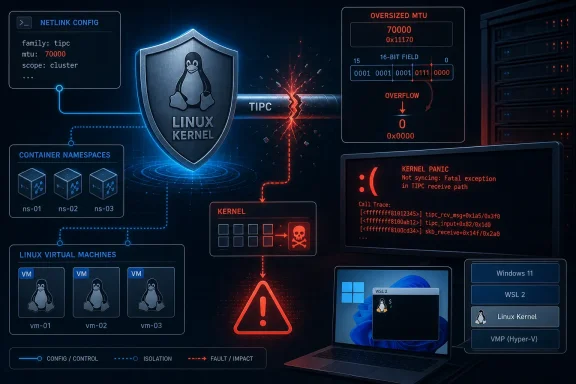 An MTU larger than 65,535 becomes zero
The fault is a classic integer truncation error with an unusually direct failure mode. TIPC accepts an MTU value through two Netlink configuration operations,
TIPC_NL_MEDIA_SETand
TIPC_NL_BEARER_SET, and had enforced a lower limit without enforcing an upper one.
The kernel later stores the supplied value in the 16-bit
l->mtuand
l->advertised_mtufields during link creation. A value of 65,536, expressed as
0x10000, cannot fit in an unsigned 16-bit integer and becomes zero. The subsequent queue-limit calculation divides by a value derived from that MTU, producing a divide-by-zero fault.
The reported crash path runs from
tipc_link_set_queue_limits()through TIPC link creation, discovery handling, and the UDP media receive routine. In other words, the malformed configuration is not simply rejected later as unusable: it reaches a calculation that can stop the kernel.
Values from 65,537 through 131,071 do not necessarily produce a zero MTU. They still wrap around to much smaller values, however, which the Linux CVE description says can lead to broken TIPC links and unpredictable protocol behavior. A configuration interface that accepts an MTU of 100,000 but silently applies a radically different value is already a reliability defect; the zero case turns it into a security-relevant availability problem.
Both TIPC configuration routes needed the same guardrail
The patch is small, but it closes two distinct paths that had independently missed the same maximum-value validation.
One is the UDP-media validation helper,
tipc_udp_mtu_bad(), called when a user changes media settings through
TIPC_NL_MEDIA_SET. The other is a separate inline validation sequence in
__tipc_nl_bearer_set(), reached through
TIPC_NL_BEARER_SET. The patch rejects MTUs above
U16_MAX, which is 65,535, before either value can reach a 16-bit link field.
That two-path detail matters for anyone considering a narrow local workaround. Blocking only a particular TIPC administration command or changing the default UDP-media MTU does not remove the underlying issue if the bearer-setting path remains accessible. The corrected kernels enforce the same ceiling in both interfaces.
The vulnerable logic traces back to the April 2018 change that introduced configurable UDP-media MTUs, identified in the fix as commit
901271e0403a. That history matches the NVD’s affected-version data: Linux 4.18 and later are considered affected until the relevant stable branch picks up the correction. This is not a regression unique to the latest kernel line.
Fixed versions are already identified, but distro builds still need checking
The NVD record identifies upstream fixed points for supported stable series:
- Linux 6.6.148 fixes the issue in the 6.6 long-term-support branch.
- Linux 6.12.101 fixes it in the 6.12 branch.
- Linux 6.18.42 fixes it in the 6.18 branch.
- Linux 7.1.6 fixes it in the 7.1 branch.
- Linux 7.2-rc5 carries the upstream mainline fix.
Those are upstream kernel release numbers, not universal package versions. Red Hat, Canonical, SUSE, Debian, cloud-image maintainers, appliance vendors, and hypervisor platforms frequently backport individual fixes while retaining a different base version string. Conversely, a kernel that looks newer than an upstream branch threshold is not automatically safe if it is a custom build based on an older tree.
Administrators should first identify the running kernel with
uname -r, then consult the distribution or platform vendor’s kernel advisory and changelog for CVE-2026-68297 or the TIPC MTU-validation patch. Systems using custom kernels should compare their source history against the upstream fix rather than relying solely on the reported release number.
A reboot remains necessary after installing an updated kernel. Restarting TIPC services, containers, or virtual machines does not replace the already running host kernel.
The exposure is narrow, but containers make the distinction important
TIPC, short for Transparent Inter-Process Communication, is a Linux kernel clustering protocol. It is not required for normal Ethernet, Wi-Fi, VPN, Windows file sharing, or common server workloads. A system without TIPC compiled in, loaded, or otherwise reachable through its network configuration is not exposed through this bug.
The Linux kernel documentation describes TIPC bearer and UDP-media management as Netlink configuration functions scoped to a network namespace. The CVE report adds a material condition: the crash was triggered as an unprivileged user through a user namespace. That means the relevant question is not simply whether a user has host-level root access.
On a system that permits unprivileged user namespaces, a process may obtain network-administration capability inside a newly created namespace. Whether that can be turned into the vulnerable configuration depends on the kernel build, TIPC availability, module-loading policy, namespace behavior, and the local security policy. Container hosts and multi-user systems should assess that combination rather than dismissing the bug because ordinary users lack
CAP_NET_ADMINin the initial host namespace.
The evidence currently supports a local kernel-crash risk in affected TIPC-enabled configurations. Neither the NVD entry nor the upstream patch description claims code execution, data disclosure, or an escape from a container to the host. Security teams should not inflate this into a proven root compromise. They also should not reduce it to a harmless TIPC misconfiguration: a reliable local panic can be a serious outage vector on shared build runners, hosting systems, lab clusters, and developer workstations where untrusted code executes.
Windows systems are affected only through Linux guests or WSL 2 kernels
CVE-2026-68297 does not affect the Windows kernel. It can matter to Windows administrators when a Windows machine hosts a Linux environment: Hyper-V virtual machines, container hosts, dual-boot installations, development appliances, or Windows Subsystem for Linux 2.
Microsoft’s WSL documentation is clear that WSL 2 uses a real Linux kernel, built by Microsoft from an upstream stable branch. Microsoft’s public WSL2-Linux-Kernel repository is currently tracking a 6.18-based branch, while WSL also permits a custom kernel and a custom modules VHD through
.wslconfig. That makes a blanket statement about every WSL installation impossible: the active kernel version, the presence of TIPC, and custom module configuration must be checked on the individual host.
For stock WSL 2 users, the first step is to check the Linux-side kernel version with
uname -rand ensure WSL itself is updated through its normal servicing channel. For users who specify a custom
kernel=image or
kernelModules=VHD, the responsibility shifts squarely to the local administrator: Microsoft’s WSL documentation explicitly supports replacing the inbox kernel and loading a custom module image.
The narrow TIPC prerequisite substantially reduces the chance that a typical WSL development environment is exploitable. But custom WSL kernels, network-testing setups, and Linux lab environments are precisely where non-default networking protocols are more likely to be enabled. Those are the installations that should be checked first.
Do not wait for a CVSS score to make the maintenance decision
NVD has not assigned CVSS 3.x or CVSS 4.0 metrics to CVE-2026-68297 as of August 11, 2026. That absence should not be read as a low-severity assessment; it means NVD enrichment is incomplete. The technical record already establishes the trigger, the failing arithmetic, the affected code, the stable fixes, and an upstream test path involving an unprivileged user namespace.
The Linux kernel project also cautions that its CVE process assigns identifiers conservatively to stable fixes because the exploitability of kernel defects can be difficult to determine from a patch alone. That is useful context here: the CVE label identifies a real corrected kernel fault, while the deployment-specific severity depends heavily on whether TIPC and relevant namespace capabilities exist on the machine.
For most Windows-focused readers, the actionable conclusion is straightforward. Update Linux guests and WSL 2 kernels through their normal vendor channels, verify custom WSL and appliance kernels separately, and prioritize systems where TIPC is enabled or where untrusted workloads can create user namespaces. The fix is already in supported upstream branches; leaving an exposed host on an older kernel preserves a kernel-crash path whose input validation now consists of a single missing upper bound.