
ipw2100 Wi‑Fi driver, but it is relevant only to machines that still use Intel’s PRO/Wireless 2100 hardware and have the driver enabled. The newly published NVD record, sourced from kernel.org on August 10, identifies faulty cleanup during PCI-device initialization rather than a flaw in Wi‑Fi packet handling, firmware parsing, or network authentication.For most Windows users, this is not a Windows security update and does not apply to Intel’s current Windows wireless drivers. The vulnerable code is Linux’s
drivers/net/wireless/intel/ipw2x00/ipw2100.c, an upstream driver for the Intel PRO/Wireless 2100, an early Centrino-era, 802.11b Mini PCI adapter. Linux Wireless’ own driver inventory lists
ipw2100as a legacy Intel PCI driver with 802.11b support, far removed from the
iwlwifistack used by current Intel Wi‑Fi hardware.
The practical action is narrow: administrators maintaining old Linux laptops, specialist images, vintage ThinkPads, or embedded builds with
CONFIG_IPW2100enabled should take their distribution’s kernel update containing the fix. Organizations without that hardware, or with the driver omitted from their kernel configuration, do not have an exposed code path to remediate.
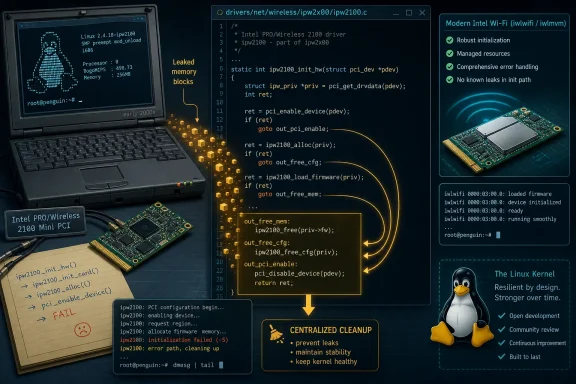 The leak occurs when the driver fails to start
The defect sits in
ipw2100_pci_init_one(), the driver’s PCI probe routine. That function runs when Linux binds the
ipw2100driver to a matching adapter, mapping the device’s memory, allocating the network-device structure, enabling the PCI function, reserving device regions, setting DMA limits, requesting an interrupt, and finally registering a network interface.
NVD’s description says the allocation made by
ipw2100_alloc_device()was not released on some later error paths. The upstream source confirms the sequence: the driver creates the network-device object before calling
pci_enable_device(), then historically used direct
return errstatements after failures of PCI enablement, DMA-mask setup, and PCI-region reservation. Those direct returns bypassed the centralized
fail:cleanup block, which is responsible for releasing the driver allocation and unmapping I/O memory.
The correction is mechanically modest but important for code hygiene. Error paths after the private driver structure has been initialized are redirected to the common cleanup path; the earlier
pci_enable_device()failure is handled separately because the
privpointer has not yet been established. In other words, the patch does not change normal Wi‑Fi operation. It makes failed initialization unwind the resources it already acquired.
That distinction substantially changes how this CVE should be prioritized. A system must first have the legacy Intel hardware, load or bind the
ipw2100module, and then encounter one of the applicable initialization failures. The record describes a resource-retention bug in that failure sequence. It does not describe remote code execution, Wi‑Fi-frame-triggered memory corruption, privilege escalation, information disclosure, or a denial-of-service condition reachable by an ordinary network peer.
Why a CVE without a score should not be inflated
NVD has published CVE-2026-68413 but has not assigned a CVSS v2, v3, or v4 score, weakness classification, or attack vector. That absence is not a declaration that the flaw is harmless; it means the enrichment record is incomplete. It is also a reason not to invent a severity from the word “memory leak.”
The kernel.org description calls the issue a “potential memory leak,” and the observable consequence supported by the patch is that a failed driver-probe attempt can leave allocated kernel memory behind until the system reclaims it through broader lifecycle events, typically a reboot. On a one-time failed probe, the operational effect may be negligible. Repeated device reprobes, module load attempts, hot-plug activity, or a recurring PCI initialization fault could make the leak more consequential on a constrained system.
There is no public exploit analysis, proof of concept, or independent incident reporting attached to the record as of August 11. No other outlet appears to have independently reported attackability or exploitation, and the NVD entry contains only the kernel references. Administrators should therefore treat this as a patch-management item for a specifically affected legacy driver, not as evidence of an active wireless attack campaign.
Calling every kernel memory-management fix a critical security emergency creates the wrong operational response: broad outage-risking updates for machines that neither contain the old card nor build the old module. The right response is more targeted. Identify whether the driver is present and whether the hardware exists, then update the kernel package if it does.
The affected driver is older than many installed Linux systems
The
ipw2100driver remains in the upstream kernel because old equipment still exists, not because it represents Intel’s modern Wi‑Fi platform. Kernel documentation identifies it as support for the Intel PRO/Wireless 2100 Network Connection and describes a driver project whose published material dates to 2003–2006. Its feature list centers on managed and ad-hoc 802.11b operation, older Wireless Tools interfaces, WEP, and experimental-era WPA/WPA2 support.
Linux Wireless still lists the driver as upstream, but its current hardware matrix marks
ipw2100as PCI-based and 802.11b-only. By comparison, the contemporary Intel
iwlwififamily covers newer PCIe devices across 802.11a/b/g/n/ac/ax/be generations. A laptop using
iwlwifi,
iwlegacy,
ipw2200, a USB wireless adapter, or Ethernet is outside this CVE’s named driver scope.
That hardware filter matters more than a raw kernel-version check. A distribution may ship an affected source version while its installed kernel has
CONFIG_IPW2100disabled, or it may include the module on disk but run it on no systems. Conversely, a museum piece, repair bench, industrial image, or retro-computing laptop can still use the module in 2026. The CVE’s importance follows the device, not merely the calendar age of the kernel.
Administrators can establish relevance without triggering the driver:
lspci -nncan identify whether the host has an Intel PRO/Wireless 2100-class PCI device.grep CONFIG_IPW2100 /boot/config-$(uname -r)can show whether the running kernel was built with the driver enabled or as a module.modinfo ipw2100can confirm whether the module is available in the installed kernel package.
A missing module or absent matching PCI hardware means there is no need to make this CVE a separate emergency maintenance event. Normal kernel patch cadence remains the sensible course.
Fixed kernel lines and distribution backports need separate checks
The CVE record identifies Linux 2.6.14 and later as affected in the upstream lineage, then names first fixed releases in several maintained branches: Linux 6.6.148, 6.12.101, 6.18.42, 7.1.6, and the development release 7.2-rc4. It also supplies five stable-tree commit references, indicating that the cleanup correction was backported across multiple stable lines rather than being left only in the development tree.
Those version numbers are useful baselines, but they are not the last word for enterprise deployments. Red Hat, SUSE, Ubuntu, Debian, Oracle, appliance vendors, and custom kernel builders frequently backport individual patches while retaining a vendor-specific version string. A host reporting a lower-looking base version can already contain the fix; a custom kernel can also omit it despite appearing newer if its maintainers diverged from upstream.
The dependable check is the distribution’s own kernel changelog or security tracker, followed by inspection of the shipped source or patch set where necessary. If a vendor has not yet issued an advisory, the upstream fix is small and localized enough that kernel maintainers can backport it with limited functional exposure—but production teams should use the vendor package rather than manually replacing a single driver source file.
CVE-2026-68413 is a real upstream correction, and the kernel’s decision to assign it a CVE makes it trackable across distributions. Its concrete consequence is narrower: update legacy Linux systems that actually run the ipw2100 driver; do not mistake it for a vulnerability in modern Intel Wi‑Fi, Windows networking, or ordinary wireless traffic.